

Tracking The Mideast
Reviving The Dream
U.S. Jewish divisions resurface as peace groups launch initiatives.
MICHAEL J. JORDAN
Jewish Telegraphic Agency
New York
A
Arabs, some of whom erupted into
violence against Israeli forces in the
early days of the latest fighting.
By speaking out, the peace camp
may wipe away the veneer of "unity"
and "solidarity" that has enveloped the
Jewish community since violence broke
out two months ago. It may also re-
expose the deep communal fissures
that emerged along the rocky road in
search of peace.
fter weeks of Middle East
violence that stunned them
into silence, self-doubt and
soul-searching, American
Jews most out front in promoting the
peace process are rediscovering their
voices.
Groups like the Reform
movement's Union of
Hard Second Thoughts
American Hebrew
U.S. peace
Ever since the Oslo peace
Congregations and
groups want to
process
began seven years
Americans for Peace Now
revive initiatives,
ago, American Jews — like
are launching new cam-
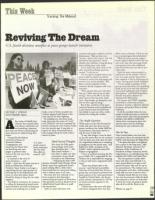
like this Peace
their Israeli brethren —
paigns to promote their
Now effort in
have been at odds over what
vision of the way out of the
Israel in 1997
concessions, if any, should
current crisis.
be made to the Palestinians.
In contrast to the view of
Following the May 1999
many American — and
election of Israeli Prime Minister Ehud
Israeli — Jews that the peace process is
Barak, many Jews applauded Barak's
dead and Palestinian Authority
peace-seeking efforts, while others
President Yasser Arafat is no longer a
denounced him for a perceived willing-
negotiating partner, these groups are
ness to achieve peace at all costs.
focusing less on the Palestinians and
But since this new outbreak of vio-
more on what they believe Israel
lence erupted in late September,
should be doing to bring the two sides
American Jewish backers of Barak have
together.
been generally muted as diaspora Jewry
The Reform movement, for instance,
rallied behind Israeli efforts to quell
is calling for dismantling Jewish settle-
the insurrection.
ments buried in the heart of Arab pop-
Early on, peace advocates were
ulations and reaching out to Israeli
wracked with anger, confusion and dis-
illusionment. They say they were
"forced to look in the mirror" and "ask
themselves hard questions" about
whether they had been wrong all along
about talking peace with Arafat.
At the same time, their rivals on the
other end of the political spectrum
crowed, "I told you so."
"It's not easy to recognize that a pur-
pose or ideal in which you heavily
invested so much time and energy and
emotion may not be possible," Phil
Baum, executive director of the
American Jewish Congress, said in an
interview.
"Who can give that up? I can't give
that up. I don't want to say we were
wrong. I want to be able to say that
these events of the last seven weeks
were a big mistake, an aberration, and
that we were right all along."
But of late, members of the peace
camp has become newly emboldened,
in part because they say hard-liners
have failed to come up with a viable
solution for ending the conflict.
The Arafat Question
While peace activists feel betrayed by
Arafat and agree that there must be
greater insistence that Arafat fulfill his
commitments, they assert that he is
still the man to deal with.
"It may take longer, it may be hard-
er, but the notion that we can continue
with the status quo and reject the idea
of a negotiated settlement is exceeding-
ly dangerous for the Jewish state," said
Rabbi Eric Yoffie, president of the
UAHC, which represents some 900
Reform congregations.
"I have no problem pointing the fin-
ger at Arafat. He is responsible for the
violence, he is responsible for stopping
it. But we still want a negotiated settle-
ment."
"There were always risks to the
process," said Michael Sonnenfeldt,
chairman of the Israel Policy Forum, a
group that was formed to promote the
peace policies of the Labor government
headed by Yitzhak Rabin, the former
prime minister assassinated in 1995 by
an Israeli extremist opposed to the
peace process.
"I think those risks were well-taken
and there's disappointment that they
didn't come to fruition. I have no rea-
son to second-guess the calculations."
While the peace activists support
Israel's right to defend itself in the cur-
rent crisis, they also encourage Israeli
introspection over what additional
steps the Jewish state can take to pro-
mote peace.
From the peace camp perspective,
settlements are the primary "barrier"
now to a peace accord. Several have
been targeted of late by Palestinian ter-
rorists, earning quick Israeli retaliation.
"It's not simply a question of let's
give up more and more, but something
Israel can do in its own best self-inter-
ests toward ending the cycle of death
and violence," said Mark Rosenblum,
founder and policy director for
Americans for Peace Now.
For its part, the UAHC campaign,
conceived as a three-year project,
intends to recreate a "glimmer of hope"
for peace, said project director Esther
Lederman.
It will be unveiled within the next
couple of weeks and strive to atone for
"tactical errors" after Oslo by pro-peace
activists, who failed to sufficiently
inform their constituency about the
need for peace and the challenges
blocking the way, Lederman said.
Not So Fast
Other Jewish leaders were less than
enthusiastic about the initiatives by the
UAHC and Americans for Peace Now.
"I do agree that there is no alterna-
tive to peace in the long term," said
Malcolm Hoenlein, executive vice
chairman of the Conference of
Presidents of Major American Jewish
Organizations, an umbrella group that
includes the UAHC and Peace Now
"But the question is under what
terms and what road will lead to it,
and a precondition is to have a real
partner for peace who will live up to
his commitments. The evidence now
would appear to be that, unfortunately,
Israel does not have a partner there."
Hoenlein hinted that any new initia-
tives may be premature while the death
toll continues to mount on both sides:
"I think the events are going to dictate
what all of us will do. Facts on the
DREAM on page 47
12/1
2000
45