

This eel
Israeli officials
dispute charges of
using "excessive force."
AVI MACHLIS
Jewish Telegraphic Agency
Jerusalem
treams of words have been written
and spoken about the Israeli-
Palestinian violence that erupted in
late September.
But none stand out as much as one
phrase, "excessive force," in describing
how badly Israel's international image
has been tarnished.
Although the conflict evolved from
Palestinian riots into a far more com-
plicated guerrilla-style campaign, the
debate over Israel's use of force against
S
Tracking The Mideast
Palestinian demonstrators and rioters
attacks intensify, and Israel's ever-harsh-
is still on the international agenda.
er retaliations expose the enormous
Since the beginning of the crisis, more
imbalance of military power in Israel's
than 200 Palestinians have been killed,
favor, questions are being raised about
including dozens of children.
the legal limits of Israel's response in a
The issue came up again
warlike conflict that falls
Monday, when the U.N.
short of an all-out war.
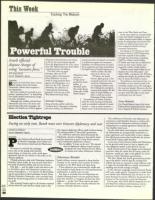
Palestinian youths
human rights commissioner,
B'Tselem, the Israeli
run from a
Mary Robinson, accused
human rights group in the
barrage of tear
Israel of using excessive force
occupied territories, has crit-
gas
fired by Israeli
against the Palestinians. In a
icized the Palestinians for
soldiers in
report to the U.N. General
not keeping children away
Ramallah earlier
Assembly, she called for an
from flashpoints and given
this month during
"international monitoring
unequivocal support for the
clashes
after Friday
presence" to be set up in the
right of Israeli soldiers to
Muslim prayers.
West Bank and Gaza Strip.
shoot to kill any armed
Palestinian firing at them.
Nevertheless, B'Tselem criticizes
Internal Critique
Israel for never having invested seri-
Along with the conflict itself, the
ously in nonlethal methods of crowd
"excessive force" discussion is heading
control — such as water cannons —
into new territory. As Palestinian
despite years of demonstrations and
Election Tightrope
Facing an early vote, Barak must steer between diplomacy and war.
DAVID LANDAU
Jewish Telegraphic Agency
Jerusalem
1p
rime Minister Ehud Barak has launched
an election campaign amid violent con-
flict between Israel and the Palestinians.
He hopes to conclude the campaign
some time in the spring with renewed
peace hopes, or, better yet, with a draft peace
agreement that he can submit to the public as his
election platform.
If Barak achieves a deal with Palestinian Authority
President Yasser Arafat, he may yet pull back from
the brink of political defeat and win the election.
If he fails — and the odds at this time have to be
on his failure, given the Palestinians' present and
recent intransigence — it is hard to see Barak defeat-
ing the presumptive Likud candidate, former Prime
Minister Benjamin Netanyahu, who currently leads
Barak by 20 percentage points in Israeli public opin-
ion polls.
After acceding Tuesday night to the Knesset majority's
obvious desire for early elections, Barak made it clear
12/1
2000
46
that vigorous diplomatic efforts would continue during
the coming months of "lame-duck" government.
In a television interview, Barak bemoaned the
Palestinian rejection of ideas put forward by Israel
and the Americans at July's Camp David summit
and in subsequent diplomatic contacts.
But, he added, "It may not be over." He insisted
that his diplomatic efforts would continue
alongside the Israel Defense Forces' efforts
to contain and reduce Palestinian violence.
Palestinians Watchful
Israeli military sources reported a sharp decline
Tuesday in the number and intensity of violent
incidents in the West Bank and Gaza Strip.
If this reduction was orchestrated by Arafat and
was intended to help Barak out of his parliamentary
predicament, it plainly came too late.
But there is no doubt that the Palestinians are
closely following Israel's intricate political drama.
And they will have to recognize the fact that their
behavior — on the "war" front and in the peace
talks — could directly and critically influence the
outcome of Israel's domestic contest.
riots in the West Bank and Gaza.
It also says, based on extensive field
work, that Israel's widespread use of
rubber-coated metal bullets is inappro-
priate for dispersing riots because the
bullets are lethal ammunition and
have caused the deaths of many
unarmed Palestinians.
According to the Palestinian Red
Crescent Society, 9,093 Palestinians
had been injured in the conflict
through late November, including
3,649 by rubber-coated bullets.
B'Tselem says there are no official sta-
tistics on how many deaths were
caused by rubber-coated bullets.
"Rubber-coated metal bullets do not
disperse riots; they kill people," said
Tomer Feffer, a spokesman for B'Tselem,
adding that despite the problems Israel
faces, it cannot fire freely at rioters.
"According to international law, it is
forbidden to mix armed people with
unarmed civilians since this endangers
the unarmed people. However, the fact
that there are gunmen in a crowd does
not give Israel the right to fire indis-
criminately into the crowd."
Army Rebuttal
Col. Daniel Reisner, head of the Israel
Defense Force's international law depart-
ment, disputes B'Tselem's criticism.
This confluence of domestic and diplomatic cir-
cumstances could therefore become a catalyst, driv-
ing Israel and the Palestinian Authority toward a
comprehensive or partial agreement before the elec-
tion deadline draws near.
On the other hand, some skeptics contend that
the Palestinians are not genuinely interested in a
peace agreement and would prefer to face a harder-
line Likud government that would take the interna-
tional blame if peace talks founder.
In any case, events between Israelis and Palestinians
on the ground could prove to have a negative and
even dangerous impact in the election run-up.
Barak seemed aware of this danger in his televised
interview, when he vowed that the army, under his
direction, would not "play to the gallery" by overre-
acting to violent Palestinian provocations.
Too often, Barak said, Israeli governments pander-
ing to the public's natural urge for revenge have
ordered the army to overreact to Arab violence, only
to regret the harmful effects to Israel's international
standing and overall strategic strength.
As the election campaign moves forward, Barak
will come under greater temptation to strike back
ever harder after Palestinian acts of terror or vio-
lence because he cannot afford to be perceived by
sections of the electorate as soft and hesitant.
For its part, the Likud will be tempted to criti-
cize Barak for softness and hesitancy, and to
demand ever harsher military measures.
❑