

4 . 11. 11. 11. 1111. 01.401. 11111 41.1.1111.1.11....16 '
jol.
Greek and American Cuisine
OPEN 7 DAYS A WEEK
6527 Telegraph Rd.
Corner of Maple (15 Mile)
Bloomfield Township
(248) 646-8568
4763 Haggerty Rd. at Pontiac Trail
West Wind Village Shopping Center
West Bloomfield
(248) 669-2295
841 East Big Beaver, Troy
(248) 680-0094
SOUTHFIELD SOUVLAKI
CONEY ISLAND
Nine Mile & Greenfield
15647 West Nine Mile, Southfield
(248) 569-5229
FARMINGTON SOUVLAKI
CONEY ISLAND
Between 13 & 14 on
Orchard Lake Road
30985 Orchard Lake Rd.
Farmington Hills
(248) 626-9732
UPTOWN PARTHENON
4301 Orchard Lake Rd.
West Bloomfield
(248) 538-6000
HERCULES FAMILY RESTAURANT
33292 West 12 Mile
Farmington Hills
(248) 489-9777
Serving whitefish, lamb shank,
pastitsio and moussaka
3/24
2000
86
'
AV"
Collages On Canvas
Artist Larry Bell exhibits more than 450 of his "very small
works" at Detroit's Center Galleries.
154 S. Woodward, Birmingham
(248) 540-8780
Halsted Village
(37580 W. 12 Mile Rd.)
Farmington Hills
(248) 553-2360
01I
Entottain
4omehe
oiliffir
CONEY ISLAND
41
SUZANNE CHESSLER
Special to the Jewish News
It
ecycling enters Larry Bell's
art world through his series
"Fractions," small collages
of fragments from earlier
paintings assembled in his mounting
press. Started in 1996, the pieces are
part of a quest aimed at producing
10,000 separate images.
Bell will show more than 450 of
them April 1-29 at Center Galleries in
Detroit and discuss his artistry at a
public lecture two days before his
exhibit opens.
"I consider exhibitions an extension
of the studio," says Bell, whose last
visit to the city was in the 1980s,
when his work was shown at the
Detroit Institute of Arts. "We will see
what we learn from the experience of
taking this work out of my environ-
ment and putting it into another envi-
ronment. Hopefully, I'll get feedback
from the audience."
Bell's traveling images represent var-
ious periods in this artistic venture.
They will be arranged in rows so that
viewers get close to each piece and
read the surface quality, and the way
the light interfaces with it.
"The pieces have the ability to
seduce the eye into the space and then
carry that seduction from
one unit to the next if
one allows daydreaming
into the visible [area],"
explains Bell, who is
approaching his 8,000th
image.
"Since we're putting up
so many in this line, the
show will have a bit of a
panoramic quality to it,
an environment of very
small works. If we do the
presentation right, we'll
do all kinds of things to
the viewer's peripheral
vision because of the repetition."
The foundation for this exhibit
comes from a series of collages on can-
vas that Bell worked on in the 1980s.
It was a spontaneous assembly of vari-
ous bits of materials, papers, mylars,
laminate films, thin metals and paint
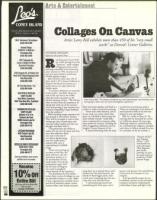
Artist Larry Bell: 'The always considered my work experimental, and certainly what
we're going to show now are recent investigative experiences."
films laminated together and fused to a
surface to make an imitation painting.
"Some were really fantastic, and as
in any work run, some weren't that
great, so I decided to throw away the
ones nobody wanted," recalls Bell,
who is represented in museum collec-
tions across the country, including the
DIA, Guggenheim Museum and Los
Angeles County Museum of Art.
"I started destroying them by chop-
turned into an enormous project.
These are mindscapes of my frame of
mind and have little to do with any-
thing I've ever seen before."
Bell, 61, works in Taos, N. M.,
moving after he launched his career
in California almost 30 years ago.
Although raised in a Jewish family,
he overlooked the religious examples
and chose to follow instead the artis-
tic examples set by his mother, a
"Fraction #5762"
and "Fraction
#6142," 1999,
mixed media on
watercolor paper:
These fragments
from earlier
paintings are part
of a quest aimed at
producing 10,000
separate images.
ping them up to discard them, and I
realized that the little fractions, the
shards of these bigger pieces, were
much more interesting than the can-
vases they were liberated from.
"I started playing around and
recombining the little parts, and it
pianist and painter. He attended the
Chouinard Art Institute in Los
Angeles.
As he launched his career, he was
considered a pioneer in the minimalist
sculpture movement. Exploring the
relationship of space and light to the