
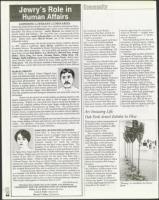

Jewry's Role in
Human Affairs
LIONIZING LITERARY LUMINARIES
France has produced fine Jewish writers who vaulted to international fame,
among whom is part-Jewish Romain Gary, author of the widely translated
best-seller The Roots of Heaven. Andre Maurois was lauded for his
novels, essays and criticism. The Last of the Just, a towering tale of the
Holocaust's havoc by Andre Schwarz-Bart, won the prestigious Goncourt
prize. Before them came Marcel Proust, one of the century's most
influential writers.
A continent away, the Jewish American literary tradition dawned
in 1805 when a southerner, Isaac Harby, published his neo-classic
Alexander Severus. He predated a literary flowering unmatched in extent
by any other ethnic population. Our most gifted and popular novelists of
these times include Saul Bellow, E.L. Doctorow, Howard Fast, Joseph
Heller, Erica Jong, Ira Levin, Norman Mailer, Philip Roth, J.D.
Salinger, Budd Schulberg, Leon Uris and Herman Wouk. Before them
came Dorothy Parker, once labeled the most widely quoted writer since
Shakespeare. The only similarity intended in featuring Proust and Parker--
both half-Jews--is how their lives and works were mindful of their different
cultures.
MARCEL PROUST
(1871-1922) b. Auteuil, France Plagued since
youth with delicate health, he turned away from a
commercial career to dedicate his future to writing
and social advancement. By the mid- to late-
1890s, the charming and witty conversationalist
became a popular guest in elite Parisian salons
and composed a body of short stories, poetry and
sketches. His fictional images were often drawn
from the snobbish and self-indulgent dilettantes and aristocrats whom he
befriended.
Proust was devoted to his Jewish mother, an adoring caregiver who
deeply influenced his life; after her death in 1905 he began to withdraw
from society. Walled in a cork-lined room shut to sound and daylight--to
appease his crippling asthma--Proust soon began producing his seven-
volume masterpiece: Remembrance of Things Past. The cyclical work,
published in sections from 1913 to 1927, projected himself in its pages as
Charles Swann, a sophisticated and erudite Jew in conflict with his identity.
Proust's homosexuality also ruled many of his personal relationships and
subtly colored some of his writings.
His elegant and profound grand opus has had formative effects on
later writers dealing with time and memory, and with internal and external
reality. The adjective, "Proustian," entered in dictionaries, reflects the
impact his work has made on world literature.
DOROTHY (ROTHSCHILD) PARKER
(1893-1967) b. West End, 'NJ On hearing of
President Calvin Coolidge's death she snapped,
"How can they tell?" "Men seldom make passes
at girls who wear glasses," was another of her
immortal remarks for which the sardonic,
mischievous and droll writer gained fame. The
daughter of an affluent New York City family
launched her career as a book and drama reviewer
and
for The New Yorker which also ran much of her
Vanity
Fair,
Vogue
for
short fiction. Parker came into her own with the poignant "Big Blonde," a
winner of the 1929 0. Henry award for the year's best short story--
considered her finest. Three of her early books of verse, reissued in
Collected Poems: Not So Deep as a Well (1936), were acclaimed for their
satirical wit with ironic overtones. While churning out short stories which
appeared in Laments for the Living (1930) and Death and Taxes (1931), she
also scripted Hollywood films and co-authored two hit Broadway plays.
A legend among urbane readers, Parker furthered her reputation as
a co-founder with Robert Benchley of the celebrated Algonquin (Hotel)
Round Table to which many writers of the period were drawn. Her biting
and trenchant humor outlives her, as when tweaking Katherine Hepburn:
"She ran the whole gamut of emotions from A to B."
- Saul Stadtmauer
11/26
1999
44
Visit many more notable Jews at our website: www.dorledor.org
COMMISSION FOR THE DISSEMINATION OF JEWISH HISTORY.
Walter & Lea Field, Founders/Sponsors
Irwin S. Field, Chairperson
Harriet F. Siden, Chairperson
the workload. Jewel Kosher
Catering in Oak Park catered the
meals at which the local students
served as waitresses.
Out-of-towners stayed with fami-
lies in the Oak Park/Southfield
Orthodox community. Many fami-
lies housed six or more girls. The
response was so overwhelming, 130
more beds were offered than need-
ed. Community members shuttled
the girls between activities, homes
and airports.
Entertainment included skits and
dances. Choir songs were created
and a convention newspaper was
published. Activities included roller
skating on Friday afternoon and a
Saturday-night pizza party with
dancing to Rabbi Yerachmiel
(Rocky) Stewart's Segulah Orchestra.
The Oak Park school building
was elaborately decorated. Flags
were erected in the parking lot dis-
playing the visiting schools' colors.
Paper dolls lined a ball, dressed in
real swatches of the participating
schools' uniforms. Classrooms used
for workshops were transformed
into each of the seven days of cre-
ation; other rooms had their own
decorative themes. Assembly hall
walls were covered with murals and
banners depicting the convention
theme of Temimos — roughly trans-
lated as "completeness," or "perfec-
tion of character."
Notwithstanding all the fun and
excitement of presentations, singing,
dancing and gabbing till the wee
hours of the morning, serious Torah
learning was the real focus of the
convention.
Distinguished speakers addressed
the theme of Temimos, exhorting
the girls to develop and refine their
characters, and to perfect their rela-
tionships both with the Almighty
and other Jews. Speakers included
the Novominsker Rebbe, Rabbi
Yaakov Perlow, head of Agudas
Yisroel, Brooklyn; Rabbi Jacob Elias,
head of Breuer's Seminary in New
York; Rabbi Zev Leff, ray of Moshav
Matisyahu in Israel; Rebbitzen
Zhava Braunstein, head of Ateret
Torah in Brooklyn; Rebbitzen Zlata
Press, head of Bnos Leah of Prospect
Park, N.Y.; and Dr. Bentzion
Sorotskin, a New York psychologist.
For local principal Goldie
Silverstein, the high point of the
convention was, after all the pre-
planning and preparation, "seeing
the room filled to capacity with girls
enjoying what was done."
❑
Art Imitating Life:
Oak Park Artist's Exhibit In Flint
Depicting an artistic interpretation of
the Israeli conflict, Deanna Sperka
has opened a new installation called
"Encave and Precinct" at the
Buckham Gallery in Flint.
The two-person, whole-gallery
exhibit with Shawn Skabelund of
Flagstaff, Ariz., is constructed of cyan-
otype (blueprint)/canvas, photo/film,
steel, fiber glass, wood and stone.
An Oak Park resident, Sperka
describes the works as "basically
about barriers, physical and psycho-
logical." Inspired by the political con-
troversies in Israel, she says the six
canvas panels include statements
taken from the Israeli press, as well as
photos she acquired while living in
Jerusalem.
Displayed through Friday, Dec. 3,
the installation includes letters of the
alphabet, scattered on the floor,
spelling out statements and messages
in Hebrew and English. Edible
home-baked cookies are offered to
viewers, says Sperka, "to be absorbed
as words, digesting points of view,
being fed to the masses." TI
"Shouting," an installation by Deanna
Sperka