
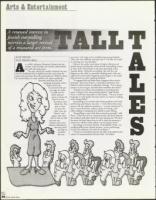

A renewed interest in
Jewish storytelling
mirrors a larger reviva
of a treasured art form:
A
JULIE WIENER
Jewish Telegraphic Agency
s
a child, whenever Peninnah Schram lost her
temper at her brother, her mother admonished
her with the same story.
The tale, which her mother claimed was true,
was of a husband who is drafted into the czar's army for
years and must leave his wife and small son. When he final-
ly returns home, in army uniform, he stops outside the
doorway and hears his wife
speaking intimately with a
4,
deep-voiced man.
A
Consumed with jeal-
ous rage, he walks
in, pulls out his
pistol and pre-
pares to shoot the
man he is con-
vinced has cuck-
olded him. But
just in time,
he hears the
other man say
"Mama" and
gasps with relief
that he did not kill
his own son.
Schram went years
without thinking of
the story until
1 10
one day, as
4'
an adult,
she was
isK/Aft.3%,V
W
10/15
1999
84 Detroit Jewish News
overcome with anger at her misbehaving young daughter.
Then, the tale suddenly returned and it "was like my moth-
,
er standing over my shoulder.)
Schram, the author and editor of eight collections of
Jewish stories and founder of the Jewish Storytelling Center
at New York's 92nd Street Y, has been described as the
grande dame" of Jewish storytelling. She and her col-
leagues say the craft is a powerful teaching tool, with mes-
sages from stories often lingering much longer in the mind
than lectures or other teaching methods.
"It engages kids and helps them integrate what they're •
learning," said Lynn Hazan, a storyteller, performer and
Hebrew-school teacher in suburban Chicago. "It's as partic-
ipatory as you can get. And the kids remember the stories."
"Schools now think of storytelling as something they
want to bring in for educational purposes," said Gerald
Fierst, a full-time storyteller in New Jersey. "The use of oral
language in early grades has been shown to improve reading
and writing ability."
Storytelling is an art form that shares qualities with both
performing and literary arts, but — with tellers often stop-
ping to ask the audience questions — is more interactive. It
also is more fluid than a play or piece of writing, with
tellers adding or dropping new details at each telling.
• "Storytelling is very much akin to stand-up comedy," said
Fierst. "There has to be a connection back and forth between
the audience and teller, there has to be spontaneity. We know
the story but don't know how to tell it until the moment it
comes out, which is what makes it an exciting art form."
According to Corinne Stavish, of Southfield, Mich., sto-
rytelling differs from theater because "you're performing
not for the audience, but with the audience."
"There's an immediacy between the teller and audience and
a form of communication between both," she added.
CC