

What is considered to be a "Jewish" story varies.
For example, at this year's Coalition for the
Advancement of Jewish Education (CAJE) confer-
ence, storytellers shared traditional Jewish tales,
Jewish adaptations of other folktales, personal
memoirs and original works of fiction.
Schram, for the most part, sticks to the tradi-
tional fare, stories told by her parents, found in
Midrash or Talmud or uncovered through research
at the Israel Folktale Archives in Haifa.
But Hazan has delivered a story about participat-
ing in a breast cancer walk-a-thon as well as one
about being reunited with her childhood Hebrew-
school teacher. And Fierst recently wrote and per-
formed a story about a Jewish boy in the Civil War
South who, during Passover, helps two slaves escape.
Tellers generally agree that to be considered
Jewish, a story should have a moral or message con-
sistent with Jewish teachings. In addition, Jewish
stories generally revolve either around Jewish char-
acters, Jewish places or the Jewish calendar.
But, tellers note, because Jews lived amidst
other cultures, many traditional tales considered
authentically Jewish" — ones found even in the
Talmud — often were variations on tales from
other cultures.
Long a fixture of Jewish culture, storytelling
became less common in America as immigrant
families assimilated.
Schram, a professor of speech and drama,
recalls in 1970 asking her students at Stern
College, the women's school of Yeshiva University,
if they knew the traditional tales about Chelm.
"When they said they didn't, I thought,
`Something's wrong if yeshiva kids don't know
these stories,'" she said, noting that this spurred her
to help establish a storytelling festival. The festival
grew into the Jewish Storytelling Center, which
hosts monthly workshops and performances.
Today, in large part because of Schram's work,
Jewish storytelling is experiencing something of a
revival, with a proliferation of anthologies, festivals
and networking among the tellers. Many syna-
gogues and Jewish schools regularly bring in story-
tellers for programs with children as well as adults.
With approximately 150 members, storytellers
comprise one of the largest and most visible net-
works of educators in CAJE, with the bards swap-
ping tales and performing every night of CAJE's
annual conferences.
The Jewish storytelling revival mirrors a larger
revival in storytelling, with bards and fans from
around the world now meeting annually for sever-
al days in October at the National Storytelling
Festival in Jonesborough, Tenn.
Many storytellers attribute the recent popularity
to a culture fatigued with the electronic mass
media of computers, movies and television.
"There is no substitute for the human voice,"
said Schram. "People feel the need to go back to
the human — it's comforting, healing and teach-
ing. Yes, you can read stories, but there's some-
thing more in the human contact."
"I like that this is void of technology except for
the microphone," said Stavish, who co-chairs
CAJE's storytelling network. It keeps me
grounded in the essentials of humanity." I I
((
INA
e sat
congregation,
t to pray or change
Nos moil'
but to tell stories.
er
"% Then I heard a Jewish storyteller during a
service, I becarne very interested," she recalls.
That she heard the call of this ancient tradi-
tion in a religious context is important, she says,
while noting that several other elements con-
tributed to her interest.
"I've always had a
propensity for drama,"
says Stavish, who earned a
masters degree in the
field. Coupled with that,
she says, was very active
in the synagogue. So
everything was sort of a
kaleidoscope" that came
together in this vibrant
Jewish tradition.
Since then, she's made her way to
Southfield, practicing and performing oral
artistry all the while. Her pursuit has taken
Stavish from schools and libraries to syna-
gogues and churches, to theaters and galleries,
and now to the National Storytelling Festival.
The festival, an annual gathering of 20
tellers and thousands of fans, took place at the
beginning of October in Jonesborough, Tenn.
One of two Jewish
tellers featured
in it
Th
arge tent to
going fro
another, sitting on stiff
wooden seats for hours at a
time to be captivated by
tellers of national renown.
For these devoted patrons
she planned to serve a gen-
erous slice of Jewish stories.
"I will be doing about 90
percent Jewish material," she said shortly
before the festival.
And, foreseeing her major solo perfor-
mance of the weekend, in which Stavish
would have a stage to herself for an
extended telling, she brimmed with
confident exuberance. She calls this per-
formance "all-Jewish inidrashim" for a predo
nantly non-Jewish audience.
"And they will love it."
Returning from a venue of such size and
prestige to her everyday routine in
Southfield might seem like a letdown. B ut
Stavish, who works as director of the
Technical Communication Program at
Lawrence Technical University, expresses
no anticipation of disappointment after
her time in the national spotlight.
Her voice loses none of its excitement as
Stavish talks of upcoming performances at
the Detroit Institute of Arts, where she's
scheduled to spin tales Oct. 30 and four
Saturdays in January
Though she's a solo act, she cites col
laborators, of sorts: She speaks most
highly of the DIA's Italian art galleries,
where she's to perform.
Stavish credits the American storytelling co
with incorporating tellers of various religious an
nic backgrounds. "Most festivals," she says,
very hard. Diversity is very much a part of the story-
telling community.'
As a result, "People are becoming very, very faniiliar
very, very aware of Jewish storytelling. I think \Nre're
very well represented" LI
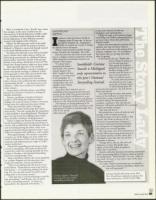
Southfield's Corinne
Stavish is Michigan's
only representative to
this year's National
festival.
telling Festzva
Corinne Stavish: "Diversity
is very much a part of the
storytelling community."
nti s
Corinne Stavish tells stories at the DIA
Oct. 30 and four weekends in January. For
more information, call (313) 833-7900.
10/15
1999
Detroit Jewish News
85