
Rosh HaShana
Talking To Your Kids
About Sin And
Repentance
ANN MOLINE
Jewish Family & Life
D
C
434'4. 7511i
•
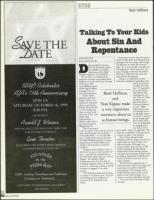
JOIN US
SATURDAY, OCTOBER 16, 1999
8:30 P.M
.
HONORING
4/144,641 PiofrieA,
SENIOR EXECUTIVE REGIONAL DIRECTOR
FOR 30 YEARS OF SERVICE
Qom 74ea-ble
FEATURING THE PURPLE ROSE THEATRE
COMPANY PRODUCTION OF
A /Alga
• t'll:. T'''
,f., ..r---1
, - 4-, z 16
- - 4 i 4 -b -..,
-1,- -
Jj' CP -.
.:)..i•
,
Cif
`4..'1. (i.
:,..1-_,, 1 1
,
FOR MORE INFORMATION, CALL BBYO
248.788.0700
9/10
1999
1,52 Detroit Jewish News
ipping apples in honey,
blowing the shofar, gather-
ing together as a family —
these parts of the High
Holidays appeal to most children.
But to teach our children only
about the customs surrounding Rosh
HaShana is to give them just one part
of the story. The
more difficult aspect
of the High Holiday
message is the sin
and repentance part.
"To me, Rosh
HaShana and Yom
Kippur make a very
important statement
about us as human
beings. They say that
we can change into
who we want to be,
who we can be," says
Rabbi Amy
Scheinerman, a
Reform rabbi with a
part-time pulpit in
Blacksburg, Va.
"This is very hard
work. So hard, in fact, that we have to
stop everything else we are doing —
work and school — to set aside the
time." Rabbi Scheinerman says that
the High Holidays provide a unique
opportunity for both children and
adults to look inward, to examine
ourselves.
"The gem of the holiday is that it
allows you to put a mirror in front of
you — you look at yourself face to
face and think about how you want to
change," she explains. Rabbi
Scheinerman says that the value in
attending religious services is that they
provide a community setting in which
everyone is engaged in the same
process.
"The looking inward and deciding
to change is very hard work. It can be
comforting and more effective if
everyone else is doing the same
thing."
Repentance comes when the person
admits he has done something wrong,
apologizes for the wrong, and changes
the behavior to make the situation
right. So, it isn't enough to simply ask
for forgiveness. There must be a con-
scious change in the way the person
behaves in order that the same mis-
take will not be repeated.
Teshuva, or repentance, occurs
when the transgressor apologizes and
makes an attempt
to repair the situa-
tion. "It is ground-
ed in the notion
that human rela-
tionships are cru-
cial. How we relate
to others says a
great deal about
the type of person
we are," Rabbi
Scheinerman says.
An apology is not
an apology unless
we mean it, and try
to set things right.
How many times
have we demanded
an apology from
our kids, only to
get a sullen "Sorry" in response? "We
must do it and feel it if the process is
to have an effect," she explains.
The 10 days between Rosh
HaShana and Yom Kippur provide an
opportunity to work on these con-
cepts as a family. Although very
young children may not have a full
understanding of the theological
implications of the holiday, parents
can begin by discussing concepts such
as sharing, being kind to family and
friends, and the notion that we all
make mistakes.
We all have the opportunity to
choose between right and wrong, and
sometimes even adults make the
wrong choice. The message of the
High Holidays allows each of us to
admit to our shortcomings. In so
doing, we emerge refreshed, renewed
— returned toward the path of right-
eousness.
Rosh HaShana
and
Yom Kippur make
a very important
statement about us
as human beings.
Scanned image of the page. Keyboard directions: use + to zoom in, - to zoom out, arrow keys to pan inside the viewer.
September 10, 1999 - Image 130
- Resource type:
- Text
- Publication:
- The Detroit Jewish News, 1999-09-10
Disclaimer: Computer generated plain text may have errors. Read more about this.