
zr:IEWISH
JEWISH
,„
of M etropolitan Detroit
LI-
Tips For Teaching
About Sin,
Repentance
• Know what you believe before
embarking on a discussion with your
kids.
• Only tell your kids what you
believe. If you believe that God is a
process, rather than an all-powerful
being, for example, don't tell the kids
that God watches their every action.
You might want to discuss different
ways of interpreting God, in order to
present alternatives, but be sure to say,
"This is what I believe."
• Don't give children any more
information than they can handle, but
at the same time, do not underesti-
mate their capacity to grasp intangible
concepts. "No human being is too
young for introspection," says Rabbi
Sheinerman. "Even preschoolers can
understand the idea of right and
wrong. We begin to teach them the
concepts inherent in the High
Holiday message when we talk to
them about how we treat others."
• Take part in a Tashlich service.
Tashlich means casting, as in casting
off sins. On the afternoon of the first
day of Rosh HaShana, Jews tradition-
ally gather by the nearest moving body
of water. Families bring leftover bread,
torn into crumbs, to toss into the
water at the appropriate moment.
The act of throwing the bread into
the water symbolically allows us to
cast away our sins, and they are borne
away by the flowing water so that we
can begin anew.
• An easy family Tashlich activity:
purchase some dissolving paper at a
craft or magic store. As a family, write
down things that each member —
including the adults — wants to
change or try to do better in the com-
ing year.
Bring the papers with you to
Tashlich, and when the time comes to
throw bread into the water, throw
your papers into the water, and watch
the "sins" dissolve. Even if there is no
Tashlich service in your community,
you can go together as a family to a
nearby stream or brook and make up
your own service.
• Observe the 10 Days of
Repentance. The 10 days between
Rosh HaShana and Yom Kippur are
the time during which we think about
our relationships with each other, and
with God. We make the effort to ask
forgiveness from those we have
wronged, and we resolve to try to do
better in the coming year.
Try to rake some time on each of
the days to do something Rosh
HaShana- or Yom Kippur-related. A
little piece of trivia: the American tra-
dition of making New Year's resolu-
tions for Jan. 1 came from the Jewish
tradition.
• A family activity for the 10 Days
of Repentance: Send "teshuva-grams"
to each other. These are notes which
ask individual members of the family
for forgiveness about specific acts. An
example: Dear Sarah, I'm sorry I lis-
tened in on a telephone conversation
you were having with your friend. I
respect your need for privacy, and I
won't listen again when you are on the
phone. Love, Mom.
• Read some great Jewish books
together. Rabbi Scheinerman runs a
terrific Web site with a wonderful,
annotated Jewish book list. Two of her
favorites for the season are "Yossl's
Prayer" and "Even Higher." Check out
the Web site: ezra.mts.jhu.edu/-rab-
biars
• Talk to your kids. You can begin
the topic of sin and repentance by
telling them something you did that
you feel badly about (like the teshuva-
gram). Admitting that you aren't per-
fect opens the door to allowing the
child to own up to things about which
he feels badly.
These kinds of conversations will
also set the precedent during the year
for honest and open communication
among members of the family.
• Stay home from work, let the kids
stay home from school, and go to ser-
vices as a family. At the end of Yom
Kippur, invite one or two other fami-
lies to join you for a break-the-fast
meal — you will create long-lasting
memories for your children, and for
yourselves.
E.
TOteshes fie
C 0122122
uni{y
=tot rlivemp
firczy you and ours ge inscri&of
ano f seakof or a g000lyear.
Jeffrey Garden
Rabbi Lee Buckman
President
Dr. Helene Cohen
Head of School
Director of
Academic Affairs
"If you believe you can do damage, then believe you can repair!"
Rabbi Nachman of Breslov
Likutey Moharan II, 112
The Academy is an independent coeducational Jewish high school that
offers a rigorous college preparatory curriculum integrated with an intensive Jewish studies
program. The school welcomes families of all educational
and religious backgroun ds
The Jewish Academy of Metropolitan Detroit
6600 W Maple Rd.
West Bloomfield, MI 48322
248-592-JANID (5263)
Opening Fall of 2000 for the 9th and 10th grades.
//may
the
Alew Yeae
being to all our
reiends
and
Patients - Health,
Happiness, Peospektify
and evekything
good in lifer
Dr. G Mrs. Barry Feldman
Dr. E Mrs. N. Elyas
Dr. Mrs. Bruce M. Kaplan
Families and Staff
Detroit Jewish News
9/10
1999
:'
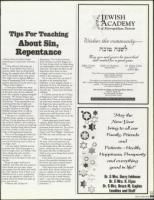
Scanned image of the page. Keyboard directions: use + to zoom in, - to zoom out, arrow keys to pan inside the viewer.
September 10, 1999 - Image 131
- Resource type:
- Text
- Publication:
- The Detroit Jewish News, 1999-09-10
Disclaimer: Computer generated plain text may have errors. Read more about this.