
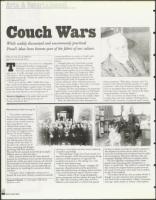

Couch
While widely discounted and uncommonly practiced,
Freud's ideas have become part of the fabric of our culture.
FRANCINE KLAGSBRUN
Special to the Jewish News
T
he first book I ever wrote was a biography
of Sigmund Freud for young people.
Although it was well received by the New
York Times and other publications, the
only review I vividly remember came from a critic
who hared it. After tearing the book to pieces, he
concluded sarcastically, "Clearly the author is in love
with Sigmund Freud."
This was in the late 1960s. I didn't know then
that a small anti-Freudian movement among schol-
ars and critics had begun to gather steam. It would
burst into full flame about 10 years later. Nor was I
aware that early feminists were tracing many of
Francine Klagsbrun is the author most recently.
of 'Jewish Days: A Book of Jewish Life and
C ulture Around the Year'
PSYCHOANALYZE THIS
Suzanne Chessler is a Farmington Hills-based
fi-eelance writer.
88 Detroit Jewish News
Famous question, "What _does a woman want?" he
meant it. He referred to female sexuality as "a dark
continent," and wrote of women's anatomy as if it
were an incomplete Form of men's. HOW apt was
Germain Greer's comment that "Freud is the father
,
of psychoanalysis. It had no mother.•
Were I to rewrite my Freud book I would
include these and other failings. (Psychoanalysis
itself, Freud's invention, has proved useful mostly
from page 83
"The exhibit communicates
the central theme of psycho-
analysis while making available a
variety of ways to have access to
that central theme," says
Michael Roth, curator of the
exhibit originally planned for
the Library of Congress and on
loan to The Jewish Museum.
"There's a core intellectual
message about psychoanalysis
and making sense of the past
through certain key ideas. At
the same time, there's a lot of
funny, interesting and thought-
provoking stuff from television,
film and Freud's personal record that gives people
different slants on those key ideas."
Roth, associate director of the Gerry Research
Institute for the History of Art and the Humanities,
divided the exhibit into three sections as he showed
the development of Freud's theories. Each segment
shows Freud's advancement toward explaining cur-
rent behavior by searching for unconscious desires
and fears-.
"Formative Years" emphasizes crucial turns in
Freud's life as he built a family, pursued his scientific
8/6
1999
womens problems in society to Freud's male-
oriented interpretation of their needs and
desires.
I thought about my Freud book recently
after seeing The Jewish Museum exhibition
"Sigmund Freud: Conflict and Culture." The
exhibit caused conflicts of its own before first
opening at the Library of Congress in 1998.
Anti-Freudians, now visible and vocal, had
complained that as planned, it ignored criti-
cisms of Freud's work. In response the show's
curator, Michael S. Roth, included quotations
from critics in the displays. The result is an intrigu-
ing and thought-provoking exhibition.
Looking at the show and reading its accompanying
book.of essays, I can certainly see how my little biogra-
phy would enrage a Freud critic. Not having had my
feminist consciousness raised yer, for example, I didn't
realize how little Freud understood about women.
When he asked Princess Marie Bonaparte his
training as a neurologist and then started exploring
interpretive psychology.
"The Individual" probes how Freud created con-
ditions he thought would help patients grasp the sig-
nificance of their symptoms, an approach that
would become known as "the talking cure," and
recalls his most famous cases.
"From the Individual to Society" catalogues the
expansion of psychoanalysis and his speculations
about the social functions of religion and art and how
crises reveal fundamental aspects of human nature.
Museum visitors will see vintage photographs,
prints, manuscripts and first editions that span Freud's
life, 1856-1939, including 1905's Jokes and Their
Relation to the Unconscious, in which Freud opened
the door to deeper meanings of everyday experiences.
Also displayed are home movies, objects from his
study and consulting room and pieces from his collec-
tion of antiquities. Clips from television, film and
newspapers highlight influences on popular culture.
The now-legendary consulting couch, where
patients went through guided introspection, is
shown in model form. The exhibit's re-created office
also contains the original Persian rug that covered
the couch, Freud's green velvet chair and an authen-
tic pair of his eyeglasses
"The exhibit started out with an outline of what I
thought was most important about psychoanalysis
and much of this is contained in a book I wrote some
years ago, Psycho-Analysis As History," Roth explains.