

"For me, in some ways therapy is a sort of praying.")
to patients who do not suffer from severe mental
Freudian terms such as "repression," "projection,"
illness.) I might even add criticisms of my own.
"ego" and "superego" fill our everyday speech. And
For instance, scholars have made much in recent
Freudian ideas about the hidden meaning of dreams
years of Freud's connections to his Jewishness, and
and the power of the unconscious mind have become
particularly his knowledge of the Bible. Yet Freud
basic to our thinking. (Cartoons and film clips in the
built his major theory of human development, the
exhibition — some serious, some hilarious — show
Oedipus complex, around Greek mythology. Based
Freud's profound influence on popular culture.)
on the story of Oedipus, who unwittingly killed his
Perhaps most important for us now were Freud's
father and married his mother, he held that children
attempts to understand the forces that shape soci-
become attached to their opposite-sex parents and
eties and cultures. Disturbed as we've been by
feel both rage and terror in relation to their parents
images of massacres in Kosovo, mur-
of the same sex.
ders
in Littleton, Colo., and last
Maturity involves coming to terms
Opposite page, left:
week's
carnage in Atlanta, we can
Nv i h these feelings. But what of sibling
Freud during the last
appreciate
his speculations on how
feelings, so prominent in the Bible?
year of his life, at
primitive
desires
and unresolved con-
What about fratricide — Cain's murder
Maresfield Gardens,
flicts
drive
individuals
and groups.
of Abel — at its very beginnings? Freud
London,1939.
He spoke of societies in the throes of
skimmed over these issues, minimizing a
violence as reverting to "primal hordes,"
crucial aspect of human conflict that the
uncontrolled
by
the restraints of civilization. "The
Bible had recognized long before his time.
fateful
question
for
the human species," he wrote,
With all that, I still stand by the conclusions of
seems
to
me
to
be
whether
and to what extent their
view
\lye
MN'
, book: Sigmund Freud changed the way
cultural
development
will
succeed
in mastering the
the world. Though his theories of gender and sexual-
disturbance
in
their
communal
life
caused by the
iry have flaws, he made it possible for people to
human instincts of aggression and self-destruction. It
speak about problems of love and sex with an open-
may be that in this respect precisely the present time
ness never before permitted.
deserves our special interest."
Though he may have exaggerated the success of
These words, from Civilization and Its
some of his treatments, his pioneering studies of the
appeared in 1930, as Hitler was rising
Discontents,
mind and emotions have made psychotherapy a viral
to
power.
You
don't have to be in love with
tool for gaining mental health. (Admittedly not
Sigmund
Freud
to recognize how applicable they
always well used. Here is Monica Lewinsky respond-
remain today. 7
ing to a reporter's question about whether she prays:
Opposite page, left: Freud (front row, fourth
from right) at Clark University, Worcester, Mass.,
September 1909, where he presented a series of lectures
that introduced psychoanalysis to America..
Opposite page, right: Sigmund Freud in his study
at Berggasse 19 with one of his beloved chows, shortly
before emigrating to London, 1937.
On the covey; page 83: Sigmund Freud: His influence on
popular culture is made clear in The Jewish Museum exhib-
it "Conflict and Culture." Fred Flintstone hypnotizes
Wilma until she barks like a dog, Jimmy Stewart awakens
suddenly from a dream of:Piing in "Vertigo," and Murphy
Brown quotes Freud;- "Sometimes a cigar is just a cigar
"I knew I wanted to display materials on interpre-
tation, repression, dreams, transference and sexuality
as well as the extraordinary appropriation of Freud
by artists, filmmakers, TV people and cartoonists.
My colleagues at the Library of Congress and I spent
a lot of time talking about the interesting materials
that were available.
"The great challenge was that the things people •
most wanted to see or be close to were manuscripts
that they really couldn't read. The originals, even to
Germans, were really illegible because of Freud's
using his old-fashioned script, so we came up with a
way of displaying them and pulling out key aspects
of content.
We have what we call 'exploding manuscripts or
holograms.' There will be a manuscript page [locked in
a case] and beneath it a facsimile of that page with a
highlighted sentence or two. On top of that, we have a
color-coded placard with a translation of the highlight-
ed passage, definitions that people need and a com-
ment from me to connect one passage to the next."
The Library of Congress gained its extensive collec-
don of Freud materials with the help of his daughter
Anna, who lived in the United States. She decided to
donate her holdings because she felt the items would
be safe and well cared for in the United States. Her
father moved from Vienna "to London in time to be
saved from the Nazis, who ultimately killed his sisters.
To go along with the exhibition, Roth edited
the book Sigmund Freud: Conflict and Culture
(Alfred A. Knopf) and included 18 essays about
Freud and his theories. The writers present a mix
of subject matter and attitudes. For example,
Robert Coles examines "Psychoanalysis: The
American Experience" while Muriel Dimen
addresses "Strange Hearts: On the Paradoxical
Liaison Between Psychoanalysis and Feminism."
As Roth developed the exhibit, he contemplated
differences between Freud's theories and today's ther-
apy approaches. While Freud attributed behavior to
the intersection of instincts and experience, current
therapists look more toward genetics and medica-
tions for treatment of emotional disturbances.
Still, Roth believes Freud's influences can be seen
in everyday interactions.
"The exhibit is trying to underscore that Freud was
PSYCHOANALYZE THIS on page 90
Freud's Jewish Identity
"Sigmund Freud: Conflict and Culture" gives
insight into the impact of religious and ethnic
Judaism on the life of Sigmund Freud. He was
born Sigusmund Schlomo Freud on May 5,
1856, in the small Eastern European town of
Frieburg, now part of the Czech Republic, into a
Jewish family with religious roots.
Raised from age 4 in Vienna, he soon discard-
ed any religious sentiments in favor of the system
of beliefs he was to create — psychoanalysis. Yet,
while he lived a secular life as an atheist, Freud
continued to identify himself as a cultural Jew,
according to exhibit curator Michael Roth.
Among the displayed items related to his
Jewishness — with explanations — are:
• Holograph document from the Freud family
Bible, recording Sigmund Freud's birth, with an
inscription written by his father, Jacob Freud, to
his adult son.
The Hebrew inscription called the Bible a "keep-
sake and token of love." Later in life, Freud insisted
he had forgotten how to read Hebrew, and once
described himself as a "completely Godless Jew."
• "Future of an Illusion" holograph manuscript
from 1927.
Freud thought of religion as a primitive
attempt to deal with the frightening realities of
the world and the impossibility of satisfying fun-
damental desires. Love for and fear of the father
found symbolic expression, he thought, in the
major religious traditions.
• "The Moses of Michelangelo" holograph manu-
script and pen and ink sketch from 1914.
Freud returned repeatedly in his writings to the ,
biblical. stories of Joseph and Moses. Michelangelo's
Moses, Freud explains, is both angry at the infideli-
ty of his followers and eager to bestow on them the
great gift he received on Mount Sinai. Michelangelo's
rendering of this ambivalence seems to have pro-
voked Freud's own feelings about his place in the
psychoanalytic movement.
• "A Word About Anti-Semitism" holograph
manuscript from 1938.
This short text is comprised almost entirely of a
JEWISH IDENTITY on page 91
ev
,ikvs4.$06.4, tmaK...k ''
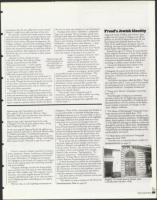
Berggasse 19, Freud's home in Vienna, with
a swastika above the door, 1938.
8/6
1999
Detroit Jewish News
89