

TIVAMX.
4.4VM:j4kg.2-4*
ney HUttrr
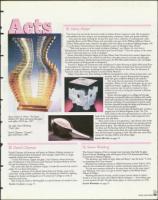
Above: Sidney R. Hutter: "RA Quasi
Modern #5"; dyed, laminated plate glass
with yellow 2GLN dye; 1997.
Top right: Steven Weinberg:
"Cube, glass.
Daniel Clayman: "Cascade";
glass and bronze; 1996
-
Vase forms that are strictly decorative make up Sidney Hutter's signature work. He recomposes
and redefines the vase using an ever increasing variety of textures, colors and spatial attributes.
One piece has been traveling for the past five years with a collection of contemporary crafts
originally shown in the White House and eventually to be part of the William Jefferson Clinton
Library: Many pieces, some related to the glass vessel and others to sculptural lighting designs, will
be at the Janice Charach Epstein Museum/Gallery as part of Michigan Glass Month.
"Their only purpose is to be viewed as objects of design," says Hutter, 44, who lives in
Massachusetts with his wife, former Detroiter Carol Parven Hutter. "I like the mystery of the mater-
ial, and I enjoy each piece as a work in progress."
Hurter, who holds a bachelor's degree in art from Illinois State University and a master's degree from
the Massachusetts College of Art, evolved his style from a hot glass process to one that uses plate glass
and aluminum fasteners. Besides showing newer pieces, the West Bloomfield exhibition also will display
his earlier projects and help provide a retrospective.
"Interest in design and architecture and a background in glass blowing and glass fabricating 'Form
the foundation for my body of work," says Hutter, whose sculptural forms have been purchased by
public and private collectors, including the Metropolitan Museum in New York, the Museum of
American Craft, the Corning Museum and the Toledo Museum.
"Many of my ideas come from thinking of different interpretations of the volume of space that a vase
occupies, and I'm currently favoring blues and greens.
Each color gives a different feeling to the material."
The artist likes the precision of working with
cold glass. When it's hot, the fluid glass can go into
unplanned shapes, sagging or slumping. When it's
cold, machines can be used to measure in thou-
sandths of an inch to bring the material to flatness
or squareness.
Hurter, who has taught art in college and through
workshops, occasionally delves into Judaica with candle-
sticks and menorahs as well as functional forms through
furniture and lamps. His commitment to Jewish causes
has been expressed through the design and donation of
award mementos for special programs.
Hutter's use of plate glass developed after windows
popped out of a Boston highrise in the '70s. The
artist, broke at the time, got permission to take truck-
loads of the mirrored glass to his studio, made sculptures from
those panes and sold three.
"Most of my work is very geometric," says Hutter, who works
from carefully measured drawings and then cuts, grinds and pol-
ishes sheets of glass. "My influences are the artwork of Cubism,
Art Deco and the Bauhaus School of design and architecture."
Many times, ideas evolve from the work itself and thinking
how the final pieces are going to look. His ideas also come from
seeing the way glass reflects and refracts light.
SIDNEY HUTTER on page 74
Steven Weinber-
yman
Daniel Clayman will showcase wall pieces as Habatat Galleries presents its
27th International Glass Invitational. One example, Layers/Tiers, is a huge
assembly of glass and copper leaves.
"I work with bronze, copper and glass," says Clayman, whose pieces are
part of collections at the American Craft Museum, Portland Museum of Fine
Art and the Museum of American Glass.
"My work looks like the antithesis of glass. It looks like carved rock, and it's
subtle. It's not about decoration."
Clayman, a graduate of the Rhode Island School of Design, came to his
career after trying another profession first. He thought he would be a lighting
designer for theater and dropped out of Connecticut College to work in
regional productions.
After trying his ability at blowing glass as a special interest, he turned it into a
The Detroit Institute of Arts is among many museums that hold the glass
forms of Steven Weinberg, who will be part of the 27th International Glass
Invitational at Habatat Galleries.
"I'm showing a new body of work, Boats and Buoys," says the artist. "I work
on something until I lose interest."
Weinberg was studying ceramics at Alfred University in New York in 1973,
when he was introduced to glass by a teacher and became fascinated with it.
"It's the most common material at the same time that it's the most exotic,"
says Weinberg, who went on to get a master's degree at the Rhode Island
School of Design.
Weinberg does blocks of work, and his current interest relates to objects
found in or near the water of his Rhode Island workspace — from lobster pots
to cross sections of hulls. His glass buoys appear in various positions as if left
DANIEL CLAYMAN on page 75
STEVEN WEINBERG on page 75
•
7
4/2
1999
Detroit Jewish News
73