

GLASS ACT'S FROM PAGE 69
•
ro
114 040
0.01
•
0::=%':
R icky Bernsie in
Ricky Bernstein thinks of himself as
more of a painter than a glass artist.
That's because he creates cartoon-like
wall reliefs depicting everyday life, usu-
ally humorous on the surface with a
deeper message intended as social satire.
Of the 10 works that will be shown
at the Charach/Epstein gallery, only one
has a specifically Jewish theme, Lathes
and Apple Sauce. It shows a man in a
yarmulke lighting a menorah.
"I think of that as a joyous piece, a
celebration of Chanukah," says
Bernstein, 46, whose studio is in the
Berkshire Hills of western
Massachusetts. 'All the other pieces are nondenominational. My
reliefs are meant to be significant, and I think of glass as a vehicle for
narrative scenes.
Bernstein's most recent relief, Working Up a Sweat, measures 6 by
12 feet and shows a human-scale dog talking on a cell phone while
riding an exercise bike and watching "I Love Lucy" on TV. Brain
Dead captures a man holding two phones with a cord around his
neck and carryout food on his desk.
"My imagery seems to be getting more barbed," says Bernstein, who
also will be showing his early work, vessels with imagery. "It's a tempered
cynicism, and my intent is to remind people that we all share a common
experience with similar goals, failures and successes. By jabbing a humor-
ous and poignant finger at our many foibles, we might better realize
some of the folly in our lives and discover what is truly important."
Bernstein attributes his early interest in building works of art to
spending time with his grandfather in a basement workshop. The
subjects often refer back to youthful hours spent watching TV sit-
coms.
Bernstein earned bachelor and master's degrees at the University
of Massachusetts, where he concentrated on glass and ceramics. A
Fulbright Travel Grant took him to the Royal College of Art in London, and
he went on to receive a master's in glass from the Tyler School of Art in
Philadelphia.
'All the way along, I knew I didn't want to be a production potter,'
Bernstein says. "I dabbled in the abstract and found my way into narrative
expression about my life and what I see around me. I average seven pieces a
year.
Bernstein thinks of glass as a canvas. He blows glass sheets of various colors,
embellishes the surfaces with paint, cuts out shapes and forms a construction
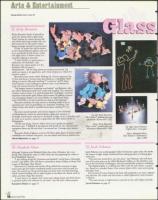
Top left: Ricky Bernstein:
"The Cheater"; painted glass and
aluminum construction; 1992.
Above: Ricky Bernstein:
"Brain Dead'; painted glass and
aluminum construction; 1996
Top right: Jacob Fishman:
"Lightwriters," neon glass.
Above: Elizabeth Mears:
"Join Hands in Celebration";
glass; 1998.
RICKY BERNSTEIN on page 74
-...=n":”"i- -=1 .M..X;If4-1Egli
a Elizabeth Ali ears
4/2
1999
facob Fishmf
Although Virginia artist Elizabeth Mears has a line of Judaica, she is not
Jewish. Her inspiration came in 1994, when she was preparing for a show at
the Philadelphia Museum.
"I was making things for Christmas and decided I would honor Chanukah
as well," says Mears, who will show a menorah at Ariana Gallery in Royal Oak
as part of Michigan Glass Month.
Educated as a scientist and teacher, Mears shifted her attention to glass
many years ago but hadn't considered herself a true artist until the past five
years. She started out doing stained glass and then went into flameworking,
which involves holding rods or tubes of glass in the flame of a bench torch to
soften and then shape the material.
"I don't have an art degree, but I spent time taking classes and think there's
a spiritual quality and narrative to my work," says the artist, whose projects
Jacob Fishman was a photographer before he became a glass artist. He thinks
his interest in light simply transferred from taking pictures to infusing glass
with neon.
"The neon has toned down over the years," says Fishman, who will show
one of his early pieces at the Alfred Berkowitz Gallery on the Dearborn cam-
pus of the University of Michigan, where he periodically conducts workshops.
The displayed glass is a collaborative effort with his wife, Petrie, a cerami-
cist. Based on a wooden frame, it has ceramic plates with a neon arrow going
through a heart.
For the past 20 years, Fishman has been self-employed as an artist, engineer
and educator. His studio and home base is called Lightwriters and is located
in Illinois.
"The main activity at Lightwriters is centered on the craft of glass, basically
ELIZABETH MEARS on page 75
JACOB FISHMAN on page 75
72 Detroit Jewish News