

Arthur Miller
married movie actress Marilyn
Monroe, which caused a national stir.
"Arthur and Marilyn were a very
unlikely couple," chuckles Brater, who
notes that Monroe converted to
Judaism when she married Miller.
"Here was Marilyn, this kind of invent-
ed sex goddess movie star, and here was
Arthur Miller, this Jewish intellectual
playwright from New York. Jewish
American boy meets shiksa above all
shiksas! It was insanity in that regard."
For years, Miller was reticent to
talk about Monroe. But in his autobi-
ography, he writes about the warm
relationship Marilyn had with his
mother, the constant harassment he
and Marilyn endured from a relent-
less press, their private moments,
Marilyn's vulnerability and even the
baby she lost to an ectopic pregnancy
during their marriage.
It was around that time that Miller
decided to turn The Misfits, a story he
wrote for Esquire magazine, into a
screenplay. He rewrote the woman's
role for Marilyn. He thought Monroe
was a fine actress and wanted to give
her an opportunity to prove the depth
of her talent.
Shortly after the filming in 1960,
their marriage ended. Two years after
Monroe's 1962 death, Miller wrote
After the Fall, which is based on their
life together. In the drama, Quentin, a
lawyer, has conversations with an invis-
ible listener, recollecting his life. His
beautiful yet troubled wife, Maggie, a
singer, has committed suicide.
In an interview with U.S. News 6-
World Report some 10 years ago,
Miller addressed the mystique sur-
rounding Marilyn Monroe. "I doubt
that anybody could have predicted
Marilyn's longevity in the public
mind," he says. "That she wasn't for-
gotten is a mystery, and anybody who
can solve it is better than I am.
"Her films were very few and aren't
shown that much. She is noted more
as a persona than an actress. I would-
n't know how to talk about Marilyn's
impact on my writing.
Its probably still going on, and I
can't quite see it yet. But I've written
a lot of stuff that has nothing to do
with her. So, the question is more on
the public's minds than on mine.
"I wrote one screenplay for her,
The Misfits. That was it, really. After
the Fall was something else again. It
was more a reflection on what her
career and her catastrophe symbolized
in wider terms."
In 1962, Miller married his third
wife, photographer Inge Morath. They
live in a farmhouse in Roxbury, Conn.,
a home he bought while married to
Monroe. Through her pictures — she
has been a photographer for Magnum
Photos since 1953 — she has provided
a visual record of their life together.
With her husband, she has authored
four books, including Chinese
Encounters and Salesman in Beijing.
Miller and Morath have a daughter,
Rebecca. She is married to actor
Daniel Day-Lewis, whose mother hails
from a prominent Anglo-Jewish fami-
ly. The couple met while Day-Lewis
was filming his role as John Proctor in
the screen version of The Crucible, for
which Miller wrote the screenplay.
Over the years, Miller has kept
close ties with the University of
Michigan.
He has returned to the campus on
several occasions, including the 50th
anniversary of the Hopwood Awards
in 1981, when he gave the keynote
address.
In October of this year, Miller will
celebrate his 84th birthday. To mark
the occasion, the University of
Michigan Press will release Arthur
Miller's America, a book edited by
Reflections on `Death'
ince first performed on the
New York stage, Death of a
Salesman has had a profound
influence on theatergoers.
Below, some of America's most
notable playwrights, producers and
authors share their interpretations
and memories of Miller's masterpiece.
The following excerpts are from
the fall 1998 issue of the Michigan
Quarterly Review, edited by Laurence
Goldstein, and the just-released book
It Happened on Broadway: An Oral
History of the Great White Way
(Harcourt Brace; $35), by Myrna
Katz Frommer and Harvey Frommer.
S
Edward Albee, playwright. "Like all
of Arthur's plays, Death of A Salesman
forces us to observe much that we
would rather not, consider much that
we are less than comfortable with,
holds up to us a clear reflection of
both our potentialities and our avoid-
ances. It is a powerful, sad, brutal
play, and it has 'conscience' written
all over it, and probably set a stan-
dard for that unpopular word."
Tony Kushner, playwright: "I sat
behind Arthur Miller at the 1994
Tony Awards, and I stared at the
back of his head — far more interest-
- ing than anything transpiring on
2/5
1999
92 Detroit Jewish News
stage. Inside this impressive cranium,
inside this dome, I thought to myself,
Willy Loman was conceived: for an
American playwright, a place compa-
rable in sacrosanctity to the Ark of
the Covenant or the Bhodi Tree or
the Manger in Bethlehem. I wanted
to touch it, but I thought its owner
might object. The ceremonies ended,
and I thought I'd missed my oppor-
tunity to make contact with the cra-
dle whence came one of the three
postwar pillars — the other two
being of course, A Streetcar Named
Desire and Long Day's Journey Into
Night — upon which the stature of
serious American playwriting rests."
Joyce Carol Oates, author: "Willy
Loman has become our quintessential
American tragic hero, our domestic
Lear, spiraling toward suicide as
toward an act of selfless grace, his
mad scene on the heath a frantic
seed-planting episode by flashlight in
the midst of which the once-proud,
now disintegrating man confesses,
`I've got nobody to talk to.' His
salesmanship, his family relations, his
very life — all have been talk, opti-
mistic and inflated sales-rhetoric; yet,
suddenly, the powerful Willy Loman
realizes he has nobody to talk to;
nobody to listen. Perhaps the most
memorable single remark in the play
is the quiet observa-
tion that Willy
Loman is 'liked
...but not well-liked.'
In America, this is
only B+. It will not
be enough."
Neil Simon, play-
wright: "I think
many people who
saw the play saw it
through their own
subjective view, that
Mr. Miller was
telling their story
and not necessarily
the one Mr. Miller
had in mind. It
made no difference.
The play's purpose,
as all plays' purpose
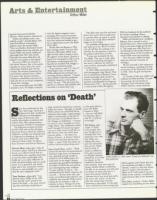
Arthur Miller in 1949, when "Death of a Salesman" was
should be, is to make
first
performed.
an impact on the
audience's emotions,
bilities against and I knew that was
their psyches, their own sense of
one mountain too high to climb.
being, whether failed or otherwise.
Instead, I used it to my own advan-
No play in my memory ever left such
tage as I made it the one play to
an impact on those who saw it. I
aspire to. If I only made it up two-
have never gotten Death of a
thirds of the summit, I would have
Salesman out of my mind and proba-
achieved more than I ever dreamed
bly never will. In fact, it's the one
of."
play that almost kept me from
Paul Libin, producer: "Arthur Miller
becoming a playwright. It's this play
tapped into something so true about
that I measured my own young capa-