

In the spring of 1936, Arthur
next masterpiece, and it was the play
Miller won his first Hopwood Award
that catapulted him into international
for that play, which he called No
prominence. "He somehow was able
Villain. He'd modeled its Jewish char-
to put his finger on the pulse of the
acters, the Simon family, after mem-
nation and capture the cultural milieu
bers of his own family, and it dealt
in a way that had not been done
with a strike in a garment factory that
before," explains Laurence Goldstein.
set a son against his father.
"It was also a very experimental play
No Villain was first performed
technically, and people were fascinated
March 12-13, 1937, at the Lydia
by the unusual structure. He used
Mendelssohn Theater by U-M's Hillel
those timebends, going back and forth
Players under the title
They Too Arise.
The Hopwood Award
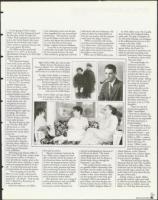
Right: Arthur Miller, left, with his older
came with a prize of $250
brother, Kermit. They lived in relative
— a lot of money in those
luxury in Harlem, N Y, until Miller's father
days, and Miller was afraid
suffered business reversals, and the family
he had exhausted every-
had to move to a smaller home in Brooklyn.
thing about his family in
his first play. He feared he
Far right: Arthur Miller as a student at
the University of Michigan, which he
would have nothing else
attended 1934-1938. His first Hopwood
to write about, says Brater.
Award-winning play, "No Villain,"
But in 1937, he earned
was first per formed, under the title
another Hopwood for
"They Too Arise," March 12-13, 1937, at
Honors at Dawn, a play
the Lydia Mendelssohn Theater in Ann
about brothers Max and
Arbor by U-Ms Hillel Players.
Harry Zibriski, whose
political beliefs are at odds.
Below: Arthur Miller and Inge Morath
While Miller failed to
with their daughter, Rebecca, in 1965
win the prize in 1938 dur-
at their home in Roxbury, Conn.
ing his senior year, the
recognition he earned
from his two previous
awards enabled him to
land writing jobs right out
of college. He worked
briefly for the Federal
Theater Project, and then
wrote radio dramas.
His first Broadway play
was The Man Who Had
All the Luck, in 1944.
Reviewers were not kind
and the play closed after a
brief run.
Temporarily shifting
directions, Miller tried
writing books. Situation
Normal, about soldiers in
World War II, and Focus,
exploring anti-Semitism,
were published.
from past to present.
Returning to the theater, Miller, in
"Also, he created an American fig-
1947, wrote All My Sons, a drama exam-
ure, Willy Loman. People have been
ining human conflict. In the play, a
able to identify and feel the passion of
man sells defective airplane parts to the
the American dream, and the play stirs
United States Army, resulting in a plane
in them the disappointments and frus-
crash and causing the death of 21 peo-
trations of living in a society in which
ple. To avoid prosecution and to pro-
there are so many pressures and obsta-
tect his business, he accuses his partner.
cles to achieving the dream. Of course,
"This was going to be his last
there were always critiques of material-
effort to write a play; otherwise he
ism, but no one had done it as well
was going to give it up and do some-
and as focused as Arthur Miller."
thing else," says Brater. "And the day
After Salesman, there was a string of
after it debuted on Broadway, he
artistic achievements, each one skillful-
woke up famous."
ly crafted. In his works, Miller is
Death of a Salesman was Miller's
provocative, and his characters are
often faced with moral dilemmas. His
plays are about the responsibility we
have for one another, and the complex
social issues that plague mankind.
"Miller is concerned with society,
and that comes through very powerful-
ly in all his work," says Enoch Brater.
"His plays have staying power, and he
goes right to the center. It has taken a
lot of guts to stick to that."
While none of Miller's plays is pro-
In 1953, Miller wrote The Crucible,
about Puritan New England's Salem
witch trials. The play, a metaphor for
the McCarthy hearings, was analogous
to the redbaiting that went on in this
country in the early 1950s.
Miller had been subpoenaed to
appear before the House Un-
American Activities Committee, and
while he admitted attending a few
informal Communist Party meetings,
he refused to name others
who were there.
Not surprisingly, the
Holocaust and anti-
0
Semitism also have been
addressed in Miller's work:
In Incident at Vichy, a man
sacrifices his life to save a
Jewish doctor from the
Nazi death camps. Playing
0
for Time tells the story of
an inmate of Auschwitz
whose life is spared
because she plays in the
camp orchestra. Broken
Glass, about a Jewish
woman stricken with
paralysis when learning of
the Nazis' atrocities in
Germany, is set in 1930s
Brooklyn.
"There is a very real
Jewish preoccupation in
Miller," notes Brater.
"There also is a Jewish atti-
tude in a positive sense. The
idea that you are responsible
0
for those around you is
0
Jewish thinking."
Playwright Ari Roth, a
former instructor at U-M
who as a student won a
Hopwood Award — pre-
sented to him by Arthur
Miller in 1981 — agrees.
In the Michigan Quarterly
Review fall issue, he
writes, "Miller's work
moved me to see him as a
kind of theatrical rabbi
(albeit Reform, in the Classical
sense). Or better yet, a fusion figure,
uniting the pulpit, the bench, the
lectern and the spotlight.
"He had been married to Marilyn
[Monroe] after all. And [The Crucible's]
John Proctor had had an affair. A hero
could have sins on his hands, lust in his
heart and still wage a moral war. One
could indict and not be above the fray
but part of the muck."
Indeed, without a doubt, Miller's
private life could be a play unto itself.
In 1940 he married Mary Slattery, with
whom he had two children, Jane and
Robert. In 1956 they divorced, and he
C.
0
0
claimed autobiographical, elements of
his life can be found. "The closest
autobiographical play is American
Clock, which deals with the Baums, a
Jewish family who go through the
Depression, says Brater.
"The conflict between father and
son parallels Miller's relationship with
his father, and the mother in the play,
Rose Baum, is based on Arthur Miller's
mother. In fact, when American Clock
was first produced in New York, Joan
Copeland, Miller's sister, played the
part of Rose, and when the play was
revived recently, the part of Rose was
played by Miller's daughter Rebecca."
2/5
1999
Detroit Jewish News
91