

Enoch Brater. U-M also plans a sym-
posium in October, whose partici-
pants will include critics, directors
and Arthur Miller himself. It will be
open to the public.
Miller does not seem to be slowing
down. "He always has projects going
forward," says Laurence Goldstein,
"The 1990s were one of his best
decades for writing, in terms of the
volume of publishing and produc-
tions. They were shorter and less
ambitious pieces than in the past, but
he's kept active."
Miller's latest plays are especially
popular in England, where, at the end
of the 20th century, serious drama
seems to be more appreciated than it
is in the United States. One of his
most recent staged plays was last
year's Mr. Peters' Connections, which
starred Peter Falk on Broadway.
It deals with a man at the end of
his life who is desperately trying to
American culture, about the ruthless-
ness of capitalism, about how people
delude themselves into thinking
they're part of the American dream.
There are lines in the play that give
me the chills even today.
7 _17;
Karen Malpede, playwright: "Miller
is the direct descendant of a time in
American history when theater felt it
had both a right and a duty to speak
to the citizens of a democracy about
our role as the makers and safeguards
of the society in which we live. Miller
wants the middle classes to be
responsible. He knew that upward
mobility and assimilation might sap
somethina finer in the nature of a
people of b immigrants who suddenly;
because they had defeated fascism,
could become globally rich and pow-
erful. I appreciate Miller's honesty,
his courage and his sense of citizen-
ship; his secular Jewish belief that
through human action the social
world might become a better place,
and his conviction that dramatic fic-
tion has a role to play in this worth-
while endeavor."
Flora Roberts, theatrical agent:
"Whenever I read news plays, I
would put my hand over the name of
the playwright so as not to be fright-
ened by the author. One day I read a
play called Death of a Salesman. The
author was unfamiliar to me. But it
was so painfully moving, and except
for Eugene O'Neill and the best early
Tennessee Williams, as good a play I
had ever read. I knew only a few
figure out what everything means.
Miller remarked on Mr. Peters'
Connections at a 1998 symposium he
attended at the University of
Evansville in Indiana, during a ques-
tion-and-answer session reported on
in the Michigan Quarterly Review.
"There's a widespread feeling that
life has no essential meaning," he
said. It also comes from the fact that
we human beings kill so many other
people. We've murdered millions of
people in the last 60 years, maybe
more than ever before in history.
"We're certainly conscious of it,
but we don't know how to handle
that consciousness. ... I think lodging
deep within all of us somewhere is
the feeling that the human being isn't
worth very much. ...It diminishes our
grasp on the importance of life.
"So that's in the play. Mr. Peters
isn't consciously dealing with it, but
he's desperately striving for some kind
of redemption, some holiness, con-
nected with human life."
One of the audience members asked
Miller what he liked to do for fun. "I
work. Although, it seems to me, I don't
do as much as I could. I live in the
country and I wander around a lot,
staring into space. I also fiddle around
in the house, and we have lots of good
friends. They come over, and we waste
some time that way.
"I also make furniture now and
then. I have a very nice shop. And I
have children who call me up and
make problems, and so on. I do what
most people do who don't have to go
to the office. That's the greatest thing
about my profession — I can stay at
home. And that's what I do, and
there's a lot of fun it."
Enoch Brater believes that Miller
will be remembered as an extraordinary
playwright and an American intellectu-
al who was always there to comment
people had seen it, maybe Elia Kazan
started to cry. I remembered how
and a few others. So it was a real
during rehearsals people would
thrill for me to have the chance to
always be crying, and Kazan would
write it up for Kermit Bloomgarden.
say, 'Please, keep quiet. I'm trying to
Kermit decided to produce it, and
listen to the actors.' When the play
even though it had no stars and an
ended there was no applause whatso-
unknown playwright, I gave him the
ever, only deathly silence. The actors
$500 I had
came out for the
saved up to that
first curtain call, and
point.
still there was total
Ultimately it
silence. It was only
cost $60,000 to
when the curtain
put on. It was
came up again that
$5,000 here,
everyone started
$10,000 there,
applauding.) ,
and $500 from
me. The play
Ari Roth,
opened in
playwright: "I rally
Philadelphia on
whenever Miller is
a Saturday
assailed as a moral-
night. The set
izing scold, out of
wasn't ready, so
step or out of date.
we opened late.
Only the cold ideo-
We had no
logically driven
advance sales,
could turn his back
but Paul Muni
on the pain of a
was starring in
father and son sepa-
They Knew
rated by disappoint-
What They
ment. What I know
Wanted across
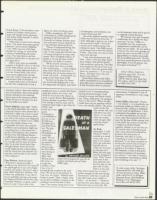
Joseph Hirsch designed the cover for the
to be true is this:
the street, so
program and book jacket of Arthur
That Salesman was
Miller's play.
we got the
the first play to ever
overflow. There
move me to tears.
were a lot of
That it is the only
young dating couples in the audi-
show that's caused me to touch a
ence. We sat up in the balcony. It
perfect stranger on the arm during
was very, very quiet. Nobody knew
intermission. And that it's still the
what to expect. Then it began. And
play that comes most readily to
as the play unfolded, everyone in the
mind — to the heart — whenever
audience moved forward in their
one fears for one's place; when one
seats. The woman sitting next to me
loses one's way, or one's job. The
on the important issues and be part of
an ongoing cultural discourse.
We associate that with European
intellectuals, but it hardly ever hap-
pens here," he says. "Miller is a
remarkable man. He is gloriously
unpretentious. Intellectuals can be
aloof, but not Miller. He can speak to
a man on the street and a garbage col-
lector the same way he talks to a col-
lege professor or another playwright.
He is incredibly humanistic. The fact
that he is one of the greatest American
playwrights, if not the greatest, has
never gone to his head." ❑
Arthur Miller's Death of a
Salesman opens Feb. 10 at the
Eugene O'Neill Theatre,
230 W 49th St, New York City.
For tickets, call (212) 239-6200
or (800) 432-7250.
achievement of Salesman is one of
exposing vulnerability at every stage
of life.
Arthur Miller, playwright: "Drama
— any theater — is a manifestly, pre-
eminently public art which exists in
historical time. Politics is imbedded
in every work of significance. I don't
understand why people try to sepa-
rate these two elements. It's all one
twine rope. The caring for the fate of
man, for the fate of their society, that
it not evolve into some evil disorder,
is implicit in all the [Greek]
tragedies. Hamlet is not just the son
of a mother who is fooling around
with a man who had murdered her
husband. He's the prince of
Denmark, and when it is said,
`Something is rotten in the state of
Denmark,' it's to direct attention to
the fact this country has to be gov-
erned. The politics of America is
implicit in the whole of Salesman.
The Salesman is close to being the
universal occupation of contempo-
rary society — not only in America,
but everywhere. Everybody is selling
and everything is for sale." Fl
To order a copy of the "Michigan
Quarterly Review" fall 1998 spe-
cial issue devoted to Arthur Miller,
send a check for $7 to Michigan
Quarterly Review, 3032 Rackham
Building, 915 E. Washington,
Ann Arbor, MI 48109-1070.
2/5
1999
Detroit Jewish News
93