

abbiIrWin Groner of origregation
Shaarey Zedek views the exhibit as an aesthet-
ic experience for Jewish visitors.
"We can appreciate the artistic beauty
which expresses the Christian beliefs," said
Rabbi Groner, who characterizes the modern
Conservative concept of angels as poetic and
not literal.
Rabbi Groner explained that angels would
not be depicted by early Jewish artists even
though the Torah describes angels as messen-
gers conveying divine commands and promis-
s and the Book of Daniel describes 1VIichael
as Israel's representative in Heaven.
We wouldn't find paintings of angels
ewish artists because that would offend
eligious sensibilities of not portraying
d's messes Groner said
ger of Agudas Yik9
more literal view.,
cro €s all religions;
lie said . ery ambiguous so
renditions.
ith incidents of
we meet up with
aily basis here is a false notion
n a person dies, he or she becomes a
, that is not what Judaism
rabbi points out that, accor
ation, angels and people
erent days.
where angels are called u
in Orthodox
ance, according to Rabbi
Eisenberger, i
-:rbris. A chair is set asi&k..-s,
the angel of 9patizi,cision to ensure a
recovery, for t
w
ANGELS on p
Angels In Jewish Life and Literature
T
he concept of angels has fasci-
nated earthbound humans for
centuries. The book A Gathering
of Angels (Ballantine Books) by
Morris B. Margolies explores these beings
from a Jewish perspective.
According to Rabbi Margolies, a profes-
sor of Jewish history at the University of
Kansas at the time of the book's publica-
tion in 1994, angels first appear in the ear-
liest passages of the Bible, portions of
which date back 3,000 years. They pop up
sporadically throughout the books of the
Bible, which were compiled over a period
of 1,000 years and edited by the Rabbis
after the middle of the first century C.E. as
the Holy Scriptures.
The books left out of the Bible during
this editing process comprise the Apoc-
rypha ("outside writings") and the Pseude-
pigrapha (writings attributed by the author
to someone else, usually a well-known bib-
lical character).
The works comprising the Apocrypha
and Pseudepigrapha were composed over a
period of nearly 300 years — from roughly
200 B.C.E. to 100 C.E.. These were years
of severe crises for the Jewish people, and,
writes Rabbi Margolies, the quest for
supernatural redemption from suffering is
reflected in the literature of this period.
Angels fill virtually every page.
While the rabbis stopped short of deny-
ing the existence of angels, they felt com-
pelled to censor a literature in which angels
seem to be autonomous. They did so, writes
Rabbi Margolies, because the Judaic princi-
ple that God is One is diluted when God is
buttressed by so much celestial assistance.
While the Rabbis instituted the virtual
disappearance of the Apocrypha-Pseude-
pigrapha from Jewish literature, Christiani-
ty, which was born during this period,
incorporated many of these writings into
its own version of Holy Scripture, assuring
their survival.
Here is just a sampling of the angelic
characters that live in the pages of Jewish
literature.
• CHERUBIM
The Cherubim are the
first angels to be mentioned in the Torah.
The readers' first encounter with them is in
the climax of the Garden of Eden story
when Adam and Eve had been cast out and
God "stationed east of the Garden of Eden
the cherubim and the fiery ever-turning
sword, to guard the way to the tree of life."
(Genesis 3:24)
-
• THE SERPENT AND SATAN
The
persuasive serpent who tempts Eve to eat of
the fruit of the Tree of Knowledge of Good
and Evil is also considered an angel, for it
is Satan in disguise, the Angel of Death.
The image of a beguiling snake has since
become a metaphor for the serpent within
us all, the temptation of self-indulgence
LIFE AND LITERATURE on page 93
—
—
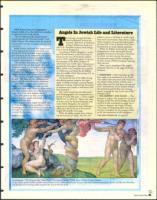
Michelangelo: "The Original Sin," detail from "The Sistine Ceiling ,'”1512, firsco, Sistine Chapel, Vatican.
In the climax of the Garden of Eden story (Genesis 3:24), Adam and Eve are cast out, and God "stationed east of the .Garden of Eden the cherubim
and the fiery ever-turning sword, to guard the way to the tree of
tem
-
tk,_4*t**liti~
Detroit Jewish News
8/21
1998
91