

S: In
Our Midst
Works of art from the Vatican collections visit the DIA and raise
questions about the concept of angels in Judaism.
SUZANNE CHESSLER
Special to The Jewish News
he works of art are from the Vati-
can, but the core concepts derive
in many ways from early Jewish
teachings.
That's what viewers will note as they expe-
rience "The Invisible Made Visible: Angels
From the Vatican," the traveling exhibit run-
ning Aug. 23-Oct. 18 at the Detroit Institute
of Arts (DIA).
The exhibition explores the portrayal of
angels throughout history and the challenge
of representing what is believed to exist but
cannot be seen.
Spanning more than two millennia, the
collection features more than 100 paintings,
sculptures, artifacts, ceramics, liturgical ves-
sels and vestments.
It shows works from the Assyrian, Etr-
uscan, Greek-Roman and Christian traditions
currently preserved in the Vatican's collec-
tions, which are found in 13 museums, sever-
al basilicas and the papal apartments.
Prototypes from nonbiblical cultural and
artistic tradition — winged victories, genies
and semi-divine figures — also are present in
the artistry by Raphael, Fra Angelico,
Georges Rouault and Salvador Dali, among
many others.
8 /21
1 99-8
fmt
90 Detroit Jewish News
"We give full and important credit to the
Jewish tradition that introduced the idea of
angels to Christianity," said Iva LisikewyCz,
DIA curator for this exhibit. "The source
material comes from the Bible."
While three archangels are named in the
Old Testament — Michael, Gabriel and
Raphael — only Michael is represented in
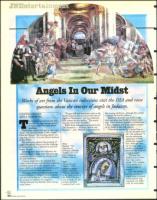
Above:
Raphael: "The
Expulsion of
Heliodorus from the
Temple," 1511-14,
fresco, Stanza di
Elidoro, Vatican.
Right
Georges Rouault:
"Misere," 1939,
tempera on paper,
Vatican Museums. .
"Miserere mei Deus,"
in the Latin version of
the Bible, is the first
verse of Psalm 51, the
canticle of David
invoking God's mercy.
the touring exhibition, although the context
is outside the Jewish tradition.
Lisikewycz describes one of the images
-.'
that does relate specifically to Jewish teach-
ings, Youth From the Expulsion of Heliodorus,.
a fresco fragment and brush sketch complet-
ed by Rafael in the 16th century
"Heliodorus was sent by a Syrian king to
rob the Jerusalem tern-
ple," she explained. "It
was the miraculous
appearance of three
youths that stopped
him. Although there
are no wings men-
fioned, it is an inter-
pretation that these are
avenging angels.
"We treat this
exhibit as an art show
first," the curator
added. "The visualiza-
tion is artistic as it
relates to religious
themes."
How the exhibit
and the concept of
angels relate to Jewish
interpretation were
expressed very differ-
ently by local rabbis.