
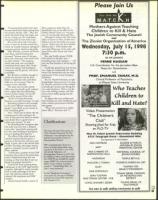

Please Join Us
op.
"Consumer demand has been slow
because there's been little coming from
the primary sources GM . "Plus, the
mines have been busy, and virgin met-
als are coming into the marketplace
and going nose-to-nose with scrap."
But on the other end of the spec-
trum, at least two Jewish-owned busi-
nesses are actually seeing an upsurge of
customer activity, thanks to the strike.
Mike Winston, co-owner of Burton
Auto Parts, said his business has
increased "because some of the guys
have more time now to do more work
on their vehicles." The company,
which sells used, new and rebuilt
name-brand auto parts, does 70 per-
cent of its volume with installation
companies and 30 percent with do-it-
yourselfers.
But Winston is realistic enough to
admit this situation may be short-
lived, or might last only until these
folks run out of money. Then he
expects to see a decrease.
The same time-on-their-hands
effect may also benefit small, indepen-
dent retailers like Jerry Rosenberg,
owner of Flint Carpet. He has felt
none of the strains of the strike.
"So far we've been fortunate.
Business is actually booming," he said.
Rosenberg attributes that anomaly
to his store's affluent customer base,
people "more likely to save money to
buy something good."
And, "There may be those who are
sitting around with nothing to do
who, if they don't live hand to mouth,
may decide this is a good time to
spend some money," he said.
But Rosenberg also recognizes that
the strike may have lost or delayed
some sales, "particularly among strik-
ers who were thinking of buying but
are now holding off a little bit."
The. effects of the strike haven't
reached attorney David Leyton, a
partner in the law firm of Leyton and
Kasle. Leyton, who is the elected clerk
of Flint Township, the largest munici-
pality in Genessee County outside of
Flint, explains:
"I think that a number of the UAW
members who work at the metal plant
and at Delphi East knew this was
coming, so they were able to save up
funds and prepare themselves."
Leyton's law firm is among those
taking part in the UAW legal benefits
program, although he said it provides
only a small percentage of his busi-
ness. His clientele includes both
salaried GM employees and UAW
workers.
Dentist Daniel Gotlib, a native of
Flint, commutes daily from his
Southfield home to his office in the
Golden Dental Clinic in a very poor
area of economically depressed Flint.
Although he believes the GM strike
affects everyone in Flint, Gotlib sees a
different picture for health care practi-
tioners. Strikers just lost their benefits
effective July 1. GM workers who
were laid off because of the strike will
keep all but their dental and vision
benefits.
But, said Gotlib, almost 70,000
GM retirees in the Flint area —
including many of his patients — will
not lose their benefits at all during the
strike.
Gotlib also pointed out that the last
two weeks are traditionally the time
when GM autoworkers are not work-
ing because of the annual company
shutdown.
Yet, Dr. Harold Steinman, an oph-
thalmologist whose practice is in near-
by Davison, pointed out that workers
normally get vacation pay during the
two-week shutdown. That is not the
case with striking workers, and that
means fewer dollars going into the
economy.
He figures that once strikers and
their families lose their benefits he and
other medical practitioners will feel
the squeeze.
"There will certainly be a trickle-
down effect," Steinman said. 0
Mothers Against Teaching
Children to Kill & Hate
The Jewish Community Council
and
The Zionist Organization of America
Wednesday, July I 5, 1998
7:30 p.m.
as we present
FERNE HASSAN
U.S. Coordinator for the Jerusalem Base
Peace for Generations
and
PROF. EMANUEL TANAY, M.D.
Clinical Professor of Psychiatry
at Wayne State University
Who Teaches
I airetlifo'O;oiIijttt .
warribr.iiesbttledres.
•
•
Children to
Kill and I-tate?
Video Presentation
"The Children's
Club"
The June 30 panel discussion on
The Vatican's Response To The
Holocaust" was sponsored by the
Jewish Community Center of
Metropolitan Detroit.
800 congregational school stu-
dents received scholarships rang-
ing from $140-$240 in size from
the Jewish Federation of
Metropolitan Detroit in 1997-98.
In addition, when total allocations
for 1998-99 are divided by enroll-
ment, Hillel Day School receives
$681.18 per student (numbers
noted in "Scholarships Rise" on
July 3 were incorrect).
In the "Sandwich Generation"
story June 26, the age of Sheldon
Litman was incorrectly reported.
Mr. Litman is 52.
Showing Jihad for Kids
on PLO-TV
Max M. Fisher Jewish Federation Building
673 S Telegraph Road • Bloomfield Hills
Co-sponsors In Formation
EUGENE & MARCIA
AISH HATORAH
APPLEBAUM JEWISH
AMIT
PARENTING CENTER
BAIS CHABAD OF
FARMINGTON HILLS
NATIONAL COUNCIL OF
JEWISH WOMEN
HADASSAH
TEMPLE BETH EL
MACHON L'-TORAH
WOMEN'S AMERICAN ORT
NCSY
WOMEN FOR
ISRAEL'S TOMORROW
OHR SOMAYACH
SARA TUG MAN
BAIS TORAH CENTER - W.B.
CONG. SHAAREY ZEDEK
YOUNG ISRAEL COUNCIL
OF METROPOLITAN
DETROIT
YOUNG ISRAEL OF
SOUTHFIELD
No one is safe unless everyone is safe
7/10
1998