

THEY REWARDED AMERICA FOR THEIR SUCCESSES
For many immigrant and first generation Jews, America was seen as a clean
slate on which ambitious citizens could write their rags-to-riches stories.
And to a great degree, they have prevailed in business, industry, finance and
communications, to name a few professions.
Examples are many and a few are outstanding. George Soros is a
legendary money trader respected for his brilliance. Former U.S.
ambassador Walter Annenberg shaped a vast publishing empire. Jack
Dreyfus empowered small investors by popularizing mutual funds. Joseph
Hirshhorn amassed a fortune in gold and uranium holdings. Norton
Simon built a food-related business complex ranked among our top hundred
corporations. And all repaid America for enabling their wealth--donating
hundreds-of-millions of dollars to worthy causes, to hospitals and medical
research, museums, schools, libraries and much more. Others followed suit:
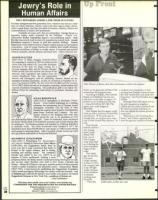
JOSEPH PULITZER
(1847-1911) b. Mako, Hungary Publisher/Editor
On emigrating to America in 1864 he enlisted in the
Union Army and settled in St. Louis after discharge.
Penniless at . the time, he began writing for a
German language daily and his fortunes changed.
Within several years the reporter was elected to the
Missouri state legislature and helped form the
Liberal Republican Party. But his commanding
interest was newspapers, and his publishing ventures helped set the
standards of modern journalism. In turn, he revitalized or founded The St.
Louis Post-Dispatch (1878), The New York World (1883) and The Evening
World (1887) which thrived on investigative reporting, sensationalism and
exposés of political wrongdoing. His posthumous gift to our nation: the
Pulitzer Prizes for outstanding achievement in journalism, literature and
theater.
JULIUS ROSENWALD
(1862-1932) b. Springfield, IL Merchant / Philan-
thropist From modest beginnings as a clothing
salesman, the enterprising son of German Jewish
immigrants eventually took the helm of what
became the country's most dynamic merchandising
giant--Sears, Roebuck and Company. His one-
quarter interest in the fledgling mail order firm
(1895) paved the way to its presidency in 1910
and chairmanship fifteen years later. Under his leadership, Sears introduced
the famed "Money Back if Not Satisfied" guarantee and a profit sharing plan
for employees. His business acumen was matched by a lifelong dedication
to charitable works. The Julius Rosenwald Fund, founded in 1917, has
distributed more than $70,000,000 to such causes as YMCAs and schools
and housing for deserving blacks. Others he aided include Jewish war relief
and agricultural settlements in Russia and Palestine.
SOLOMON R. GUGGENHEIM
(1861-1949) b. Philadelphia, PA Businessman /
Art Collector Headed by Swiss-born father Meyer
(182R-1905), the Guggenheim family drew its
seven sons into a huge consortium that made its
fortune in the copper industry, and in minin
smelting and - refining metals. The company's
founder had settled in the U.S. (1847) as an
importer of Swiss needlework. Seeking a more
prosperous future, the family turned to metal processing which grew in sc e
and success; major facilities were built in New Jersey, Colorado and
Mexico. Almost all of Meyer's sons gave sizeable portions of their personal
wealth to public foundations and charitable causes. Among them, Simon
(1867-1941), is best known for establishing the Guggenheim Foundation
whict awards prestigious fellowships for creative work and research. And
to Solomon goes credit for the family's most visible civic gesture: the famed
Guggenheim Museum in New York City, a pantheon of abstract art.
—Saul Stadtmauer
Visit many more notable Jews at our website: www.dorledor.org
COMMISSION FOR THE DISSEMINATION OF JEWISH HISTORY
7/10
1998
10
Walter&LeaField,Founders/Sponsors
Irwin S.Field,Co-chairperson
Harriet F. Siden, Co-chairperson
17.100'
y
Mike Winston of Burton Auto Parts said business is brisk at the moment.
thanks to the generosity of Flint's GM
autoworkers during good times.
According to Kaplan, Flint's Jewish
Family and Children's Services was
told prior to the strike to expect a 13
percent cut in its allocation this year
— from $31,245 to $27,183. The
agency has a total budget of
$473,000.
Now Kaplan fears his agency could
wind up with a minimum United Way
contribution. "If the strike goes on
through July, we could see even more
cuts in what United Way allocates," he
said.
Flint's Jewish
business commu-
nity, among
them Lorbec
Metals USA
Ltd., one of
Flint's largest
scrap metal deal-
ers, is feeling the
most immediate
impact of the
strike.
Two weeks
ago, for the first
time since
Lorbec opened
in Flint in 1991,
the company had
to lay off eight
workers because
of the slowdown
in business
resulting from
the strike.
"They (the
UAW strikers in Flint
workers) were temporaries we had
working here through various services.
But they worked here, and made their
living here," said Vice President Larry
Lifshitz.
Although Flint's GM plants are not
his only customers or suppliers,
Lifshitz said the strike, combined with
the recent economic turbulence in
Asia, has helped drive down prices for
scrap metal.
"Aluminum is now searching for a
home," said Lifshitz, signaling bad
news for pop-can recyclers everywhere.
last week.