

Different Goals;
A JTS Study
a y finds
disparities in thejobs
male and female rabbis •
g o for and win upon
ordination.
JILL DAVIDSON SKLAR
Special to The Jewish News
hile no comprehensive
study has been done
on the placement and
career advancement of
4/17
1998
84
female ordination and make a recom-
mendation for the 1979 Rabbinical
Assembly Convention.
To the administrators of the JTS
and to those deciding the question of
ordination in the Rabbinical Assem-
bly, the matter was much more com-
plex, primarily involving Halachic
standards for both sexes — what
women were allowed to do, what both
sexes were obligated to do and what
they were forbidden to do according
to Jewish law.
"We see ourselves as a Halachic
movement, one motivated by
Halacha," said Dr. Lerner of JTS. "We
female Conservative rabbis, a study
released this year by the Jewish The-
°logical Seminary of meri
A ca indi-
cares that women are not making it
to the pulpits in the same numbers
as male rabbis.
The study, an excerpt of which
was published in the seminary's
winter 1998 newsletter, focused on
the career aspirations of rabbinical
students who went through the
seminary between 1985 and 1994.
In the period covered by the study,
36 percent of the graduates were
women and 64 percent were men,
Of those who were ordained
between 1990 and 1997, 61 percent
of the total found their first post-
graduate jobs as congregational rab-
based our decisions on Halacha."
While legally vexing, the question
of ordination also posed a threat to
the very membership of the RA.
In fact, some RA members took a
minority dissenting opinion regarding
counting women in the minyanim
and remained confident that some
congregations would never allow that
to happen.
They were right. In a study of
Conservative synagogues in North
America that was issued last year, a
full 17 percent still do not offer egali-
tarian rights and privileges to its
membership.
pb eis;ce1
n3 tpaesrcheAts,atsabJebwis7oe audears, 6
an 4 percent
and
perce nt as H e 1
directors, administrators d: chap-
lains. Two percent of the graduates
went into non-rabbinic professions.
The disparity, however, is seen in
the breakdown of first jobs for both
men and women. Men overwhelm-
ingly listed their first job as a con-
gregational rabbi (74 percent for
men vs. 40 percent for women).
At the same time, women . 4**
became Jewish/adult educators at a
higher rate than men (27 to 13 per-
cent) and also were more likely to
enter academic fields (26 to 5 per-
cent).
While some anecdotal evidence
But to those same RA mem-
bers, the issue of female ordi-
nation was a step too far in
the wrong direction. They
threatened to leave the move-
ment if the measure passed in
the RA and the seminary
On October 24, 1983, four
years after the original dead-
line, the seminary voted 32-8
in favor of female ordination
with five members abstaining.
The RA, in a separate vote
the same year, concurred.
Some of those in the minority
could not stomach the
impending change and left the
movement to found their own
organization, the Union for
Traditional Judaism in New
Jersey.
The approval of female
ordination, however, did not
mean equality within JTS
itself, said Rabbi Debra Oren-
stein, who was part of the first
crop of female graduates
ordained in 1985. She served
as the Conservative scholar-in-
residence in Detroit in 1996 and leads
Congregation Makom Or Shalom in
Tarzana, Calif.
During her years at the semi-
nary, Orenstein, a seventh-generation
rabbi, found that although rampant
discrimination was not visible, subtle
signs remained.
To her, the gender bias particularly
became apparent in the curricula. Of
the 70 required readings in one phi-
losophy class, none was written by
women. In a Bible class, the male
teacher examined a number of differ-
ent texts, all dealing with issues of sex-
ually violent and adverse conditions
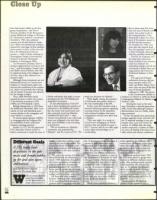
Photo by John M. Disc her
Photo by Daniel Lippitt
have had women rabbis in the first
group of graduates," said David
Teutsch, president of the Reconstruc-
tionist Rabbinical College in Wyncote
Pa. Humanistic Judaism, a movement
founded in 1963, also admitted
women into all roles from its incep-
tion. When the movement's seminary
opened five years ago, its first students
were women. In fact, its first two rab-
bis to be ordained next year are
women — both of them studying in
Birmingham Temple's International
Institute of Secular Humanistic
Judaism, in Farmington Hills.
"In Humanistic Judaism, there is
absolute egalitarianism of women and
men," said Birmingham Temple Assis-
tant Rabbi Tamara Kolton, who will
be ordained along with colleague Sta-
cie Fine, who is also referred to as
assistant rabbi.
Although those movements are not
halachically bound, as Conservative
Judaism is, Conservatism takes into
account the conditions of the modern
era. And it was precisely the evolving
role of women in society that allowed
for the change to begin.
Thus, while Henrietta Szold
opened the door a crack, the women
in the feminist movement of the
1960s and 1970s kicked it down.
Rulings dating back to 1955 from
the Rabbinical Assembly's (RA) Com-
mittee on Law and Standards grant
women aliyahs in the synagogue and
count them in a minyan.
As women gained greater visibility
in congregational and religious life,
the possibility of their ordination
became a pressing question.
Finally, in 1977, the RA appointed
JTS Chancellor Gerson Cohen to
head a committee to study the issue of
exists regarding
re ardin the difficult time
women have in finding pulpit posi -
tions, the study offers a different
perspective as to why women are
not making it to the pulpit in the
same numbers as men.
Rabbinical students from 1985
to 1994 were asked to gauge their
interest in different rabbinic career
paths. Men predominantly wanted
pulpit positions (71 percent for
men vs. 55 percent for women),
while women showed a stronger
b
interest in Jewish education (43 to
41 percent), academics (52 to 39
percent) and counseling (42 to 23
percent).
Professor Jack Wertheimer,
provost of the seminary and co-