

for females such as rape, incest and
ordeals of adulteresses.
"He had been unaware that there
was such a theme until I pointed it
out," said Orenstein, who is the editor
of the Lifecycles Book Series on
Women in Jewish Life.
Others found more disturbing the
existence of a non-egalitarian minyan
\_, offered at the same time as an egalitar-
ian option.
"As a student, you were aware of
which fellow students and which fac-
ulty members worshipped in the non-
egalitarian minyan," said Rabbi
Debra Newman Kamin, rabbi of Am
Israel in Northfield, Ill.
"It made you wonder what they
thought of you as a female rabbinic
\— student."
Rabbi Amy Greenbaum of Mar-
•
tinez, Ga., felt uncomfortable with
some of the other facts of seminary
life.
For example, the female rabbinic
students were told to don tefillin and
tallit as a part of morning prayer, a
Halachic requirement for men that is
not required of women. She was told
that as a rabbi, she would be held up
/--- as a role model for both men and
women and therefore was required to
use the tefillin and tallit.
"I was very uncomfortable with
that," she said. "Since it is not a
Halachic requirement for women, I
don't believe the seminary should
require women rabbinical students
and women rabbis to obligate them-
selves in this way.
And, acceptance does not come
•
easy outside of the seminary, either.
Many women rabbis report subtle to
overt acts of gender discrimination
from congregants, members of other
•
"
author of the study with Aryeh
Davidson and Ariela Keysar, said it
remains unclear whether women
are choosing not to go into the pul-
pit as men traditionally have or
whether they are directed into other
positions. It is a subject he hopes to
pursue in the near future.
"Until we try to do some com-
prehensive survey on that issue, we
are not going to know," he said.
"This is something for which I
hope we will have the funding
sooner rather than later.
"This gets to the question of
leadership in the Jewish community
and the access women have to these
positions," Wertheimer added.
movements and both male and female
rabbinic colleagues.
Rabbi Greenbaum, who is married
to Rabbi Alex Greenbaum, feels slight-
ed when she is referred to by congre-
gants as "rebbetzin," even though she
and her husband could both be con-
sidered as such — according to the
term's traditional definition.
And to make matters more delicate,
congregants at her husband's congre-
gation switched from Orthodoxy to
Conservativism two years ago and are
currently adjusting to mixed seating.
Many are unused to full female partic-
ipation — much less female rabbis —
so some continue to refer to Green-
baum as the rebbetzin.
Surprising? No. Grating? Yes.
"I am fighting against the old
image of the rebbetzin," she said. "I
want to be identified as an individual.
I want them to see me as a rabbi."
"It has gotten a lot better," Green-
baum conceded. "But there is still a
long way to go."
Perhaps because she has been in the
field a bit longer, Rabbi Kamin of Am
Israel has experienced more overt
forms of discrimination. During inter-
views with congregations following
her ordination, she was asked about
baby-sitting arrangements for her 6-
month-old. The same interviewer then
asked whether it would be more diffi-
cult for her to leave her child with a
caregiver when the child became more
communicative.
"This is a question I am sure they
would not ask a man," she said.
The issue of child care itself has
split the body of female rabbis. While
their male counterparts have tradition-
ally handed over the responsibilities of
child rearing to their wives, female
Opposite page:
Far left: Rabbi Debra New-
man Kamin: Her pulpit is
outside of Chicago.
Above right:
Rabbi Debra Orenstein —
part of the first group of
female graduates ordained in
1985.
Below right:
Rabbinical Assembly Vice
President Rabbi Joel Meyers.
First page, bottom photo:
Faculty, students, rabbis and
cantors, as captured by pho-
tographer Frederic Brenner at
the Jewish Theological Semi-
nary of America, in his book,
Jews, America, A Representa-
tion. FrOill left: Rachel Ara-
noft; JTS rabbinical strident;
Jill Jacobs, Columbia College
student; Caitlin Bromberg,
JTS Cantors Institute student;
Tapia Caracushansky, JTS
rabbinical strident; Rachel
Lerner; Ramaz Upper School
student; Rabbi Pamela Jay
Gottfried; Miriam Gelfifild,
JTS Cantors Institute student;
Rachel Berger; Frisch Yeshiva
High School student; Dr. Anne
Lapidus Lerner, vice chancel-
lw; JTS; and Marcey
Bergman, JTS Cantors Insti-
tute student.
rabbis are responding in much the
same way as their non-rabbinic coun-
terparts.
Rabbi Greta Brown left her day-to-
day clergy duties as rabbi of a
Solomon Schechter day school in New
Jersey to raise her three small children.
She noted that her male colleagues
were much more supportive of her
decision than her female colleagues.
But others — including Rabbi
Adina Lewittes, assistant dean of the
rabbinical school at JTS — have
found the movement more accommo-
dating in that sense. Lewittes just left
her post for maternity leave to have
her third child.
Similarly, the Greenbaums were
both given breaks in their studies
when their child was born just ,before
they graduated from JTS last spring.
"I am incredibly fortunate,"
Lewittes said. "Some women are torn
between the commitment to their
career and a commitment to their
families. But I see being a mother as a
religious commitment and I am
blessed that my superiors have been so
flexible in allowing me time to fulfill
this role."
While some battles have been
fought and won, some loom larger on
the horizon. For example, nearly all of
the female rabbis have had to accept
the idea that pluralism within the
movement means that others are not
required to count them in a minyan,
let them read from the Torah during
services, or allow them to serve as a
witness, much less call them rabbi.
"We all value pluralism, but women
are asked to put aside our status as
rabbis," Kamin said. "It is like saying,
`I am waiting for you to give me my
legitimacy.'"
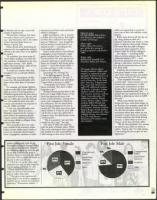
First Job: Female
Congregational
Rabbis
Jetvish/Adult
Educators
Academics
Other
. 5%
is
I \ \
Congregational
Rabbis
Jewish/Adult
Educators
Academics
Other
4/17
1998
85