
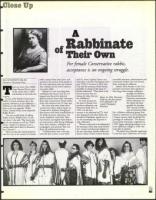

Photo cour tesy o f The Jewish Museum o f Maryland
Rabbinate
of Their Own
For female Conservative rabbis,
acceptance is an ongoing struggle.
JILL DAVIDSON SKLAR
Special to The Jewish News
III
L
here are times when Rabbi
Greta Bernard Brown tires
of the names she is called
and bristles at the looks she
is given.
As one of 87 female Conservative
rabbis in North America, she is fre-
quently referred to as the rebbetzin, a
reference to the wife of a rabbi. Then
there is the ever popular "Rabbi
Greta" instead of the more respectful
Rabbi Brown.
"No one would think of calling
Rabbi Groner 'Rabbi Irwin.' It just
isn't done," she said. "But many peo-
ple do not hesitate to call me 'Rabbi
1 Greta.' Maybe it is because I am a
young rabbi, but I feel it is because I
am a woman."
There are also the raised eyebrows
cast her way at the notion of a female
-
rabbi, mainly from other Jews, and
questions she receives from people in
her own movement who are unaware
that a female can be both Conserva-
tive and a rabbi.
Perhaps it is not surprising that
trailblazers like Brown and her col-
leagues have faced the skeptical
glances and less than warm welcomes,
given that Conservative female rabbis
came into existence just 12 years ago.
But since that time, these select
women have had a major impact on
Conservative Judaism, changing its
face forever with their contributions in
the fields of prayer, education, text
study, chaplaincy and ritual. Most
have had to accomplish these histori-
cal innovations while facing challenges
from their teachers, colleagues and
congregants and pressures that con-
front all professional women.
"Unfortunately, that is the case
with the first women in any field,"
successful educators, administrators and
said Dr. Anne Lapidus Lerner, vice
communal workers, but were barred
chancellor at Jewish Theological Semi-
from entering the rabbinate.
nary (JTS) of America in New York
Indeed, those females in the Con-
City and the secretary of the faculty
servative movement who aspired to
assembly in charge of the issue of
the clergy often sought ordination
female ordination. "They have to be
through the Reform,
braver because they are
Reconstructionist or
taking the risks; they are
Above: In 1903, Henrietta
Humanist movements
the trailblazers."
Szold was the first woman
where ordination on
An early pioneer on
to be admitted to the
the whole has been
the path to female Con- Jewish Theological
possible for decades.
servative ordination was Seminary.
The Central Confer-
Henrietta Szold who, in
ence of American Rab-
1903, was the first
bis, a Reform rabbinical group, first
woman to be admitted to JTS. And
issued a statement in 1922 saying that
that happened only after Szold, the
"women cannot justly be denied the
founder of Hadassah, agreed not to
privilege of ordination." The Recon-
use the knowledge she acquired to
structionist movement, organized in
seek ordination.
1955, began admitting women to its
Women continued to be admitted to
own rabbinical college in 1969, the
the seminary, where they earned bache-
year after it opened.
lor's, master's and doctorate degrees in
"We didn't have [female] applicants
the arts, education, Jewish studies and
in the first year. Otherwise, we would
history. Many of those women became
4/17
1998
83