
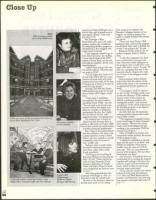

Right:
STaR Practicum coordi-
nator Dina Shtull-Leber
STaR's new home at the recently finished School of
Social Work Building in Ann Arbor.
Proseminar coordina-
tor Sue Sefansky.
r r e444 "\ \N.-
STaR staff members Katherine Sholder, Dina
Shtull-Leber, Armand Lauffer and Sue Sefansky.
2/6
1998
84
Project STaR
Administrator
Katherine Sholder
during a staff meeting.
interview at Project STaR gave me a
feel for what type of people were in
the program already," Gross said.
She chose U-M.
Kari Grosinger, a West
Bloomfield native and U-M under-
graduate student who coordinates
the Rekindling Shabbat program at
the Federation, also struggled with
which school to attend.
"I had originally wanted to go to
New York University," she recalled.
"I met with the dean of the NYU
School of Social Work, and he said
he'd help put together a Jewish com-
munal program.
"I asked where he'd go if he were
me, and he told me, 'You'd be crazy
not to go to U-M.'
"I'm very happy that I went to U-
M and truly believe that for a com-
bination of social work and Jewish
communal service study, it's the best.
U-M gave me a chance to be part of
small and large groups."
Grosinger also feels that Project
STaR prepared her more for her job
than a simple MSW degree would
have.
"I don't think I would have
accomplished the same (without
attending Project STaR)," she said.
"You can work in the Jewish corn-
munity without that degree, and
there are a number of competent
professionals like this. But I didn't
have to learn on the job, and I
understood what I was getting into."
The students have a variety of
experiences that have put them in
position to effectively use Project STaR
Some of their parents are social workers
or Jewish communal professionals.
But, "Most of the students bloom
into this profession. For some it was
a camp experience or trip to Israel.
Others may have worked at a Jewish
community center for a year or
two," Lauffer said.
Tachman chose to work within
the Jewish community because he
came from a place with a small
Jewish population.
"Growing up in Grand Rapids
had a big influence on choosing this
field," he said. "Other experiences,
such as Camp Tamarack, North
American Federation of Temple
Youth and Project Otzma in Israel,
only strengthened my desire to want
to do it."
After Echt graduated from the
University of Michigan in 1991, he
didn't know what he wanted to do.
He went to San Francisco, where he
decided social work was his calling.
One summer, he worked at the
Brandeis Collegiate Institute in Los
Angeles, an intensive program for
adults to explore Judaism and commu-
nal service.
"There were some Project STaR
graduates there, and once the program
was finished, that's when I decided this
is what I was going to do," he said.
Being one of four males in the 15-
student program, however, bothers
Echt.
"I wish that programs like these
were marketed for everyone and
that I had more male colleagues in
the program that I could have a dia-
logue with about issues," he said. "If
this was a program that was in the
business school, I'd guess the num-
ber of men in the program would
increase."
Recent graduate Robin Axelrod,
Echt's sister, feels the content of the
Judaic study classes is not necessarily at
an appropriate level for graduate stu-
dents.
"The program needs to improve
on the number of Judaic study cours-
es that are offered to STaR students,
because some of the courses are
offered to graduate students and
undergrads as well," said Axelrod,
coordinator of the Jewish Experiences
for Families program at the Agency
•
for Jewish Education.
But Echt feels that the leadership
training qualities surpass what is lack-
ing in Judaic studies.
"The program is invaluable because
of the broad range of what is learned,"
Echt explains. "Between the course
work, social work background and
working in the community, STaR has
opened a lot of doors."
Many of Lauffer's co-workers and
community leaders attribute the success
of the program to him.
"I admire his dedication to the pro-
gram and his career in the field," said
STaR's Sue Sefansky, who's known
Lauffer since she came to U-M 22
years ago. "He's very quiet about the
success of the program. He's not about
blowing his own horn."
Says Aronson, "Armand has done an
outstanding job in putting the program
together and making it the best in the
country. It gets more out-of-state stu-
dents, which is what we want to get
national respect and notice.
"If you take the number-one ranked
school of social work (according to
U.S. News and World Report) and the
number one Federation, you can't help
but succeed, and people take notice of
this."
❑