

<,NN
'‘„• mb ;Z
STAR from page 81
active in rescuing and rehabilitating
Jews around the world.
"The placements as a whole are
great," the administration major said.
"We get to know how an agency works
and how a non-profit agency needs to
run.
Echt, who is placed at the Jewish
Federation of Metropolitan Detroit,
helps put together several large pro-
grams, including the Allied Jewish
Campaign's Super Sunday fund-raiser,
and started a network of volunteers
from all the agencies in the area.
"We're given a tremendous amount
of respect and responsibility," he said.
STaR graduate Taron Tachman
could have spent a year in a placement
at Detroit's Federation as well, but
chose to take a job with Hillel at
Eastern Michigan University.
"It was too good an opportunity to
pass up. I feel like I have a real positive
effect on many of the students' lives."
Another facet of the STaR program
is the "proseminar," a three-credit class
students are required to take through-
out the duration of the program. It
allows them to meet with community
leaders in an informal setting.
"It's an opportunity to integrate
social work, Judaic studies, and field
work, while discussing relevant issues
within the community," according to
Sue Sefansky, the proseminar coordina-
tor. "It's also one of the only times that
all the students are together."
Some community leaders that are
frequent hosts are Bob Aronson, execu-
tive vice president of the Jewish
Federation of Metropolitan Detroit,
and Dr. Conrad and Linda Giles.
"My wife and I hold one per year,
where we invite the students over for
dinner," Giles said. "She is the presi-
dent of Detroit's Agency for Jewish
Education and I am the president of
the national Council of Jewish
Federations. We both have experience
in the Jewish communal field, and we
tell the students what brought us to
these activities."
STaR continues today, largely
because of support within the Detroit
Jewish community and some from the
university. But funding is still an issue
for, both Lauffer and the students. The
current cost of the program is nearly
$10,000 per year for in-state students
and twice that for out-of-state, which is
comparable to most U-M master's pro-
grams.
"As the program began to grow, it
became clear that we couldn't depend
on funding from Detroit, or any other
federation, in the long term," Lauffer
said. "We needed to become more self-
sufficient."
In 1995, U.S. District Judge Avern
Cohn introduced the Friends of STaR
Campaign, which is co-chaired by
Federation Vice-President Larry Jackier
and Conrad Giles. The Friends have
raised over $150,000 in gifts and
pledges to provide operating expenses
for the program. According to Lauffer,
the gifts range from $500 to $40,000,
from a maximum of 36 donors.
According to Sholder, the School of
Social Work gives no outright funding
to the program, but STaR is given
space in the school's building, and is
included as part of the school.
"The fact that STaR is still here is a
testament to the fund-raising we've
done," Giles said.
The latest pod news for Project
STaR is the establishment of a perma-
nent chair in Jewish communal service
and directorship of Project STaR, a
position that Lauffer currently
holds. The final legal barriers are
being cleared for the chair.
The total contribution to the
chair totals $2.4 million — half
from private funds and a contribu-
tion from the United Jewish
Foundation and half from a match-
ing donation from the university,"
Federation's Aronson said.
The chair is named for Sol
Drachler, a past executive vice presi-
dent of the Federation and former
Allied Jewish Campaign director. He
now acts as a consultant to a variety
of philanthropic organizations and
non-profit institutions.
The interest income from the
endowment will pay for the salary of
the professor and related operational
costs.
Project STaR draws most of its stu-
dents from out-of-state and Canada.
Lauffer said most come to STaR a
few years out of college, at an average
age of 27. But a 55-year-old student
who graduated last year, Ida Kogan, is
now program services director at the
Teitel Federation Apartments in Oak
Park.
"The more experience the students
get between graduation and starting
STaR, the better use can be made out
of this type of program," Lauffer said.
Amy Gross, 22, enrolled in Project
STaR right out of college.
"Project STaR was the program I
had heard the least about," the
University of Florida graduate said. She
had been accepted by Hebrew Union
College and Yeshiva University.
"Second-year students and the staff
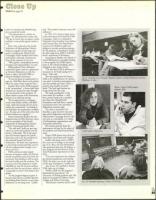
Sherri Umansky, Lisa Freiman, Suzanne Lipton, Andrea Freedman and Sue
Waldman in class.
Dr. Zvi Steinfeld teaching a Project STaR class.
2/6
1998
83