

Dream
Weavers
Barton
Call them visionaries or virtuosos,
this group of
up-and-coming Detroit leaders
makes things happen.
Without a doubt, these young Jews are con-
tributing something significant to the future of
the metropolitan Detroit community — from
business to politics to the arts or urban planning.
And simply by the way they are living their lives.
0
-
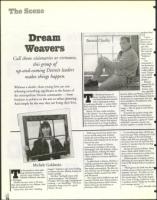
Michele Goldstein
he buzzwords in urban plan-
ning and historic preserva-
tion are "sense of place." For
Michele Goldstein, that place
is Michigan.
Michele has seen more in 28 years
than many people see in a lifetime. And
still, she marches forward.
Career-wise, she's not a "building
2/6
1998
76
hugger," looking to save every building
no matter the cost. Michele chooses her
battles carefully.
She likes "laid-back" places with
"good atmosphere," like Maria's in
Ferndale. She loves yoga, exercising and
creating — art, friendships. "The most
important thing is that I'm a good
friend," she says.
•
T
he Woodward Avenue of
Barton Charlip's dreanis is a
tree-lined boulevard centered
with a landscaped median.
It's pedestrian-friendly — a place where
folks stroll from restaurants to the the-
ater or the DIA.
Barton, 36, lives, works and plays
"on the Avenue," or in close proximity
thereof. He is the owner of Canfields on
Woodward, an upscale eatery just north
of Orchestra Hall. And he lives behind
the Arts Institute in a vintage building
that is home to young professionals and
With long, brown hair, brown eyes,
and an overall earthy look, Michele
stands tall, with smiling eyes that face
the future while looking out for the pre-
sent and the past.
"Part of my interest in [historic
preservation] correlates to the strong
upbringing I had with Judaism, respect-
ing your history, realizing the impor-
tance of your history," Michele says.
"We've already lost so many significant
buildings."
In grad school at Eastern, Michele is
creating a preservation plan for the city
of Rochester Hills (one of Michigan's
first settled communities). She also con-
sults with the city of Ferndale, to set up
an historic district around Nine Mile
and Woodward.
She makes artistic kiddush cups and
recently, Michele and a friend started a
faux finishing business called Creative
Spirit (check out the bathroom at
Rochester Hills Caribou).
si students from
CCS.
"I never
leave the city,"
Barton says
with a boyish
grin that
seems in con-
flict with his
penetrating
"bedroom
eyes."
"I'm
entrenched. I
eat downtown,
workout, and
I often walk to
work. I've got-
ten to know
all the street
people."
Barton's
passion for the
Woodward
Avenue corri-
dor, especially
between Mack and Warren, led him to
the presidency of the Midtown Business
Association, an organization that pro-
motes cleanliness, beautification and
security in the area.
"We're dedicated to recreating an
image — that it's good to come down-
town," he says.
To harness the positive energy that
he felt emanating from restaurateurs,
Barton created the Downtown Detroit
Dining Association, a group of "white
tablecloth" restaurant owners who
banded together to market the city's
In everything she does, Michele pre-
serves the past while creating anew. Like
with the legacy of her late husband
Adam, who died two years ago. They
met when they were 18 and were mar-
ried for 11 months when he was diag-
nosed with cancer. •
During 10 months of illness, Adam
wrote a book called Hidden Lessons,
about what he learned as a patient that
he didn't learn in medical school.
Michele speaks to medical students,
delivering the same speech Adam gave
at his U-M Medical School commence-
ment.
"We've gotten the book into the cu
riculum, set up a fund to get [it] out to
students," she says. "It's taken me two
years since he passed away to start to
feel normal again. [His death] shaped
how I look at things, pushed me to go
to graduate school. People say it's made
me a stronger person."
❑
— Lynne Meredith Cohn