

establishments.
Barton also sits on the board of
Motown Walk of the Stars. It's just
what you would think — a Hollywood
Boulevard-esque sidewalk of Motown
"stars," right down Woodward. "We
will soon vote on the first 10 recipi-
ents."
The food and hospitality business
has been a part of Barton's life since age
13 when he worked summers at The
Rib Shack on Maple and Farmington
Roads.
It seemed natural, then, after gradu-
ating from Michigan State, for Barton
to join the management program at
Max & Erma's — until romance led
him out to California, where the rela-
tionship floundered but Barton flour-
ished with The Four Seasons Hotel con-
glomerate. Four Seasons moved him
from Newport Beach to Seattle,
Chicago and Fort Lauderdale, where he
went back to school and "pondered
life."
It was a phone call from his dad in
1996 that brought Barton home. The
building that his grandfather bought in
1940, and from which the family
watched countless Thanksgiving Day
parades, was vacant. His dad wanted to
sell. But Barton decided to plunge into
the business.
That was 13 months ago and he has
no regrets. The hours are grueling but
the experience is once-in-a-lifetime.
Soon, Barton hopes to stop and
smell the flowers, planted along his
Avenue of dreams.
— Linda Bachrack
❑
Mitch Albom
e came to Detroit in 1985.
And he doesn't plan to
leave.
Mitch Albom, 39, has
lived everywhere. Still, he says, "You're
not doing anything more important
there than you're doing right here in
Detroit.
"I've been offered a lot of things over
the years, and every time I came close to
going, I ultimately came to the conclu-
sion that the news is no more real there
than in Detroit," says the Emmy award-
winning broadcaster, Free Press colum-
nist and WJR radio host. Oh, and
author and ESPN commentator.
"This is a place where people really
get involved with their writers [and]
broadcasters," says Mitch. "It's nice to
go to restaurants and see people hun-
kered over a cup of coffee, reading your
Mollie Rattner
I
magine a car interior that is so
exciting, so fantastic, maybe
even orgasmic, that it impacts
on the entire world of auto
design. "Think neoprene or leopard-
print velvet for seating," says indus-
trial designer and soon-to-be CCS
column and not just sports nuts —
grandmothers, kids. Or pull up to a
traffic light and have someone roll down
the window and say, 'That was really
funny what you said on the radio today.'
I don't think I'd get that in other
places."
Mitch writes about the big stars, and
the little ones. His best-selling book —
Tuesdays With Morrie
is about a pro-
fessor who taught him how to fully live
life, with meaning.
Speaking of meaningful, that does
not include casinos, in Mitch's opinion.
"I hope some of the success in our
suburbs spills back into the city," he
says. "I have always, always been an
enormous advocate of strengthening the
city; I don't believe that you can have
successful suburbs without a successful
city. It's sort of like having good tires on
a car that doesn't have an engine."
Mitch grew up in Philadelphia and
Boston (Brandeis University), knows
—
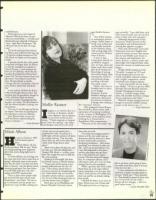
0 grad Mollie Rattner,
x 29.
One of few women
o in automotive interior
§ design, Mollie hopes to
bring crisp styling and
eco-friendly materials
to the industry, along
with cutting-edge inno-
vations and an off-beat
sense of humor.
A stint at Lear
Corporation should rev
up Mollie's imagina-
tion. At Lear, where she
began work three weeks
ago, she'll increase her
knowledge of seating
and textile design while
entering the world of
international design,
traveling to Europe
four times a year.
Mollie, who lives in
Franklin and is a devo-
tee of Rodger
Kamenetz' Jewish-
Buddhist dialogue and
mysticism, discovered
her interest in industri-
al design after making a
few "necessary" detours.
After graduation from Roeper,
she enrolled at Wayne State, with
aspirations of becoming a political
writer. A move to Washington, D.C.,
landed Mollie in the political arena,
Working for a Conservative
Republican Ohio congressman.
"Welcome to the real world," she
how cities can work.
"I'm always encouraging people to
behave as if the city could work, go
downtown, don't be afraid of it, move
in there, look at lofts and look at
developing waterfronts ... [But casino
gambling] is an absolute horrible mis-
take. I grew up around Atlantic City;
I saw what happened to that place,
and the only people who got their
lots in life improved were casino
owners. The same thing will happen
here. It's a desperate measure, and I
will remain a critic of it, even as I hope
and pray for the city's emergence.
"When I got here, they wrote a little
blurb about me in the paper before I
stared, saying this is our new guy. And
when I came up here a few weeks later,
there was mail for me already waiting
from people.
"I opened the letters, six or seven of
them. Almost every one of them said,
`We're glad you're here, we hope you
says cynically. "I got calls from rural
Ohio coon hunters and, for the first
time, I dealt with anti-semitism."
Although disappointed in her
associates, Mollie thrived on the
atmosphere and still dreamed of
voicing her opinion on paper.
Next stop: Montreal's Concordia
University, and more English and
political science courses. But money
ran out and Mollie came home to
her mentor and inspiration, her
mom, Bonnie, a creative writer and
playwright who helped Mollie redis-
cover her interest in architecture and
design.
Finally, Mollie braked at CCS.
"Actually, I escaped to CCS and
found people from all over the
world, incredibly talented teachers
and a highly competitive, world-
renowned auto design program.
"Color and textiles are my forte,"
says Mollie. "I'd love to get my MBA
through Harvard Business School's
Design Management Institute in
Boston, a veritable design think
tank, and possibly work for a design-
driven corporation like Nike."
With her unique background and
hunger to succeed, Mollie's sitting
square in the driver's seat.
Linda Bachrack
❑
.—
like it, we know you're going to leave,
but while you're here, enjoy it and just
don't leave too fast ...'
"I never understand why there's an
inferiority complex amongst people in
Detroit," Mitch says. "There shouldn't
be. They should be proud of where they
live. I've lived all over the world —
Europe, all over America — this is as
good a place as any." ❑
— Lynne Meredith Cohn
2/6
1998