

The JDC provides money for food
and clothing for the community, and
runs a clinic with visiting doctors and
medication donated by outside groups.
It also oversees the community-run
Sunday school, dance troupes, youth
groups and senior citizens groups.
Outside of Havana, the JDC and
the community have created small cen-
ters to attract Jews. Now there are 20
congregations outside of Havana, each
of which has from 10 to 30 families
who are actively participating in all
aspects of Jewish life.
Dr. Miller explained that the only
way to increase the Jewish population
is to reach out to more families. They
started out with 250 families, and now
over 500 families actively participate in
Jewish communal events.
Since 1992, there have been 100
conversions, mostly of children of
interfaith couples, 80 brit milah (some
of these are linked to the conversions)
and 50 weddings.
After the briefings, we took our bus
to South Old Havana, a neighborhood
that is not considered safe after dark.
We walked through the narrow streets
lined with crumbling buildings that
were once magnificent.
Our first stop was at Chevet Achim
synagogue. We climbed a narrow, steep
marble staircase that was punctuated
by intricately carved iron gates. The
walls were covered in brightly colored
Spanish tiles. The staircase opened into
a reception room that connects to the
social hall. Both rooms had peeling
blue paint on the walls and baseboards
of strikingly attractive tiles with blue
and yellow patterns. The social hall had
a bar area that resembled a 1950s soda
fountain.
The entire building had a leaking
roof, crumbling plaster on the walls
and light fixtures in the shape of Jewish
stars that no longer held light bulbs.
I could tell that the synagogue at
one time had been a thriving congrega- .
tion. I could almost picture the cele-
brations that took place in the social
hall and could almost hear the echoes
of the voices that at one time were lift-
ed in prayer.
However, today, the synagogue is
not in use. The community cannot
afford to sustain this building. Joseph
Levy, the president of the Sephardic
community, told us that the synagogue
was once a lively congregation. Then
the revolution came,
and one day no one
came back to the shul.
They did not come
back for 30 years. The
building stood empty
and unused during
those years.
Recently, all of the
synagogue's valuables,
including the Torah ,
scrolls, were moved to
the Sephardic Center
for safekeeping. Now
the ark stands empty
and the Ner Tamid has
been extinguished.
There were other
signs that this was once
violated. Will Recant of the JDC
a flourishing center of Jewish life.
explained that at one time there was a
There were bookcases filled with prayer
cult called the Yaruba who believed
books dating back to the late 1800s
that the crushed bones of Jews would
and an antique wooden cabinet filled
aid in their black magic, and they
with old, rusting, blue metal tzedakah
robbed many Jewish graves on the
boxes.
island.
After we left the synagogue, we
Mr. Recant also informed us that
walked a few blocks to the kosher -
when the JDC first began operating in
butcher. The butcher in Havana carries
Cuba in 1992, the cemetery was
only beef, which must be soaked and
owned by the government. The protec-
salted at home. Jewish people are
tive walls surrounding the burial site
allowed to use'their ration coupons at
had crumbled, and goats and wild dogs
the kosher butcher rather than at the
roamed freely among the gravestones.
grocery store. They are entitled to
Mr. Recant was about to lead the first
three-quarters of a pound of beef every
mission of American Jews into Cuba
nine days, when it is available. When
and he went to the government with
we were there, the butcher shop was
an ultimatum: "Either clean up the
completely empty
cemetery or I will never bring another
We left the butcher and rode on our
group into your country."
bus to the outskirts of town to the
Today, the wall has been replaced
Ashkenazic cemetery, which is called
and a guard is posted at the gates to
Bet HaChaim.
keep out trespassers of the two- and
Most of the
four-legged variety. We chanted Kad-
gravesites were well-
dish at the Holocaust memorial in the
kept. There were a
cemetery. Inside the memorial are
few broken head-
buried six bars of soap made from the
stones and some.
graves that had been human fat of Nazi victims.
We gathered all medications and
other
donated items at the hotel and
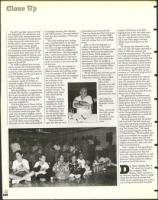
Left: Josef Levy,
loaded them onto the bus so that we
head of Havana's
could deliver them to "Il Patronato,"
Sephardic commu-
which
houses the Jewish Community
nity.
Center and a Conservative synagogue.
We entered the basement level center
Below: Jewish chil-
of the Havana Jewish community car-
dren lead a group
rying enough medication to stock the
in song at the
Patronato, or Jew-
clinic for about three months.
ish community
We then squeezed into the already
center.
full social hall. This hall, which was
once silent and empty, reverberated as
Cuban and American voices united to
sing "Am Yisrael Chad." We linked
arms and swayed together to the tune
of "Hinei Ma'atov." We all swelled with
pride as we watched the youngest chil-
dren perform a dance that they had
mastered in Sunday school. Then older
children showed off a dance that they
had created themselves.
Next, a troupe of teen-age girls per-
formed Israeli dances, complete with
traditional costumes that they had
sewn with material donated by an earli-
er mission. After the performances, the
American visitors joined the children
for spirited Israeli folk dances.
D
ay Three: Tuesday, Dec. 9
We visited the Conserva-
tive synagogue, Beth
Shalom, which is located in
the Patronato building. There is a small
chapel that has been renovated, and
which has air conditioning. It is a warm
and inviting sanctuary that is used for
1998
124
no