

ay One: Sunday, Dec. 7
Our group, led by Rob
Orley of Franklin and Robin
Toubin Stein of Houston,
Texas, met our chartered Air Cubana
flight on the runway at the Nassau air-
port.
At nightfall, we landed in Cuba.
Each of us had packed an extra
suitcase filled with medicine,
sheets, towels, clothing and
Chanukah items, and we had
been concerned that the medica-
tions would be confiscated by
the Cuban customs officials. Our
fears proved to be unfounded, as
we were whisked through cus-
toms with no questions asked.
As our group rode on our
modern, air-conditioned bus
through the streets of Havana for
the first time, I was 'struck by the
darkness of the city. In most
homes and apartments, there
were no lights. There were no
street lights and no lights on the
exterior of the homes and build-
ings to cast a warm glow on side-
walks and walkways. Neil, our
native Cuban guide, explained
that lightbulbs are scarce and
very expensive in Cuba.
I also felt that I had stepped
back in time. Most cars in
Havana date back to the 1940s
and '50s, although there are a
few modern Russian automobiles.
There is now a law that says a Cuban
citizen may not purchase a car; all new
cars are for the use of tourists or foreign
diplomats.
I can imagine that the city was once
a picturesque European-style jewel.
There have been no new buildings
built in Havana since 1951, with the
exception of a few luxury resort hotels
for tourists. The existing buildings have
not been painted or properly main-
tained in over 40 years.
The overcrowded living conditions
are almost unimaginable. If a person
owned a house or apartment prior to
the revolution (1959), and occupied
the house or apartment during the rev-
olution, then that person retained own-
ership. As a result, there typically are
three generations of a family living in
one apartment. Havana has an average
population of 47,000 people per square
mile.
When our group reached our hotel,
I was overwhelmed by the beauty and
luxury that surrounded me. In stark
contrast to all the buildings around us,
the Melia Cohiba hotel is a 3-year-old,
modern hotel with marble floors in the
lobby, which has spacious seating areas
surrounded by lush garden areas and
fountains.
As we stepped into the lobby, Lour-
dis Gittleman, a member of Young
Leadership Cabinet from Miami,
rushed into the open arms of her 95-
year-old Cuban grandmother. She had
last seen her grandmother seven years
ago in Spain. She also was greeted by
her aunt, whom she last saw 30 years
ago when her family left Cuba for
Panama. She immediately left with her
family to meet her cousins and their
children for the very first time.
After the revolution, the government
declared that loyal Communist Party
members did not need religion. As a
result, the community lived for almost
30 years with no Jewish life. Jewish tra-
ditions were completely abandoned.
The Canadian Jewish Congress
never stopped supporting the Jewish
ay Two: Monday, Dec. 8
community in Cuba. Every year, they
After our appetites were
sent Passover matzah to the Patronato,
sated, we headed to a brief-
the Jewish Community Center, and the
ing room in the hotel where
people would gather there each Pesach
we met with Dr. Jose Miller, president
to receive their matzah. For many, that
of the Havana Jewish Community, and
was the only contact they had with
Diego Mendlebaum, the cur-
Judaism.
rent Joint Distribution Com-
•
In 1991, the government
mittee (JDC) shaliach assigned
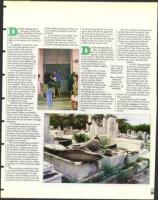
Left: The group
decreed that practicing reli-
to Cuba.
paid a visit to
gion would be tolerated,
Havana's lone
Dr. Miller, who is 72 years
and Dr. Miller decided to
kosher butcher.
old, retired from medical prac-
try to turn the tide and cre-
tice three years ago. His father
ate an active community.
Below: Havana's
was from Lithuania and his
He wrote a letter to the
Ashkenazic
mother was from Poland.
JDC
asking for help. The
cemetery, Bet
They both fled Europe and
JDC
saw
that there were
HaChaim, is
arrived in Cuba seeking refuge.
1,600
to
1,800
Jewish peo--
undergoing a slow
Dr. Miller has been work-
ple
in
Cuba,
many
of whom
renovation.
ing tirelessly since 1992 to
had no idea what it meant
revive the Jewish community
to be Jewish. Outside inter-
in Cuba. He informed us that in the
vention was crucial for the survival of
early 1960s, 90 percent of the Jewish
this community.
community emigrated to the U.S. They
Today, 80 percent of the Jewish
did not want to live in a socialist coun-
community lives in Havana. There are
try. There has been no history of anti-
three thriving synagogues: Conserva-
Semitism in Cuba, and there is no
tive, Orthodox and Sephardic. Each
indication of anti-Semitism in Cuba
week, each congregation holds Shabbat
today.
services.
D