

small gatherings. The main sanctuary,
which could seat up to 800 people
when the balcony was usable, has dark
brown wood paneling on some walls,
but most of it has been removed
because it had been eaten by termites
during years of neglect. The roof leaks,
the balcony overlooking the main floor
is sagging, the seats are rotted and the
windows above the Aron Kodesh are
broken.
The bimah is still an impressive
sight, and well-attended services are
held here each week. The Sunday
school meets in the renovated classroom
in this building. The JDC provides a
bus to transport children back and forth
to Sunday school and to all community
programs.
Adella Dworin shared a brief history
of the Cuban Jewish community. It was
interesting to hear that from the 1920s
to the 1950s, the same Jewish organiza-
tions were active here as were
active in the U.S. — HIAS, the
JDC, a clinic, drama club and
Hebrew schools enhanced the lives
of Cuban Jews. In 1925, there
were 8,000 Jews in Cuba; by
1952, there were 15,000. Today,
there are 1,800.
Many came from Eastern
Europe through Cuba to get into
the U.S. but were unable to enter
the country. The economy in the
community was based on the
import and export of sugar as well
as peddling and small businesses.
In the '40s, Jews from Antwerp
immigrated and introduced a diamond
industry into the economy. By 1959,
the community had dwindled to one-
tenth of its former size.
After lunch, we headed back into
Old South Havana to visit the Ortho-
dox shul. As we entered the sanctuary;
we were greeted by a crowd of men and
women, and were formally welcomed to
the synagogue by the president of the
congregation and the head of the
Chevre Kadisha.
The synagogue boasts a renovated
small chapel in the basement, which is
used every Shabbat, the only mikvah in
Cuba and a large sanctuary in dire need
of repair.
Prior to our leaving home for Cuba,
Eugene Sherizen received a message
from his father, Paul, telling him to
look for Solomon Gonte, a relative of
Nick Gonte of Farmington Hills. Mr.
Sherizen found him at the Orthodox
shul. Mr. Gonte's wife was too ill to
accompany him, but we were able to
bring back pictures and an address for
Nick Gonte. Nick Gonte has not seen
his first cousin for 15 years. Nick's
father and Solomon's father were broth-
ers.
Nick Gonte's family left Cuba in
1938 to come to America. Solomon has
brothers and sisters who live in Cuba,
Canada and the U.S. Solomon had the
opportunity to leave Cuba just after the
revolution, but he would not leave his
elderly father, who had reached the age
of 103.
Before the war, Solomon produced
picture frames. After the revolution, the
government seized his business and his
bank accounts, and assigned him to be
a farmer. Now he leaves his house at 3
a.m. every day to take a public bus to
the fields where he works until 6 p.m.
D
ay Four: Wednesday, Dec.
10
After another filling
breakfast at the hotel buffet,
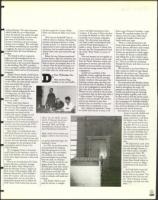
Above: Dr Jose Miller (center),
leader of Havana's Jewish com-
munity, with Neil the UJA
tour guide (left), and Diego
Mandelbaum, shaliach with the
Joint Distribution Committee.
Right: Inside Chevet Achim syn-
agogue, which is now not in use.
our group descended upon the
Sephardic Center.
In 1995, the Jewish commu-
nity purchased the building
from the government. It was
falling apart: The roof leaked,
the windows were cracked,
paint and plaster were peeling
from the walls. In February
1996, a mission visited the syn-
agogue from Zaire, and they
donated paint and other materi-
als needed to rebuild the small
chapel and a social hall. The
main sanctuary, which had been
used as a theater, still needs ren-
ovation.
The chapel, which is now
used for services, is a bright
room, with light streaming in from
windows. It has rows of chairs that face
an ornate ark flanked on either side by
intricately carved antique mahogany
chairs. The silk curtain that obscures
the Torah scrolls is embroidered with
colorful threads depicting lions of
Judah, a crown, flowers in bloom, Jew-
ish stars, the Ten Commandments and
the words "Keter Torah" or crown of
Torah.
Men and women can sit together in
the sanctuary, but women cannot read
from the Torah. However, women can
participate in services, and each week,
Shabbat services are led by one young
man and one young woman from the
congregation.
Joseph Levy, president of the
Sephardic Center, explained that each
Shabbat, 30 to 40 of the 80 member
families worship in the sanctuary. The
building is always open, but they con-
duct services only on Shabbat. If some-
one in the congregation is saying Kad-
dish, then they call people to come in.
Women are not counted in the minyan,
so sometimes they are short and create a
"Cuban minyan" by lining up Torah
scrolls to count as people. He says that
all Jews are welcome to pray here,
whether they are members or not, and
whether they are Sephardic or not.
After visiting the Sephardic Center,
we visited what may be to some a dif-
ferent type of house of worship: a cigar
factory. We watched workers sort the
tobacco leaves by color, while others
weighed the bundles of leaves and
hand-rolled each cigar.
There is a table positioned at the
front of the main factory floor which is
used by factory officials to read newspa-
pers to the workers each day. Factory
workers are permitted to smoke cigars.
As a result, the factory is smoke-filled
and stifling hot, as the windows open
only a crack to allow in a bissel of fresh
air. There is no fresh air circulating
through the factory and there is no ven-
tilation system.
We returned to our hotel where we
had a caucus in which we each shared
what the trip meant to us. The caucus
began in earnest when Rob Orley spoke
passionately about what we had
encountered on our trip.
He commented that Shabbat dinner
is a time that his entire family looks for-
ward to throughout the week. He
pointed out that the ritual of eating
challah and performing the blessings
brings his family together each week.
He then told us that the Jewish people
in Havana meet every Friday evening at
their synagogues for Kabbalat Shabbat.
But because they cannot afford challah,
they welcome Shabbat with matzoh left
over from the Pesach donations.
Rob asked us to each contribute
money to provide challah and
chicken so that each syna-
gogue could host a real Shab-
bat dinner every Friday for a
year. We would need to raise
$12,000. We were so moved
by Rob's words, and those of
the other mission participants,
that we raised $18,000, and
the Havana community will
have challah, chicken, wine
and candles every Friday for a
year.
We dispersed to catch a few
hours of sleep before our final
bus ride through Havana to
Jose Marti airport. Goodbye
to communist Cuba. We
landed in Nassau and said
tearful goodbyes to our new-
found close friends before we
scattered to catch our flights
to destinations all across the
U.S.
As I look back on my trip
to Cuba, the words of Dr.
Miller echo in my mind: "You
see poverty here, but not mis-
ery. That is because we have
two things: our faith and each
other."
❑
1/16
1998
125