

•
A World Class So
R
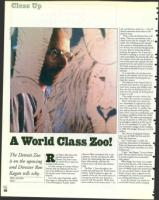
The Detroit Zoo
is on the upswing
and Director Ron
Kagan tells why.
PHIL JACOBS
Editor
10/17
1997
on Kagan talks about the
pioneer nature of the
Detroit Zoo, how it was
one of the first to share its
animals without bars.
It's that concept of a home without
barriers that has helped pull the zoo
out of the doldrums to become one of
the nation's most visited and most
beloved.
It's a cold, rainy September night.
Ron Kagan is talking from the bimah
of the Birmingham Temple. Rabbi
Sherwin Wine introduces him to the
audience. For the next hour, he talks
about the relationships that man must
have with animals, and how the
Detroit Zoo is all about that relation-
ship.
On Nov. 1, Jews throughout the
world will read from the Torah Portion
Noach. They'll rediscover again the
miracle of the ark, the continuation of
the species and how man learned to
survive with the animals. While there
were confines in the macro sense — an
ark, and barriers, man's sin — the ark
floated otherwise barrier-free in the
physical sense.
This is what the Detroit Zoo is all
about. There are not barriers in the
classic sense, bars for example. Yet, it is •
man's way of looking at the animals
that creates or disassembles any barri-
ers. If man sees animals through preda-
tor eyes, than he erects the barriers
between the species. Yet, if man sees
himself as needing to co-exist with ani-
mals successffilly, the barriers fall. After
the mission of the Ark was finished, it
was at that point the animals were dis-
persed into the real world. It was then
the Torah mentions that God teaches
man that he shouldn't harm or torture
animals.
In a sense then, it's not how man
looks at the animals, but it's how man
looks at himself concerning the ani-
mals that counts.
The mission of the Detroit Zoo is
to break those barriers. The goal is to
teach men, women and children that
they not only are looking at the ani-
mals, but the animals are looking back
at them as well.
They might not see a mirror, but
they reflect the need for co-existence.
Plenty of people have visited the
zoo. Attendance is expected to reach
some 1.2 million by the end of the
year. This is up from 1.1 million last
year, and an increase of 60 percent
from 1995. Gone are accreditation and
attendance problems of the late 1980s
and 1990s. The main zoo's attendance
was up 16 percent in 1996 over 1995.
Its attendance placed it in the top 10
of the 170 accredited U.S. zoos. The
zoo mustered a budget of $2.3 million
in 1986. The budget this year is at $10
million.
The Detroit Zoological Institute
also runs the Belle Isle Zoo and the
Belle Isle Aquarium.
Just 14 years ago, in 1983, the
American Association of Zoological
Parks and Aquariums denied accredita-
tion to what many remember as a tired
looking zoo.
"A zoo," says Kagan, "is not a theme
park. We are mission-driven. Our goal
is to help connect our community
with nature."
What Kagan also wants us to under-
stand is that this zoo, with a main cam-
pus in Royal Oak, is a center in the sci-
ence of wildlife study and conservation.
Yes, one can find Candy, a 4-year-old
female Grevy's zebra, a species on the
endangered list. Detroit Zoo scientists
are working elsewhere as well.
It was the Detroit Zoo which res-
cued Pacific Partula snails, bringing
•