

them back from the brink of extinc-
tion. It was the Detroit Zoo which
took Wyoming toads, a critically
endangered amphibian, bred them in
Detroit and reintroduced them in the
wild. Detroit Zoo scientists and
researchers are involved in animal con-
servation in Peru and other places
around the world.
Kagan, who grew up in a Jewish
home in Boston, came to Detroit from
the Dallas Zoo. He doesn't like to talk
about himself. He turns the conversa-
tion mostly towards the zoo. But what
Kagan doesn't understand is that by
talking about the zoo, he is talking
about himself. He studied science at
University of Massachusetts at
Amhearst and zoo management at
North Carolina State.
"I've always loved animals," he says.
"But I'm not a part of the public who
feels nature is something we own and
dominate.
"I wanted the Detroit Zoo to be a
real player in the area of conservation.
I wanted it to provide meaningful
experiences to this community, and I
wanted it to contribute to the science
of wildlife.
"What I didn't want was an aging
zoo that appeared to lack attention,
he says. "We wanted this zoo to be a
world-class institution. Our thinking
was simple. We have to be a leader in
everything we do.
"We need to treat nature like we
treat art," he says. "Nature is full of
masterpieces."
The Wildlife Interpretive Gallery at
the Detroit Zoo was made to do this,
to provoke people into really thinking
about their own relationship with ani-
mals.
During his talk at the Birmingham
Temple last month, Kagan discussed
the ethical treatment of animals. It
wasn't just a speech. It was a plea.
There was power behind his gentle
voice coming from the bimah, a love.
His audience sat transfixed by his
mantra: "Everything has its place." •
He also discussed what it was like to
have a zoo near an urban center.
There's "Katy, the crack house lion," a
wild animal who was found guarding a
drug house in Detroit. Now Katy lives
at the Detroit Zoo.
There was the monkey taken from a
stripper who used it as part of her act.
"We're more involved with this sort of
rescue than any other zoo in the coun-
try," Kagan says.
There are many times when people
try to raise tigers and lions as pets,
having them de-fanged and de-clawed.
It makes it difficult to place such an
animal with others of the same species.
"They do bond to us, but we need
them to bond to other animals," he
says.
Animal issues, he says, bring out a
tremendous passion in people.
"Animals are an integral part of our
own relationship with the earth."
The Detroit Zoo's relationship with
the state of Michigan is integral. The
zoo is the No. 1 tourist destination in
the state. Some 160,000 students from
2,800 Michigan schools came on field
trips to the zoo in 1996.
But this wasn't always the case with
the zoo, or any other zoo for that mat-
ter.
"Zoos were private and closed," says
Kagan. "Zoos were initially freak
shows. But what we've learned is that it
isn't enough to be popular or to be
fun, a zoo has to be meaningful also.
action with animals. There is also a
2,000-gallon coral reef aquarium,
which brings attention to endangered
environments. There are two interac-
tive areas, an interpretive theater and a
butterfly and hummingbird garden.
In Kagan's cavernous office is an
aquarium with blue and yellow dyeing
dart poison frogs hopping around the
foliage. Occasionally, one will press up
to the aquarium glass as if it were lis-
tening to the interview. A huge plush
polar bear sits on a shelf in the room.
Kagan leaps to his feet, goes to the
nearby television and VCR and proud-
ly shows what will one day be a state-
of-the-art polar bear and seal exhibit.
Visitors will be able to walk through
an underwater glassed-in chamber and
watch bears on one side and seals on
the other swim about.
Kagan showed this reporter the
"
tial. And what we did was bring
together people who were passionate
about the mission of the zoo."
Kagan was asked if the zoo is ever a
burden on the city of Detroit, a
municipality with fiscal and image
problems that still have to be over-
come. He responds that the zoo has
been in recent years a good example of
how a public institution can thrive.
But he also says that he didn't think
Detroit gets the respect it deserves.
"A public institution can thrive, a
city institution can thrive," he says.
The other issue Kagan loves to
point to is the Detroit Zoo doesn't get
most of its animals from nature.
Instead, almost every animal at the zoo
was born at the zoo.
A favorite animal?
"I'm a little like a parent," he says.
"I don't have a favorite child. In fact, I
don't look at these animals as if they
are my pets at all. I have a heavy
respect for all wildlife. Again, looking
at it as if it were art, you don't have to
touch or own a great masterpiece to
appreciate it. This zoo is filled with
masterpieces.
"For us, it's about understanding
our place in the world with ... these
masterpieces."
❑
Quick Zoo
Facts
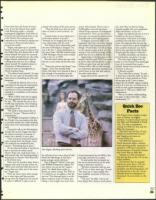
Ron Kagan: Breaking down barriers.
An old type of zoo was a place of exhi-
bition for odd things. It was like a
giant postage stamp collection."
One of Kagan's "babies" is the pop-
ular Wildlife Interpretive Gallery. It's
here where one can see the "master-
pieces" he talked about earlier in
almost an artistic setting. The WIG as
it is called has an art gallery, a first for
any zoo. The showcase piece is an ele-
phant sculpture made of bullets, pro-
viding a cruel insight into man's inter-
visual presentation for the WIG a few
years ago, and now it's a reality.
He said earlier that he doesn't see
the zoo as entertainment in the same
terms as television would be.
"We don't remember what we saw
on TV two or three years ago," he says.
"But there are so many people who
have indelible memories of their zoo
experiences.
"This zoo," he adds, "was at one
time sleepy. But it had so much poten-
The Detroit Zoo is largest compo-
nent of Detroit Zoological
Institute. It consists of 125 acres at
Ten Mile and Woodward in Royal
Oak. The other components
include the Belle Isle Zoo and the
Belle Isle Aquarium.
The Belle Isle Zoo is a 13-acre
facility located between Central
and Tanglewood streets on
Detroit's Belle Isle.
The Belle Isle Aquarium is
North America's oldest, continu-
ously operating public aquarium. It
opened in 1904 and is located at
the intersection of Inslruhe Avenue
and Loiter Way on Belle Isle.
Opened in 1928, the Detroit .
Zoo was the first in the U.S. to use
barless exhibits.
The Detroit Zoo is a natural
habitat for more than 1,250 ani-
mals and 700 varieties of trees,
shrubbery and flowering plants. Of
the 266 species at the zoo, 54 are
officially listed as endangered or
threatened. Two are extinct in the
wild.
10/17
1997
89