
Balfour At The Opera
The ZOA's annual concert
takes the stage at the Michigan Opera House.
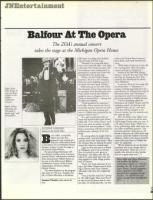
Right: Bruce
Adler brings his
song and dance
routines to the
Balfour
Celebration
Concert.
Below: Chava
Alberstein, the
rst lady of
Israeli song," will
also perform.
SUZANNE CHESSLER
Special to The Jewish News
B
ruce Adler, a song-1nd-
dance man who has
appeared with touring pro-
ductions of Broadway shows
at the Fisher, Fox and Meadow Brook
theaters, is about to take the stage at
the Detroit Opera House.
His upcoming performance will
mix favorite numbers from American
musical theater with favorite numbers
from international Yiddish theater as
he stars in the 64th annual Balfour
Celebration Concert of the Zionist
Organization of America-Metro
Detroit District.
The other headliner in the program
that starts at 7:30 p.m. Tuesday, Oct.
28, is Chava Alberstein, a 46-album
Suzanne Chessler writes about the
arts.
folk music recording artist dubbed
"the first lady of Israeli song."
"Primarily, I'm a song-and-dance
man in the vaudeville style," said Adler,
a two-time Tony Award nominee with
show business roots reaching back to
grandparents, parents and uncles who
entertained on the Jewish stage.
"When I do the Yiddish theater
material, I do it in a very energetic,
fresh way, and I Anglicize a lot of it
for those who don't speak Yiddish."
Adler picks up on the style of the
late showman Danny Kaye and stress-
es versatility when describing his own
work, which recently has included
using his voice, in disguise, for two
Disney animated films — Beauty and
the Beast and Aladdin.
"Thank goodness for nepotism,"
said Adler, whose parents put him in
vaudeville sketches when he was still a
preschooler. His first speaking part
was in a Yiddish play produced by his
parents when he was 7.
"As a kid, I performed with my
mom and dad and other great artists,"
Adler said. 'A lot of the artists I recol-
lect in my show are artists I actually
worked with and saw perform. I truly
have a connection with the material so
audiences get a glimpse of the real
thing."
As a young adult, he sought roles in
summer stock, and then had to inter-
rupt his career with Army service. After
the Vietnam War, he directed his talent
toward the American musical stage.
"I got my first real part in a revival
of Oklahoma, and it was in Detroit
that we learned we were going to
Broadway," said Adler, who met his
wife of 14 years while they were star-
ring together in a San Diego produc-
tion of Cabaret.
"I have very fond memories of act-
ing at the Fisher Theatre and of work-
ing in Detroit with Tony Orlando,
who had a talk show that originated
there.
"I was at the Fox with Tim Conway
in The Odd Couple. There were five of
us who loved the horses, and on mati-
nee days, we would pop into a car and
rush to the Detroit Race Course to
have dinner and watch the first four
races.
"We'd make it back just in time for
the evening show. After the perfor-
mance, we'd go to Greektown."
Sunday in the Park With George,
Rumors, Crazy for You and Those Were
the Days are among the New York
musicals that showcased his talents
after Oklahoma.
In concert, there are two songs that
he always does — "Rumania," a
tongue-twisting song believed to be a
big influence on Danny Kaye's style of
fast-patter lyrics, and "Hootsatsa,"
developed to recall the rhymed cou-
plet songs popular in Yiddish theater.
"I have a recording called An
Evening at the Yiddish Theater, and I'm
making a sequel, An Evening at the
Yiddish Theater, Act II," said Adler.
"The first will be available at the
Detroit concert, but the second won't
be ready by then."
After the Motor City, Adler's next
big project is a show he will be tour-
ing through Florida early next year. It
will salute Danny Kaye. While he is
busy performing, Adler takes time out
for other worthwhile pursuits. "My -
personal attention often goes to the
board of directors of a New York orga-
nization called the Yiddish Theatrical
Alliance, which is the Actors Fund for
those who have been in Yiddish the-
ater," he explained.
"We do whatever we can for those
members who are no longer able to
help themselves. There are a lot of
people who thrived in their heyday
but are in great need now." El
Scanned image of the page. Keyboard directions: use + to zoom in, - to zoom out, arrow keys to pan inside the viewer.
October 17, 1997 - Image 103
- Resource type:
- Text
- Publication:
- The Detroit Jewish News, 1997-10-17
Disclaimer: Computer generated plain text may have errors. Read more about this.