
Piano Man
ALICE BURDICK SCHWEIGER
Special to The Jewish News
F
or a while, Andrew Lippa's
biggest dilemma was decid-
ing which direction to take
his show business career.
With a full resume that includes
pianist, singer, actor, musical arranger,
conductor, composer and lyricist, the
multitalented former Oak Parker
knew he had to narrow his pursuits.
Now, with a promising musical in
the works and a plum role in an Off-
Broadway show, it looks like his title,
for the time being anyway, will be
actor/composer.
Beginning Oct. 21, Lippa will be
playing one of the leads in Two Pianos,
Four Hands, a two-man show about
aspiring classical pianists, at the
Promenade Theater in New York. The
show boasts two separate casts, and
Lippa will be appearing in the second
company once a week and acting as an
understudy the other days.
That gives him time to work on his
own original musical, The Wild Party,
which he is trying to get produced.
Based on a 1920s little-known poem
by Joseph Moncure March, The Wild
Party is about Queenie, a sensitive
vaudeville dancer, and her lover, Burrs,
a violent-tempered circus clown.
One night following a vicious
argument, they throw a party and
invite their eccentric friends. As the
evening progresses, the party turns
wild and ends with a fateful tragedy.
Lippa wrote the script, music and
lyrics.
"It's very exciting for me — all the
things that are beginning to happen,"
says Lippa, who moved to New York
almost a decade ago. "If the theater
gods are smiling, Two Pianos, Four
Hands will have a very long run, and
my play will make its way to
Broadway."
While Lippa's career may be bub-
bling now, he is far from an overnight
success. Born in Leeds, England, he
moved to the United States when he
was a young child. His parents,
Ronald and Naomi Lippa, were
British, and moved to Oak Park
Alice Burdick Schweiger is an Ann
Arbor based freelance writer.
-
17
7
because they had family living in the
Detroit area.
Lippa developed an interest in the
arts early on: Throughout his school
years he studied voice and piano, was
in a men's choir, performed in school
plays and sang in a quartet. "I did
everything that I could musically,"
says Lippa, who attended Pepper
Elementary, Frcist Middle School and
Oak Palk High, where he was one of
11 kids in the state of Michigan
selected to compete in the Michigan
School Vocal Association competition.
When it was time to enter college,
Lippa went to the University of
Michigan and majored in voice and
education. On the advice of his good
friend Jeffrey Seller, a producer of Rent
and also an Oak Park High grad,
Lippa expanded his musical horizons.
"I was playing piano and singing,
and Jeffrey suggested that I write a
musical as well," he recalls. "Until
then, I had never pondered writing.
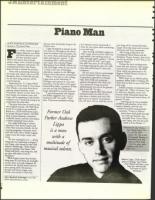
Former Oak
Parker Andrew
Lippa
is a man
with a
multitude of
musical talents.
So I listened to him and started to
write my own shows while continuing
to act and sing."
After earning a bachelor's degree in
1987, Lippa moved to New York City
and landed a job teaching music to
fifth- through eighth- graders. "I loved
working with the kids," says Lippa.
But after four years, he left teaching
and began playing the piano for audi-
tions and performing in various pit
orchestras.
He was music director and arranger
at the Goodspeed Opera House in
Connecticut, appeared at Carnegie
Hall, Town Hall and numerous
cabarets throughout New York City.
'As it turns out, being an accom-
plished pianist was one of the greatest
gifts in my life," he says.
His first original effort that earned
national acclaim was John 6- Jen, a
play about a brother and sister who
grew up in an abusive environment.
Jen, the sister, tries to mold her son in
the image of her deceased brother.
Lippa wrote the music and co-wrote
the book with Torn Greenwald.
After being produced at the
Goodspeed Opera House and the
Berkshire Theater Festival, John 6. Jen
ran for six months in New York at the
Lamb's Theater.
Perhaps the most exciting event
came this past summer, when Lippa
received rave reviews for The Wild
Party, which was showcased at the
Eugene O'Neill Theater Center in
Waterford, Conn.
While there are no definite plans,
producer Jeffrey Seller is helping The
Wild Party to find its way to the New
York stage.
Judaism remains an important part
of Lippa's life. "When I'm home, I go
to shul every Shabbos, and I even
hosted a Rosh Hashanah dinner last
year at my house and invited about 10
guests," - he says.
Growing up, he was a member
of BBYO and president of his AZA
chapter, Samson, and was very
involved in Jewish extracurricular
activities. "I went to Hebrew
school from third grade through
the 10th and learned a lot,
especially from Cantor Klein,"
says Lippa, who was bar mitz-
vahed at B'nai Moshe. El
Andrew Lippa: "If the theater
gods are smiling, Two Pianos,
Four Hands will have a very
long run, and my play
will make its way to
Broadway"
Scanned image of the page. Keyboard directions: use + to zoom in, - to zoom out, arrow keys to pan inside the viewer.
October 17, 1997 - Image 102
- Resource type:
- Text
- Publication:
- The Detroit Jewish News, 1997-10-17
Disclaimer: Computer generated plain text may have errors. Read more about this.