

A Marriage
In Deep Water
Kashering the kitchen almost tore us apart.
JULIE EDGAR SENIOR WRITER
A
tiny spatula flew across
the room, jettisoned from
the dishrack when David
slammed down his fist in
a rage. "I can't take it anymore!"
he yelled, abruptly turning off the
spigots of the kitchen sink and
stomping out the door.
I picked up the spatula and
brought it to the sink. "Do I have
to toivel this again?" I asked my-
self as the house vibrated from
the slamming door.
This was the beginning of
married life, and our first real
choice as husband and wife: A
happy home or a kosher home?
At the mikvah toveling trough,
we dutifully dunked every new
piece of silverware, every pot and
pan, every bowl and plate, every
measuring spoon and cup, every
appliance attachment, every plat-
ter, every whisk and every spat-
ula. We took turns — one toveled,
the other washed. It took hour af-
ter weary hour.
(According to Ortho-
dox specifications, all
new and some old dish-
es and utensils require
dunking in the mikvah
to officially transfer
ownership.)
My patience wore
thin. Our kitchen was
stacked with cartons stuffed with
grimy dishes. Balled-up news-
paper littered the floor. Our sink
was in perpetual use, making it
impossible even to fill the teapot
for boiling water. The countertop
seemed to bow under the weight
of drying dishes, as did the din-
ing room table.
And, just when we thought
we'd toveled everything, we un-
covered another cup or received
another platter from a distant
relative that needed dunking.
Would it never end?
Hours at the mikvah and the
sink lay before us. And after get-
ting a glimpse of the bottom of
the mikvah tub, both of us car-
ried a memory that couldn't be
washed away. Even if we Ivory-
soaped it, could we be sure we
killed the organisms that lived
in that tub?
The pleasantness of shared la-
bor turned to paranoia. As I
loaded another box into the sink,
I wondered: Did he really tovel
this bowl or did he just say he
did?
We bought paper plates and
plastic silverware, so we could
avoid wrecking that which had
taken us so many hours. That
didn't prevent a fallout.
Living as we had for months
— weaving through gift boxes
stacked everywhere and chasing
those hateful styrofoam packing
worms with a broom — I couldn't
take the disorder any longer. It
was one thing to boil our old
plates and silverware and coun-
tertops and sink, scrub an en-
crusted old oven and reorganize
shelves; it was another to tovel
everything while we tried to a)
settle into married life and b) not
break anything. I was agitated.
So there we were in the
kitchen, he at the sink casually
washing, me breaking down box-
es and wiping down shelves. He
was moving too slowly, it seemed
to me. If he only washed faster,
we could do two or three loads of
dishes, rather than one. I sug-
gested he pick up the pace. I
knew then what eyes look like
when they shoot daggers.
That's when he staged a strike,
storming out of the house while
graters, can openers,
carrot peelers, zesters
and forks, knives and
spoons sat in a twisted,
gleaming pile in the
sink (which, it occurred
to me, wasn't clean
enough).
He returned an hour
later, still mad. The
next day, in a kind of toveling-in-
duced stupor, he admitted that
he had been washing too slowly.
A week later, toveling was a
faded memory, but neither of us
could eat without being stricken
by a sense that we were doing
something wrong.
And one night, David woke up
yelling: "Yadda, yadda, yadda,"
or "Yah, yah, yah" or "Yo, yo, yo."
In the morning he described a
night twisted by nightmares of
kashrut. His subconscious had
become a receptacle for the flot-
sam of two straight days' worth
of reading on kosher laws and
two weeks' worth of toveling.
The nightmares have passed,
thankfully. But now both of us
have become insufferable. He has
assumed an annoying piety,
making it known whenever pos-
sible that his standard of kosher
is rising higher by the minute. I
have become a bore, rattling on
about eating whenever I get the
chance.
In the end, we don't regret our
decision to go kosher. We know
we'll grow into it. We feel good
about it. It's a big mitzvah. It's
not as hard as we thought it
would be.
And happily, both of us are
getting thinner. ❑
We 're
awa sh in
toive ling.
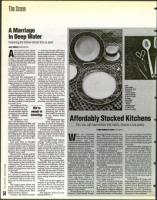
Left:
From Sango
Stoneware, four
settings of
"Spring Jewel"
sells for $39.98
at Wells Freight
& Cargo.
Cambridge
Flatware's
"Strata"
collection goes
for $49.97 for
service for eight.
Affordably Stocked Kitchens
You, too can have dishes that match, despite a low salary.
LYNNE MEREDITH COHN STAFF WRITER
W
hen you graduate
from college, it's time
to leave those plastic
plates and mis-
matched silverware behind. The
real world necessitates a real
kitchen, in which you feel com-
fortable cooking for guests.
But how do you stock your
kitchen on a low salary? Know
that you can build a solid
kitchen for under $300 — even
if you keep kosher. You just
have to know where to shop.
Stores like Meijer, Target and
Amazing Savings are good
places to start. At Amazing Sav-
ings, a national chain owned
and operated mostly by Ortho-
dox Jews, you can find four-
place-setting sets of Mikasa and
other big-name dishes for
around $40. Packaged sets of
stainless flatware cost any-
where from $8.99 to 24.99 for
four place settings, and they
also sell serving pieces, utensils
and low-cost crystal.
"Everything we have is a
closeout," says Sandy Singal,
Amazing Savings' general man-
age r. "We have contacts with
the manufacturers, and through
brokers and liquidators. Our
[items] are all name brand, usu-
ally not defective, not seconds
usually the company is either
changing a pattern or just
changing the packaging."
Bargain-basement megas-
tores like Target and Meijer
have big kitchen departments,
with dish sets, as well as those
you can buy in individilql pieces,
and sturdy, stainless steel serv-
ing utensils.
Target also sells beautiful ce-
ramic serving platters for
around $15. At Meijer, you'll
find boxed sets of drinking
glasses and well-made pots and
pans. This is the place to go to
buy a large soup pot.
But first, recognize that you
don't need everything right
away. Walter Goodman, co-own-
er of Wells Freight & Cargo in
Birmingham, suggests starting
with four place settings of dish-
es and silverware, a seven-piece
set of pots and pans (including
at least one good frying pan, two
sizes of sauce pans and a small
dutch oven), bakeware that is
also microwaveable and a good
tea kettle.
Kathie Pietrosld, manager of
Kitchen Glamor in West Bloom-
field, advises buying a "basic
five-, six- or seven-piece cook-
ware set, because the sets give
you a better value for your mon-
ey. You can always add more
pieces. Here, the man.u.factur-
er - discount the sets over the
open stock price, and we put
them on sale on top of that."
Kitchen Glamor sells a basic set
by Chantal for $199.99; the pots
are enameled and can be used
in the oven, on the stove and as
serving pieces.
Wells Freight & Cargo sells
dependable heat- and break-re-
sistant items, including an ex-
tensive line of decorative glass
dishes by J.G. Durant that re-
ally don't break (Goodman
throws an occasional dish on the
floor just to demonstrate).