

or older, I think there is sibling
rivalry when [one] gets married
first, and I think anyone who
says otherwise is full of [it]. In all
family relationships, there are
natural jealousies and competi-
tions," Dorfman says.
Sandy Rockind's younger sis-
ter, Carin, is getting married in
September. The 26-year-old old-
er sib says she never thought her
22-year-old little sis would get
married first, "but she and her
fiance have been together since
she was 18, so after two or three
years, it became obvious that she
would get married first."
"I thought I would be really
upset, but I was so excited for my
sister," Rockind says. "I don't
think I've ever seen her so hap-
py. I think I dreaded [her en-
gagement] more before it
happened — that I would feel
alone, old and very single."
"But actually, I felt happy. I
got caught up in the planning of
the wedding and was buying her
tons of bridal magazines."
Rockind sees differences be-
tween her friends and those in
her sister's circle. "My sister's
friends were very much looking
forward to getting married out
of school, whereas my friends
and I were looking forward to
traveling and establishing our
careers," she says.
And, seeing her sister with the
right mate has made Rockind re-
alize how important it is to wait
for the right person.
"I watch my sister and her fi-
ance as they plan their life to-
gether, and I realize I don't want
to get married until I find my
other half. They are each other's
other half, and I want to find
somebody like that for me," she
says.
Older brother Neil Rockind,
28, never had a competitive re-
lationship with his sisters, but
he knows of families where sib-
ling strife is common. "Pm sure
in those families, there was ex-
traordinary anger and jealousy
over the younger sibling getting
married first," he says.
While he one day wants to
marry and have children, it is not
a current priority. "I'm not out
there everyday trying to make it
happen. If I was ... then I assume
that I would be jealous that my
younger sister was getting mar-
ried first," he says.
"I can't tell you that when I
walk down the aisle ... and see
my sister on the bimah about to
be married, that I won't feel
something about myself," he
says. "Perhaps I'll want to be in
that position, and I might feel a
moment of sadness for myself
that I am not married, but I will
never feel envious or jealous to-
wards her; that is petty." ❑
Brotherhood
SUSAN SHAPIRO SPECIAL TO THE JEWISH NEWS
W
hen I told a new friend that I had
three brothers, he called me "a well-
protected woman." I laughed. Clear-
ly he did not know my three younger
male siblings, whom I always needed pro-
tection from.
At 6 years old, I found a calf's esophagus
they'd dissected on the kitchen counter,
opened the freezer to see live bees in jars
(whosever froze first won), and was assaulted
by spiders, bats, dogs, rabbits, birds and
hamsters. Their favorite game was when
Eric swing open my bedroom door at 7 a.m.,
Brian let loose a pet rat and Michael, the
youngest, stood at the sidelines, taking pie-
tures of my reaction.
Adulthood changed only the proximity.
Thirty years later, they were rough-and-turn-
ble science-brained Republicans in the Mid-
west, and I was their overly sensitive
bohemian-poet-sister in Greenwich Village,
New York.
On a weekend visit with my family an
Michigan last month, my black carry-on bag
was heavier than ust In]. I was shlepping 30
copies of my paperback poetry collection. The
slender volume of confessional free verse Pd
worked on since graduate school had just been
published by a small press. My parents' re-
sponse was not too surprising. They said,
"How could you do this to us? It's too person-
al. What will our friends think?" And then
they bought 20 copies.
I wondered what my emotionally stoic
brothers would make of the poems rd writ-
ten about them and our shared childhood.
Would they be offended? Embarrassed by my
display of vulnerability?
I assumed that Michael, who was 28, and
had my brown hair and insomnia, would get
it. Although he was starting a fellowship in
cardiology, and his politics were also suspect,
he was known to pen a dark poem or two him-
self and send them to me. (I was sworn to se-
crecy.)
I expected my two bigger, red-headed broth-
ers, Brian and Eric, to once again ask the
worst possible wrong questions — "When are
you going to get a real job with health insur-
ance?" or "So how much money will you earn
off this thing?"
Susan Shapiro, a Bloomfield Hills native, is
a New York City-based freelance writer
and the author of Internal Medicine (I'M
Press).
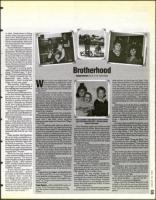
Even as children, Susan Shapiro and her brothets
gave each other a hard time — but were always
there for each other.
That Saturday night, my mother invited
everyone over to dinner. Brian came early
with his wife, Monica, and their adorable 1-
year-old son, Sam, on whom my parents dot-
ed. Next came Eric and Jill, who divulged that
they were trying to get pregnant. Monica and
Brian, perhaps competitively, then announced
that her period was late and that she might
be pregnant again.
At this point, Michael and my father, also
an internist, sequestered themselves in the
den downstairs to talk about diseases, new
medical studies and HMO idiots. My moth-
er, sisters-in-law and a few female family
friends, played with and fed Sam, whose com-
bination of drool and a giggle got a round of
applause. They swapped breast-feeding st•-
ries and took out baby pictures.
After a few hours of boredom and discom-
fort, I diagnosed my problem: Nobody was
paying any attention to me or to my poetry
book stacked on the side table; I'd carried it
600 miles for them to make a fuss.
I thought I was corning home tri
umphantly. But, suddenly, I was still out-
numbered, the outsider who flanked biology,
the oldest girl in a house of boys. I remem-
bered the alienation and feelings of inade-
quacy that had caused me to flee, 15 years
earlier, to Manhattan.
I took a copy of my book and went upstairs
to my old pink room, where I smoked a ciga-
rette and ran my hand over my "baby." Sud-
denly, there were flaws. The publishing house
was tiny; hardly anyone would review the
book. Worse yet, there were six typos. Even
with the blurbs, which yesterday I thought
impressive, and the provocative cover photo
of a naked woman dancing with a skeleton, I
could see it was nothing compared to what
my parents really cared about — the creation
of grandchildren Nothing I wrote or published
or received praise for could ever compete with
that.
Searching my book for clues, I stopped at
a poem called `Tying the Knot." It was about
freckle-faced Brian and Eric, who, as kids,
shared a blue morn split by toy train tracks.
Last year, they both got married, a week
apart. I was single at the time, and the poem
revealed how despondent I'd felt at their wed-
dings — displaced, like I'd completely lost
them.
Just then, Brian and Eric barged in, as al-
ways, without knocking, to say they wanted
to buy copies of my book. Eric took two. Bri-
an, the big spender, wanted five. They asked
me to sign them. I did. Then they hung
around, joking, sitting on my bed and turn-
ing pages as if to show they thought the po-
ems were important.
Eric said he liked "Tying the Knot." Bri-
an punched my arm and said, "I didn't know
that you were so perceptive." I was surprised
that they'd sensed how left out I felt, and
touched that they knew exactly what I need-
ed.
They went into their old blue room right
next door, and I heard something crash. I
rushed in, and there they were, in a wrestling
hold on the carpet the same position they
tumbled around in decades before, rival trou-
blemakers, born 17 months apart, forever
fighting.
I jumped in, as I always did, tickling Bri-
an to help Eric. But, once again, it only made
Brian more determined to pin us both down,
and thus reclaim his "heavyweight champi-
onship of the house" title.
My mother walked in and stared at her
three eldest children — ages 33, 35, 36 —
on the floor, sweating and giggling.
Brian and Eric brushed themselves off,
tucked in their shirts and went downstairs
to their wives. My mother looked at me and
said, "It's your fault. You wrote it in the
poem." El