

by Kaufman Chapel in 1996 involved
home deaths. Twenty years ago, he said,
it was "impossible" to die at home. If you
were dying, chances were good you would
be rushed to the hospital.
"No Jewish family goes through hospice
and doesn't love it," he said. "And we're
talking about dying. But 20 years ago, no-
body talked about death. It was simply
hidden. Now it's an issue we talk about.
You had these massive institutions that
needed to be filled with patients. Now, peo-
ple are going home to die."
Like Rabbi Freedman, Lia Wiss, the
Jewish chaplain of the Ann Arbor hospice,
believes it's important to know when to
administer care, and when to step out of
the way.
"From where I sit, this is an end-of-life
transition," she said. "We have to sanctify
these last holy moments on earth. It sounds
wonderful, doesn't it? But it's sometimes a
hard concept to sell. When you are giving
spiritual care, you aren't trying to fix any-
thing. You are merely there for the people."
When it's over, it's difficult for him to
forget the person, the family, Rabbi
Freedman said.
Breathing Life Into A Scenario Of Death
I
PHIL JACOBS EDITOR
his is probably not something I
should write about as an "objec-
tive" observer. That is what a jour-
nalist, after all, should be.
Writing this article on hospice, how-
ever, makes it impossible to push it out
of the front of my mind. Maybe writing
about it helps.
How many times do we say, "I under-
stand"? I've written stories on divorce,
AIDS, drug abuse, gambling. How can I
say I understand what is going on in any
of these cases when I haven't experienced
any part of them? During the interview
process with hospice, I could honestly say
that I understood all too well what the
families had experienced or were going
through.
So, this is what I offer you. My father,
my hero, Morton Jacobs, died in October
1984. He died of colon cancer. In a mat-
ter of eight months, he went from a
strong, healthy 70-year-old man with a
great sense of humor to a human skele-
ton, barely able to lift his arm.
When he complained of a stomach ache
that wouldn't go away, his physician ex-
amined him in the hospital emergency
room. Next, a surgeon came to talk to my
father.
Finally, a doctor I didn't know came
into the curtained-off area in the emer-
gency room where I stood with my father.
The doctor asked to speak to Mr. Jacobs.
I said, "I'll leave you two alone." He an-
swered, "No, Mr. Jacobs, I mean I'd like
to speak to you."
He told me my father had a cancerous
tumor. "We'll need to open him up and
see how far it has spread. He could live
maybe a few months more."
I don't have a monopoly on any of this.
So many have had a similar experience.
The only image I could come up with was
free falling in space without a parachute.
I remember walking alone through the
Sinai Hospital parking lot, thinking, 'This
isn't happening. What's going on here?
Did that really happen to me?"
They opened him up , and closed him.
He was going to die.
Ken Glick had just met my dad. He
was my internist, and he was head of the
Sinai Hospital of Baltimore Home Care
and Hospice Dept. He and my dad were
both New Yorkers. They both loved to
laugh.
Dr. Glick introduced hospice to Me and
my family.
What was hospice to us:
• A lady whose name was actually
Mrs. Rock (what a great name for a hos-
pice worker) came every morning and got
my father bathed and ready for the day.
• Nurses who would answer any ques-
tion, and come over at any time to check
on my dad. But they'd also come over to
check on me, my wife and my child.
• A phone call to the hospital nurses'
station to let my little daughter run
around her grandfather's room. She'd
jump on him, draw with him, make him
laugh. Better medicine, Dr. Glick said,
could not be found anywhere.
What I'll remember most:
A Thursday night phone call. My dad
was in terrible pain. His last words to me
were "no heroics." We understood that to
mean no tubes.
Dr. Glick responding to a page. He
showed up at our house at 11:30 p.m.
This man has a family of five children,
yet he was there with my dad. Two things
on the most remarkable night. First, he
called a pharmacist friend named Phil
Weiner. It was midnight. I was told to go
to Weiner's Pharmacy where the phar-
macist himself would fill a prescription
of morphine. Again, another angel from
God.
Returning home, Dr. Glick was still
there. He'd administer the morphine.
Then he brought my wife and I into an-
other room.
"You need to go to your dad now," he
said. 'Tell him that you love him and that
_
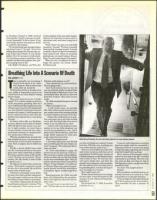
Rabbi Bunny Freedman, the man who brings Judaism to so many Hospice patients.
you did everything you could do to keep
It was an awful experience watching
him here. Tell him, now, anything you him lose weight until he resembled a
have inside that you need to say."
Holocaust survivor. It wasn't easy going
Have you ever walked up to the bed- to bed each night, expecting the sound of
side of your loved one with that sort of a bell he'd ring if he'd need help.
prescription? In the first few minutes of
But it was one of the greatest experi-
a Friday morning, we told Morton Jacobs ences I've ever had in my life. It bonded
what a hero he was. We told him how and sealed us as a family. We were with
we'd never forget him, and that his him when he died, and when we look in
strength and compassion were examples. that figurative mirror, we did everything
We also told him that we'd take care of possible for him.
his granddaughter, and that she'd grow
You know who taught us how?
up in his image as a mensch.
Hospice.
How could we not cry?
But as workers would tell us now, we
Morton Jacobs' breath got very strange already had what to do inside of us. They
the next night. It was the breath of a life just pointed us in the right direction.
coming to an end. I had never heard any-
I'll never forget Dr. Kenneth Glick and
thing like it.
all of the hospice nurses and workers.
My dad died Oct. 17, 1985. It was like They breathed life into a scenario of
yesterday for me.
death.