

c Carpet Ride
Slita Bkun woks with the children of hospice.
PHIL JACOBS EDITOR
Shira Blum believes
in magic carpets.
Amanda dreamed
that she visited God
on her magic carpet.
He was a gentle, fat
man who would hug
her. She was a 9-
year-old dying from
a brain tumor.
Blum
Shira
helped her get to
heaven. She taught
Amanda to believe
that the magic carpet
would lift her above
the clouds. The little
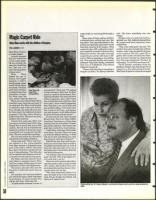
girl's room would be Shira Blum with
covered in the colors some of her
and glitter of magic. young patients.
It's what kept her
alive, and it's what she died with.
There are many stories Shim Blum
could tell, many ways she can teach. If
we could open her, Blum would explode
in emotions and colors and stories.
Now, though, the child-life specialist
for Care-ousel, the children's hospice
program of the Ann Arbor Hospice,
doesn't have time. There are too many
children who need her.
Twenty-four years ago, Blum was
serving on the front lines of the Yom
Kippur War in Israel. She was an IDF
captain. Her job was to translate the
technical specifics of American-made
armaments and equipment into He-
brew. She saw people die in combat.
She still sees people die. She still is
interpreting the highly technical.
Using large dolls, "Nina" and "Joe,"
she explains to her young patients
what their disease is doing and what
part of the body it effects. The dolls
have hair removed to emulate the ef-
fects of chemotherapy. The dolls also
can be opened in the abdomen and oth-
er areas to reveal interior body parts.
But Blum uses the dolls for much
more than an anatomy lesson. They
help the younger children play out their
expressions of fear and helplessness.
The issues, she said often are dif-
ferent for a child with cancer than an
adult.
For example, she says that children
are used to having an adult with them
for protection. So many wonder who
will go with them when they die.
"A child needs someone to come in
weeks of life, he was being fed through a
tube.
Many times, Felicia and her children
wondered about pulling that tube. But
they didn't. They remained faithful to Ha-
lachah and especially appreciative to the
help they received from hospice. What
makes the idea of Mr. Lefkowitz's experi-
ence especially powerful is that he was a
Holocaust survivor. He made it through
Auschwitz, he and his wife came to De-
troit in 1949 not speaking a word of Eng-
lish. Their extended families were largely
destroyed. They built a family, maintained
their love of Yiddishkeit. Then Simon
Lefkowitz became ill.
"I knew what the future was going to
bring for my father," Dr. Harvey Lefkowitz
said. "He knew something was very
wrong."
Hospice came in a practical and in a
spiritual way. Mrs. Lefkowitz learned from
the hospice staff about treatment, about
medications.
"They were really good," she said. "We
couldn't have gone through this without
hospice. Look, I was married for 50 years
to my husband. We had a good life to-
gether. How could I not take care of him
here at home? I learned one simple thing
from this entire experience: You have to
help people. You do what you have to do."
David Techner, president of the Ira
Kaufman Chapel, says that the growth of
hospice is in line with national trends.
More than 50 percent of funerals arranged
Ile ig 9 g4; 44 trt v . r
:
and interpret," Blum said. "I'm talking
to their neshama, their soul. As their
physical condition d.eteriorates, their
spiritual self takes over more and more
of that emptiness. Also, after I have
time to build that trust with them, they
know that I know what's happening
here. They look at me, and in their eyes
you see them asking, 'Can I trust you?'
But I come in with clay, with games
and with puppets, which differentiates
me from the nurse and the doctor."
It's not only the sick child who gets
Blum's help. There are often hidden
situations. Sometimes a sibling feels
jealousy that the sick brother or sister
gets all the attention. Then there's the
guilt that results from those feelings.
"I ask them what they think death
is all about," she said. "Some will come
up with the deepest feelings. A child
told me he stole something once, does
that mean he won't get to heaven?"
What Blum also does with her pa-
tients is to encourage them to make a
scrapbook of pictures and art work of
their life. She asks them to list all of
the things they've loved about their life
and about themselves.
"I'm helping a child alleviate fear and
guilt," she said. "This is the highest lev-
el of work that I can do."
When one of her patients dies, Blum
said she needs to take a couple of days
off to reflect. She'll often write a let-
ter to that child and then burn it, blow-
ing the ashes into the sky.
"The most important aspect is to
meet the child at his or her emotional
level. If I can do that, I've helped, and
that's all I wanted to do."
Felicia and her son, Dr. Harvey Lefkowitz. Learning from Hospice how to care for a dying husband and
father.