

emouin
■
A Southfield firm has completed the jump from an
Oak Park basement to a leader in the world of
insurance.
Af
T H E D E T R O I T J E W I S H N E WS
ALAN ABRAMS SPECIAL TO THE JEWISH NEWS
58
hen the Meadowbrook Insurance
Agency was founded in 1955, no
one had ever heard of a concept
called "alternative risk manage-
ment."
Forty years later, it led the
Southfield-based Meadowbrook
Insurance Group to the top spot
on the Crain's List of Leading Business-In-
surance Agencies.
Because of the foresight of Merton J. Se-
gal, president and CEO of Meadowbrook,
alternative risk management became an
innovation that revolutionized the insur-
ance business, an industry that does not en-
joy a reputation for quickly embracing the
winds of change. Alternative risk manage-
ment currently serves about 40 percent of
the commercial insurance market.
Most alternative risk coverage is in the
form of captive insurance companies, but
also includes risk retention groups, pools
and individual self-insurance. All are non-
traditional methods of handling exposure
to loss, and involve some sort of risk reten-
tion by the insured.
Meadowbrook targets selected indus-
try and trade groups whose insurance needs
fall through the cracks in the traditional
commercial insurance market, and creates
custom packages — frequently captive in-
surance companies — for the groups. These
are usually set up so that the insured com-
panies own part of the insurer they set up
and share the potential profits.
A captive insurance company is a corpo-
ration organized primarily to provide in-
surance just for its owners; essentially, an
insurance company owned by its policy hold-
ers.
The idea of forming an insurance com-
pany with others in the same business to
share the risk of loss is not new. That's how
Lloyd's of London came into existence 309
years ago, when shipowners agreed to share
losses.
Today, shared risk is the fastest growing
segment of the insurance business. Just
look at the ads in the industry's trade bible,
Business Insurance magazine.
"Our growth ratio over the last dozen
years exceeds most other insurance opera-
tions by quite a bit," said Mr. Segal. "Our
growth is well over 30 percent a year in our
insurance companies, and we hope to con-
tinue a 20 percent-plus growth now, and in
the future. That's growth in both revenues
as well as earnings.
"Most of our growth has been in term
growth, and not acquisitions. But we've
made two acquisitions in the last eight
months. T Ast November, we acquired a ser-
vice firm, Association Self Insurance Ser-
vice Inc., in Montgomery, Ala., where we
already had an office. This helps enhance
our marketing claims and loss prevention
capabilities to serve our clients.
"And we announced in May an acquisi-
tion of an insurance operation in Cerritos,
Calif., called Crest Financial Corporation,
which is a specialist in the truck insurance
business. It is a full-service operation, which
includes underwriting, claims, loss pre-
vention, premium finance. So we're excit-
ed about those acquisitions as both revenue
enhancers and profit enhancers, and most-
ly to serve our growing clientele in these
various areas of the country," said Mr. Se-
gal.
According to published reports, Crest re-
ported revenue of more than $12 million
and a net income of $777,000 in the fiscal
year ending June 30, 1996. The company
controls 16.2 percent of the California mar-
ket for commercial vehicle insurance.
The purchase price is reported to have
been $8.7 million in cash, with a closing date
of this past Monday (June 30). The compa-
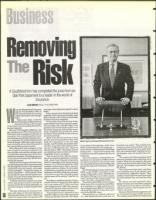
Merton Segal has developed Meadowbrook's niche.
ny has about 100 employees, which when
added to Meadowbrook's 470 employees —
many of them at Meadowbrook's Southfield
headquarters — will put the company Well
on track towards 600 employees by the end
of the year.
"One of our goals (in making these ac-
quisitions) is to increase our ability to serve
our clients anywhere in the country with
our own people doing claims handling, loss
prevention, sales and marketing," said Mr.
Segal.
The Meadowbrook Insurance Group Inc.
(MIG on the NYSE) went public in No-
vember 1995 at $21 a share. The IPO (Ini-
tial Public Offering) was 2 million shares,
and 27 percent of the common stock was
sold to the public, raising $48 million.
The stock reached $34.12 last autumn,
before losing $11 in a single day sell-offfeen-
zy in response to a single quarterly earn-
ings disappointment. Before it was all over,
the stock fell to $15.25. It has since recov-
ered to the $22-$25 range.
Michael Moran, an analyst at Roney &
Co., said Meadowbrook's stock has "re-
bounded very nicely." The problems the
company's stock encountered "were not
atypical of the market. It was a classic 'shoot
first, ask questions later' response, as usu-
ally happens when the market has a sur-
prise.
`The market never likes surprises, but if
there are surprises, they want them to be
positive. When they are negative, they wait
until it is all done and the dust settles. Then
they ask, Did we beat it up too much?"' said
Mr. Moran.
"But it has come back nicely, and there
is no credibility issue. It was simply a case
of a bad hiccup,' added Mr. Moran. 'They
needed to report solid core earnings and get
out of the penalty box, and they are doing
that."
Mr. Moran was also optimistic about
Meadowbrook's new acquisition program
"for the growth of the agency franchise,"
calling it exactly what analysts and in-
vestors want to see.
However, Meadowbrook's aggressive pol-
icy of acquisitions began before last year.
The company acquired Savers Property and