

Se Zilide
uberty and the pre-teen person that I have seizures and
years were especially dif- not to freak out. I don't mind if
ficult for Scott Becker. A they ask me questions and want
year before his bar mitz- to know more. The more they
vah, he was diagnosed as know the more they'll be able to
having epilepsy.
help me."
"This was not a fun time," re-
Epilepsy affects almost one
calls Mr. Becker, now 28. "I was percent of the population of the
isolated and didn't understand United States. It is a brain dis-
completely what was happen- order causing unpredictable, un-
ing. I was absent from school a controlled seizures that can
lot and it was difficult to make occur at any time. Seizures re-
friends. It only got a little bit bet- sult when the normal, tightly
ter as a teen when I met a bunch controlled electrical activity of
of guys in B'nai B'rith. They the brain becomes excessive and
came to understand what I was jumbled, interrupting normal
experiencing and supported me. brain activities.
"What I discovered growing
Doctors do not make the di-
up is that I couldn't allow epilep- agnosis of epilepsy based on a
sy to finish my life," says Mr. single episode. A person is di-
Becker. "I can't let it beat me; agnosed with epilepsy only after
I've got to beat it. I need to keep recurrent seizures. Sometimes
pushing forward but sometimes the causes are known; other
it's extremely hard and I need times unknown.
help.
For the past few years Scott
"When I develop a friendship Becker lived by himself in Madi-
that's important to me, I tell that son Heights and was a student
New research is making giant strides in
the diagnosis and treatment of epilepsy.
RUTHAN BRODSKY
SPECIAL TO THE JEWISH NEWS
PHOTOS BY DANIEL LIPPITT
Fear of
at Wayne State University
working on a degree in thera-
peutic recreation. This summer
he's a counselor at Camp Airy in
Maryland for Jewish boys ages
6 to 17.
After camp, he plans to return
to his parent's home in Bethes-
da, Md. and find out if he's a
good candid
ate for brain surgery
at Johns Hopkins Medical Cen-
ter.
Unfortunately, medications
developed within the last five
years to treat epilepsy did
not work completely for Scott
Becker.
According to neurologist Rob-
ert Spitzer, M.D., clinical asso-
ciate professor of neurology at
Wayne State and adjunct pro-
fessor in electrical and comput-
er engineering, with the series
of new medications, 70-80 per-
cent of patients with epilepsy
achieve 100 percent seizure con-
trol.
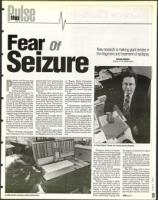
Dr. Robert Spitzer: Patients don't want to hear the diagnosis.
An EEG machine measures a patient's brain waves.
"However, there is a tremen- the stigma of seizures in school
dous difference between being is not easy."
99.99 percent seizure controlled
Seizures take many different
and 100 percent controlled," says forms, lasting from a few sec-
Dr. Spitzer who practices at onds to several minutes. Some
Beaumont Hospital in Royal cause the entire body to con-
Oak. "If a patient isn't 100 per- vulse; others simply resemble
cent controlled, there is always day dreaming or the movement
the chance of a seizure.
of one limb.
"Scott had one or two seizures
The first drug used to treat
last year and he was devastat- epilepsy, in 1912, was pheno-
ed. He was afraid to be in pub- barbital. It provided some relief
lic, he can't drive, and he is and is still used today although
constantly depending on others. patients become very tired while
His life is a mess.
using it and it interacts with
"Epilepsy can begin in adult- other medications. In 1939,
hood, but like Scott's 'case, it phenytoin (Dilantin) was dis-
Most often appears for the first covered and considered the ma-
time in children and young jor breakthrough for controlling
adults. Growing up with the seizures. It worked, well bring-
condition profoundly affects a ing complete seizure control to
person's psychological and emo-
tional well-being. Coping with
FEAR page 74
0)
0)
3-
LLJ
73