

Of course,
reaching young,
di) unaffiliated Jews
0 is at the heart of
the problem. If they
were already plugged
into a synagogue and
reading their local
Jewish newspaper,
they probably wouldn't
need an event specifical-
ly designed to find a Jew-
ish mate.
But the whole idea is to
provide contact for the assimi-
lated Jew whose internal pro-
gramming has just told him/her
it's time to marry Jewish.
Like the Conservative
movement, Reform Ju-
daism is now trying its
hand at getting Jew-
ish singles together
through eight self-se-
lecting, self-screening
singles networks across
the country.
A staff person at a centrally-located
Reform synagogue (in Detroit, it's
Temple Israel's Beshert Connec-
tion) keeps track of a local
book of singles' person-
al profiles and pho-
tos alongside their
first names
and mem-
bership
numbers.
Network
members can
check out the
listings, then
ask the keep-
.4.
s-
er of the files to
..-
4.-
4.
•
discreetly forward
their requests to the
persons they want to meet. From
there, it's up to the individuals.
Since the Colorado Jewish Social Network
started at Denver's Congregation Emanuel in
the summer of 1991, some 100 marriages have
emerged from all the networks. With more than
500,000 single American Jews ages 18 to 40,
those network marriages — which include Jews
over 40 — are not statistically stunning, but
every one counts. At the very least, the network
gets several thousand single Jews into Reform
houses of worship.
"It's certainly our hope that, at some point,
they'd join the congregation," says Gilda Fier,
singles coordinator for Reform Judaism's Union
of American Hebrew Congregations New Jer-
sey/West Hudson Valley Council.
One observer of the scene at Baltimore's Tem-
ple Oheb Shalom, headquarters for the local
Jewish Singles Social Network (JSSN), describes
the mood as desperate. She's talking about
women in their 30s, some divorced, their bio-
logical clocks ticking, outraged that network
men can't even be bothered to send a real pho-
tograph of themselves. (Instead, they send Xe-
roxes.)
JSSN staffer Judy Sheuer is more upbeat
about the 550 members, with the largest group
between the ages of 25 and 35, mostly Reform
Jews. She counts nine marriages since JSSN
started in October 1992, plus 13 engagements
in the past year.
3
Much of the organizational concern over get-
ting singles to meet and mate concentrates on
the younger, more fertile end of the spectrum.
Atlanta YAD (Hebrew for "hand"), the coun-
try's first Jewish Young Adult Agency for Jews
18 to 30, was established by the Atlanta Jewish
Federation in 1992. In the words of its no-non-
sense mandate: "The Jewish community must
begin dealing with the root causes of assimila-
tion and intermarriage by working to make Ju-
daism relevant to young adults' personal lives.
By attacking the illness (lack of Jewish rele-
vancy and meaning in life) and not only the
symptoms (assimilation and intermarriage), At-
lanta YAD believes a difference can be made in
ensuring Jewish continuity."
YAD, located on the Emory University cam-
pus, picked the right population: 4,500 Jewish
college students and 8,500 other Jewish singles,
many of them new to Atlanta. As a clearing-
house with a contact list of organizations, a 24-
hour hotline called Chai-Lites, and LINK, a
buddy system matching newcomers with YAD
members, the group publicizes Jewish singles
activities throughout the area and has been used
as a model in other cities.
And, yes, young Jews do meet and mate.
YAD's director of singles coordination and
special projects, Samantha Dressler, 27, met
her spouse, also 27, through Bogrim, the Con-
servative Ahavath Achim Synagogue's singles
division.
Effort...
and success?
Jeff Cohen, 25, and Lisa Baturin, 30, both
new to Atlanta in 1993, met at the Atlanta
JCC Young Jewish Singles Bowling League and
will marry in May. Jeff, whose Conservative
Judaism is important to him, now runs the bowl-
ing league. He says, "I wasn't looking to find
a girlfriend, but knew when it happened
she'd be Jewish. I knew I wanted to have Jew-
ish kids."
Lisa, who grew up Reform, says she "never
dated seriously anyone Jewish before Jeff, but
I knew I wanted to have a Jewish home. More
important, we're starting out with so much more
in common, culturally."
Since those who do the surveys aren't asking
Jews who marry other Jews where they met
their mates, there's no way of knowing whether
all these singles activities are making a differ-
ence or merely attracting the minority of Jews
who already were most likely to marry in.
So far, the number of weddings and engage-
ments produced by these organizations is so
small that those in search of their beshert might
do just as well hanging out at a laundromat. But
it does offer hope.
And then there's the comforting, counter-
vailing, devil-may-care approach that less is
more: Jews have always been.a minority, the
argument goes. It's quality not quantity. From
the current population of some 5.5 million Amer-
ican Jews, better a smaller, knowledgeably-Jew-
ish future population, say some, than a bigger,
by-and-large know-nothing Jewish community.
Nah.
❑
This article has been reprinted with permission
from The Reporter, the magazine published by
Women's American ORT. It first appeared in
the Spring 1997 issue.
From Freedom
To Fear
Katie Roiphe explores what sex means
to the Next Generation.
JULIE WIENER STAFF WRITER
atie Roiphe first made headlines in 1993 when her con-
troversial book on date rape, The Morning After: Sex,
Fear and Feminism, hit bookstores. Then a graduate
student at Princeton, Ms. Roiphe angered many femi-
nists with her critique of what she perceived as an obsession
with date rape and victimhood.
Now the 28-year-old author is back with another book about
a much-politicized sexual issue. This time it's AIDS.
While in Ann Arbor on a promotional tour, Ms. Roiphe said
her new book, Last Night in Paradise, is more complicated,
less polemical than her last.
"I wanted to write a book that couldn't just be summarized
in a sentence on 'Good Morning America,"' she explained.
Last Night in Paradise explores America's transition from
the sexual revolution to the era of "safe sex," arguing that fear
about AIDS is about more than the disease itself, that it rep-
resents more general fears about sex in
secular society. Were it not for AIDS,
Ms. Roiphe implies, Americans
would find other excuses to con-
trol promiscuity and depict
sex as dangerous.
Ms. Roiphe's book fo-
cuses on the experiences of
teenagers and people now
in their 20s. The way she
sees it, people in this
generation have had an
unusually conflicted ex-
perience with sex. "We
grew up in a peculiar gen-
eration, seeing the sexual
revolution but being bom-
barded with its consequences,"
she said. "It's a sexual climate of
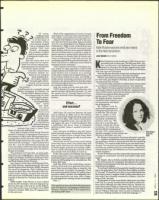
Katie Roiphe:
opposite messages. In that context, peo-
It's not all
ple have to find their own way."
AIDS.
Ms. Roiphe is fascinated by American attempts to regulate
sex — whether manifested in sexual harassment codes, safe
sex guidelines or books on dating etiquette like the bestselling
The Rules. "You want to create rules so you can break them,"
she said. "It's very hard not to have anything to rebel against,
and there are problems with too much openness. Teens don't
want parents to say, Do whatever you want'; total freedom
creates anxieties."
"In the 1970s there was this utopian idea that people would
be happy in a permissive universe, but it didn't make them
happy."
Ms. Roiphe, who is Jewish, concedes that her book raises
issues of the search for meaning in the absence of a socially
imposed moral consensus. But she says it is by no means an
endorsement of religion.
"In my book I talk about the search for morality and mean-
ing in our generation, but I don't find that religion provides
it," she said. "It's hard for me to find a way to take Jewish law
ti
that much to heart. I suppose what it really comes down to is
Cr)
CT)
that while I feel culturally connected to Judaism, I don't be-
lieve in God," she said.
The daughter of writer Anne Roiphe, Katie grew up in New
York City in a secular Jewish home and chose to attend He- .
brew school although her older sisters did not. Despite her
ambivalence about religious observance, Ms. Roiphe sees an
influence of tradition on her writing. "Someone once said to
me my writing is Talmudic. That is a part of Judaism I like,
that way of looking carefully at words and language." ❑
k
53