

The
Palk
qki
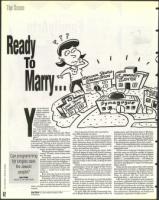
Ready
Marlyn,
THE DETR OIT J EWISH NEWS
4,
52
ou never know
when Jewish
tribal instincts
will kick in. .
Take Joel, a
38-year-old lawyer
in Los Angeles (he
asked that his real
name not be used).
"I almost married some-
one non-Jewish 10 years
ago," he said. "But when I
brought home a challah and she said, 'What
a lovely brioche,' man, was I in the wrong
place."
He speaks slowly, vulnerably. He describes
himself as "a very committed Jew" who'd "love
to be married." He has a clear picture of what
he wants, and he's willing to wait for a woman
with "a good heart, a caring person, easygoing,
warm, moderately religious."
Has he gone to any Jewish singles
events? "Frankly, those things scare
me," he says.
Successful, sensitive, definitely
Jewish, Joel's the kind of guy every
Jewish mother and her daughter —
not to mention the legions of Jewish
matchmakers, Jewish singles events
organizers and Jewish singles net-
works — would love to get their
hands on.
Ever since the Council of Jewish
Federations' 1990 National Jewish
Population Survey found that 52
SPECIAL TO THE JEWISH NEWS
percent ofJews married in the pre-
vious five years had married non-
Jews, connecting people like Joel
with a Jewish mate has become a Jewish ob-
session.
Amy Stone is a journalist living in San
Francisco.
•
•
•
OP
Only 9 percent ofJews who married be-
fore 1965 married non-Jews.
Now synagogues, national Jewish organi-
zations, local Jewish federations and commu-
nity centers, which have been bypassed by
many American Jews, are determined to focus
their organizational know-how on the mighty
task of getting Jewish singles together — to
marry and produce more Jews.
But they are not entering an empty field.
The back pages of most local Jewish newspa-
pers have long been filled with personals — all
the over-achieving, good-looking, financially
successful fans of dining out, dancing and tak-
ing long walks in the woods, looking for their
beshert.
Cheek to jowl with personals come ads for
matchmakers. From the pages of New York's
Jewish Week: "There's a time in every man's
life when he realizes he's ready for commit-
ment. Don't let those five minutes go to waste."
(An advertisement for Blumberg Introduc-
tions.)
Marketers are zeroing in on Jewish singles
at their most vulnerable. Christmas Eve has
become a night in some cities when Jewish
event planners throw the bash of the year to
bring together Jewish singles with nothing to
do and nowhere open to go.
Up until 1996, the Jewish Community Cen-
ter at Maple-Drake annually hosted a Dec. 24
IMO
singles party, and December days in Manhat-
tan lead up to Utopia Events' X-mas Eve Ball
with four deejays, a live trapeze act; cigar bar,
jazz club, sports bar and dancing. Washington,
D.C., also plans an annual "Matzah Ball" where
a few permanent matches have been made.
Some of the establishment's attempts to get
Jews to marry within the fold are guilelessly
straightforward.
Conservative Judaism's Singles Commis-
sion has come out with the concept of magnet
synagogues. Like iron filings to a horse-shaped
magnet, Jewish singles searching for their
beshert — preordained mate — will likely be
attracted to singles programming at major Con-
servative synagogues in major Jewish popu-
lation centers.
These are the same places that until recently
showed-interest in twenty- or thirtysomethings
only after they married, had children and be-
came active in a synagogue. Now they're scram-
bling to address the fact that Jews are
marrying later — and some not at all.
A $5 manual for synagogues and communi-
ty centers, published last year by the United
Synagogue of Conservative Judaism, includes
step-by-step guidance for starting congrega-
tional and regional singles programs. The idea
is to "offer the singles a Jewish alternative to
the anonymous, unsatisfying, un-Jewish and
completely unspiritual 'singles scene.' "
.141107.,