

r to have an impact with these kinds of
talks.
"I think I teach more in prison coun-
seling and by how I act toward them. They
endure things that are unfair to them in
prison. aire morality doesn't exist in the
world they ever knew," he says.
Around important Jewish holidays, up
to 25 inmates at Jackson might attend
services, but usually the number hovers
around eight, Rabbi Ponn says.
Mr. Florian and Mr. Whitney live in the
medium-security north side of Jackson, so
they see each other daily. Mr. Litt is in the
minimum-security trusty division across
the yard.
But on Saturdays, the men come to-
gether in the sanctuary to pray, sing, lis-
ten to Rabbi Ponn's sermons, read from
the Torah and study Hebrew.
It's not always easy. Mr. Litt says prison
officials constantly place stumbling blocks
in their way, losing "details," the document
required to leave and enter a new build-
ing, and picking them up late so they miss
part of the service. And they cannot bring
prayer books, tefillin or tallit with them.
'They figure if they can put you through
enough indignities, you won't come," says
Mr. Whitney, who is leading a fight to al-
low religious minorities to wear religious
headgear all the time.
Anti-Semitism is rampant among the
prison staff, but not among the inmates,
the men say. Mr. Whitney's cat was re-
ferred to as the "Jew cat" by a guard, he
says, and Mr. Florian says he's been called
a "f— Jew" by officers and staff.
Plus, Jewish inmates have to choose be-
tween a kosher diet and services. Those
who choose the former are often shipped
out to a different facility, and many don't
want to leave.
`The Torah service is the only thing that
keeps us here," Mr. Florian says.
And then there's the battle every Sat-
urday to get through the service, Mr. Litt
says. Other inmates in the church distract
them with loud voices or radios and refuse
to shut their door.
"During Rosh Hashanah, I was blow-
ing the shofar. They came over and shut
the door," he says, eliciting howls of laugh-
ter from the other inmates.
For Tashlich on Yom Kippur, the Jew-
ish inmates gathered at a pond on the
prison grounds to symbolically cast away
their sins. Mr. Litt blew the shofar out
there.
"I think the fish died," Mr. Whitney
quipped.
Searching for
Contact
on the lake and a vacation home in Flori-
da. His first car was a Porsche.
Today he earns $1.77 a day — a good in-
come, in his estimation, and a better mea-
sure of his sanity.
Mr. Lilien, 39, has served four years of
a prison sentence in the Kinross Correc-
tional Facility in the Upper Peninsula. He
doesn't consider himself a victim but notes
that had he dealt drugs in another state,
he would not have been subject to Michi-
gan's severe drug laws. For a 1992 convic-
tion on a charge of conspiring to deliver
between 50 and 225 grams of cocaine, Mr.
Lilien drew 10 to 20 years, the first 10 of
them mandatory.
A few weeks ago, Mr. Lilien stopped at-
tending Shabbat services at the prison.
Even though he strongly identifies as a
Jew, it felt "hypocritical," he says.
"After my parents, being sick for so
many years and all the suffering they went
through, I had a hard time believing. I
thought, 'How could there be a God?' I
know there is, but I don't feel it in my heart
anymore," he says.
Both his parents died over 10 years ago
of smoking-related diseases. They were in
their 60s.
And yet, Mr. Lilien says of the five or so
other Jews at Kinross, "I feel we have a lit-
tle more in common. Everyone that goes
to the service is kind of more mellow than
everyone else, maybe better mannered,
more intelligent. We have a little of the
same background."
And yet, he has withdrawn from the
company of all but a few inmates, throw --
ing himself into his job as special activities
clerk, Alcoholics Anonymous and Narcotics
Anonymous meetings, weightlifting and
reading.
Searching for meaningful contact with
the world outside, Mr. Lilien placed an ad
in The Jewish News' personals section this
year. He received one response.
`There's only a handful of people I'd have
anything to do with here. I am starved for
real conversation. I grew up with real man-
ners," he says. "In these four years, I've
probably met four people I could actually
sit down and have a normal conversation
with. It's deliberate on my part. A lot of
people, they've never worked, never paid
bills, never made a car payment," he says.
Mr. Lilien has been into drugs since a
friend in prep school turned him on to hero-
in. He doesn't know why.
"We had very loving parents who would
do anything for us. Even with my addic-
tion, I was still a nice person. I still worked
all the time, carried on day-to-day living,"
he says.
He got clean a few times over the years,
even becoming a drug counselor at a hos-
pital in New Jersey where he himself was
a patient. Before coming to Roseville to
help a friend run an antiques business, Mr.
Lilien worked for his sister and brother-
in-law, Robin and Jim Fowler, at their an-
tiques restoration business in Morristown,
N.J. He was arrested in late 1992 in Ma-
comb County after selling cocaine to an un-
dercover police officer.
"One thing led to another, and here I
am," he says.
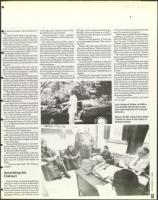
Left: Richard Lilien in 1992, a
few months before his arrest
and imprisonment for cocaine
delivery.
Below: Rabbi Allen Ponn holds
a Hebrew class in his study at
Jackson prison.
CO
0)
-
CO
Richard Lilien's upbringing typified the
lifestyle of well-to-do Jews of Randolph,
N.J.: The son of a dentist and one-time
fashion model, he attended Hebrew school,
had music lessons, summer camp in the
mountains, expensive sporting equipment,
prestigious schools, a bar mitzvah, a house
CC
LLI
CO
2
LLI
53