

•
A Lost Tribe
c.r)
LU
C/3
UJ
CC
LU
52
Miami-based advocacy and educational
organization for Jewish prisoners. Last
year, Mr. Litt led the fight to light
Chanukah candles.
Pondering the future on his way to
prison, he thought he'd become a rabbi
when he got out.
"It was a little thing I made with God. I
don't know ZIT. do it now, but I've become
a lot more adherent and studied a lot more
since being incarcerated," Mr. Litt says.
The Aleph Institute serves roughly 3,000
Jewish prisoners nationwide. Executive
Director Isaac Jaroslawicz believes there
are probably as many as 6,000 to 8,000
such prisoners, but many Jewish inmates
don't contact Aleph because they are ei-
ther afraid of identifying themselves as
Jews or never did, anyway, he says.
Michigan's Jewish prison population is
difficult to track, but Mr. Whitney, who
won the right in 1989 to hold Jewish ser-
vices in the prison, estimates there are 54
Jews of approximately 40,000 state pris-
oners. There may be twice that, Rabbi
Ponn says, but he's unsure.
And many of them, like Joe Florian, are
converts to Judaism.
"Joe, he just come over to kibitz at first,"
Mr. Whitney says of Mr. Florian, whose
mass of kinky long hair is held in check by
a black yarmulke.
"And we respect that," Mr. Litt says.
"When we see someone who is sincere and
intrigued with Judaism, we welcome him
with open arms. Someone who's fake, it
kind of bothers us. I know my people have
gone through too much suffering and pain.
If a person wants to investigate it and
study it and convert, I'm for that."
Mr. Florian, who is serving the fourth
year of an 8- to 30-year sentence for sec-
ond-degree murder, thinks he knows why
so few Jews are behind bars: the penitent
period between Rosh Hashanah and Yom
Kippur.
"Everybody feels self-reflective. That re-
ally gives you retrospect. You feel real
guilty, real remorseful. This isn't the pa-
role board; you've got to answer to God.
You gotta start thinking about what you're
going to do for the Book of Life," he says.
The 33-year-old Mr. Florian was raised
in a Christian home but didn't consider
himself religious. Then he started at-
tending Rabbi Ponn's services a few years
ago with a Jewish inmate friend. In
March, he converted.
"I didn't realize how difficult it would
be, all the homework. I'm still stumbling
over new stuff all the time. But I was im-
pressed. It's pretty good, knowing that the
Jews keep on going, keep surviving. Har-
ry turned me on to all the different books.
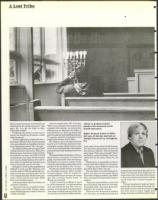
Above: A Jackson inmate
ponders the menorah in the
Jewish sanctuary.
Right: Richard Lilien in 1969,
the year of his bar mitzvah at
Temple Emanu-El in Livingston,
N J.
I just read a book about the Holocaust.
You had Jews coming from all over and
they all knew Hebrew. They all had the
same values. They were connected: 'You're
my brother, you're my family.' And a con-
verted Jew can be a part of that, too," he
says.
Whenever he is stumped by an idea or
a word, he'll look to Harry for an answer.
"I bug him about Hebrew words, bug
him about this or that," he says.
The men kibitz a lot when they get to-
gether, but they are also pretty serious
about their religious studies, says Rabbi
Ponn, the head of Temple Beth Israel in
Jackson.
"They have a great ability to learn the
facts of Judaism and delve into the deep-
est possible books. They show great intel-
lectuality. It's amazing," he says.
Those who want to convert to Judaism
are "very big in an intellectual sense and
are generally attracted to that part of Ju-
daism," but lessons of the Torah may not
always have their intended effect because
in the men's harsh environment, simple
moral truths don't always resonate, he
notes.
"It's hard sometimes to make an impact,
because the environment of the prison sys-
tem itself and the world they lived in be-i
fore they came to prison taught them
things about the world that make it hard-