
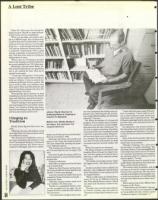

A Lost Tribe
Today, Mr. Lilien says, the cravings for
drugs are gone. His life is a stark portrait
of bad choices and few possibilities.
"When you get older, you start to view
life in a different light. Now I realize what
I could've done and I could've been. I would
embrace having a chance to do the right
thing now — to get married and have kids.
I've had the American Dream before —
a long-term relationship with a good
woman, a good job, a nice place to live, a
dog. I had that a few times in my life and
always threw it away.
"When I get out, I'm going to go right
back to the antiques, and the business is
set up and waiting for me," Mr. T Mien says.
Absolutely, says his sister Robin, 44.
She and her husband have an apartment
and a job waiting for him when he is
paroled in six years.
"I trust him 100 percent. To be quite
honest, I wish he could be here to help me
with my children. I have no one but my
husband, girlfriend and her mother. He
has so much to offer to my children (who
are 3 and 4). They send him pictures, ask
when Uncle Ricky is going to be home. It's
heartbreaking," she says.
Their parents spent a fortune on drug
rehabilitation for her brother, Ms. Fowler
says, and while they were both in the hos-
pital dying, he visited them constantly.
"They're rolling in their graves know-
ing what happened to my brother. Some-
times I cry, because if they were here,
they'd do something to help. My father had
the financial means and the love."
Clinging to
Tradition
Mindy Brass figures God wants her
alive.
Otherwise, she says, she certainly would
have died from the massive heart attack
she suffered in prison.
The 38-year-old California native is
serving a mandatory life sentence in the
Scott Correctional Facility in Plymouth
for cocaine delivery. Ms. Brass was ex-
tradited to Michigan with four co-defen-
Ci)
w
1--
CD
CC
F-
LU
0
UJ
54
"I work with the human needs of the pris-
one who understood the holiday was im-
portant to me. I don't require a lot, but dur- oner," he explains. "I don't really try to fo-
ing a couple of those holidays, it's extremely cus on their spiritual needs unless they
voluntarily ask for spiritual advice." Rab-
important," she says.
Ms. Brass, the mother of a 12-year-old bi Shemtov gets legal help for prisoners and
Below left: Mindy Brass is
daughter who is in foster care in northern provides them with educational and reli-
serving a life sentence for
California, was raised in a lower-middle- gious materials.
cocaine delivery.
His experience with Jewish inmates is
class home that she calls "traditional," but
she had no religious schooling. Her father that they either don't want him visiting be-
was a truck driver who "considered himself cause of alleged anti-Semitism in the prison
dants, one of whom got his case dismissed. a Jew first, an American second. Being Jew- or they don't have much of a Jewish back-
ish has never been just a religion for me; ground.
She was convicted in 1992.
Some of the Jewish inmates with whom
Since then, Ms. Brass, who owned an ad it's a heritage. My daughter was the same
agency in San Diego, has fought to get her way. Since I've been incarcerated, I've tried he's had contact are embarrassed for social
own case overturned, claiming the prose- to arrange to get her menorah candles," she rather than moral reasons.
"Nobody's thinking, 'I'm a Jew and I
says.
cutor withheld evidence.
should
adhere to higher standards.' The
Both
of
her
parents
are
deceased.
"I'm in prison for a crime I didn't com-
Ms. Brass arranges to send items to her only thing I hear is, 'I was making $200,000.
mit, I'm terminally ill, and fm angry," she
daughter Erica through the Aleph Insti- I had a big house. Here I am on TV and all
says.
tute.
And she speaks and writes to her at my customers and friends and suppliers
And she's fought the prison staff to be
able to maintain as many Jewish customs least once a week. Erica visits her mother are watching while I'm walking out of the
court in chains,' " he says.
once a year.
as she's able.
Rabbi Shemtov says he wanted to take
"It's
harder
on
her
than
anyone.
She's
It hasn't worked out.
Scott offers no religious services for Jews the biggest victim," Ms. Brass says of Eri- up Ms. Brass' case because of her heart con-
dition and her family problems.
ca.
and no kosher food.
"She needs a heart transplant, and she
Another sometime visitor is Rabbi Levi
Before her first Passover at the prison,
can't
get on the list for a heart transplant
Shemtov,
who
is
affiliated
with
the
Daniel
Ms. Brass paid $50 for kosher food from the
Sobel Friendship Circle locally and with because she's a prisoner. She was never
outside. It never came through.
married and the father of her daughter nev-
Last year, she got her kosher food, but it the Aleph Institute.
"When a rabbi comes, it's almost thera- er really had anything to do with the child,
consisted of boxes of matzah and candy —
peutic.
So for me, it's difficult not having who goes from foster home to foster home,"
nothing for meals.
This year, she got a kosher meal, but it that. When Rabbi Shemtov comes, I talk to he says.
But he seems to have had a different kind
him about God. He seems to listen to me,"
was "inedible," Ms. Brass says.
of
impact on Ms. Brass.
Thanks to a sympathetic kitchen work- she says.
"I didn't believe in God before," she says.
The rabbi, who currently works with sev-
er who smuggled out raw eggs, she ate
matzah brie for a week that she cooked in en Jewish inmates, says his motto is, "I'm still alive and I'm not supposed to be,.
"Everyone is treated like a brother or a sis- so I must still be alive for a reason. I guess
her microwave.
I started to believe in God again."
"I was fortunate enough to have some- ter."
Above: Mark Chartier is
studying Hebrew, hoping to
convert to Judaism.