

4.
I
%VIZ
..,===45,1..WOMMOIMZMMMEM
. MOMMOMMSWOMMKOMMM.M.,-..
SlanMift
•
a
.
Professional Rivalry?
Getting
The Degree
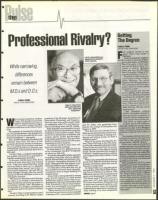
Left: Dr. Howard Sobel was
attracted to the osteopath's
holistic approach.
While narrowing,
differences
remain between
,
with ejuif44
:Osteo
betligtutc4
M.D.s and D.O.s.
—)
PAMELA YOUNG
SPECIAL TO THE JEWISH NEWS
Right: Dr. Robert Sokol
believes the differences
have "pretty much
disappeared."
C-
0
hen pioneer physician Andrew
Taylor Still decided to buck the
medical establishment back in
1874, he didn't realize the effect
his efforts would have on the future of med-
icine.
His emphasis on treating the whole per-
son, not just the disease, was daring for its
time and it laid the groundwork for a new
branch of medicine — osteopathy.
Now, 35,000 osteopathic physicians will
celebrate more than 100 years of this
uniquely American branch of medicine,
Nov. 3-9. Despite their numbers and their
outstanding reputation as primary care
practitioners, misconceptions about D.O.s
still exist.
Carolyn Utter, a medical technologist,
has worked with both D.O.s and their al-
lopathic counterparts, the M.D.s.
In the past, she felt many of the D.O.s
tried to do more than they were trained
to do. "I also was worried that they would
not be as likely to refer you to a specialist
and perhaps they weren't up-to-date on
their medical education," she said. Her at-
titude changed, though, after she started
taking her 84-year-old father-in-law to an
osteopathic internist.
"We found out that that wasn't the case.
He refers us as needed to specialists be-
cause he feels he can't keep up-to-date on
everything," said Ms. Utter. "My father-in-
law has been to a urologist, neurologist and
a podiatrist and he has gotten excellent
care."
Carolyn Utter's misperceptions aren't
unusual, according to Dr. Melvin Linden,
W
president of the Michigan Association of
Osteopathic Physicians and Surgeons.
There are some areas of the country which
are unfamiliar with D.O.s, but these bar-
riers are breaking down, said Dr. Linden.
Both allopathic and osteopathic doctors
are fully trained and licensed to prescribe
medication and to perform surgery. There
are D.O.s in all branches of medicine and
surgery, said Dr. Linden, but the majori-
ty are family practitioners. They have been
leaders in family practice for 100 years,
stressing preventive medicine.
In contrast, the M.D.s have been well
known for specialty medicine.
So what makes a D.O. different from his
or her counterpart, the M.D.? It depends
on whom you talk with.
"It was the osteopath's holistic approach
to medicine that really whet my appetite,"
said Dr. Howard Sobel, who has been a fam-
ily practice osteopathic physician for 40
years. "Osteopaths offer their patients a very
personal, hands-on type of medical care."
Dr. Sobel didn't always feel that way. In
fact, he didn't even know about osteopath-
ic programs when he began thinking of a
medical career.
Armed with a strong interest in science
and a love for medicine, Dr. Sobel started
looking into medical schools while an un-
dergraduate at Syracuse University in New
York. Eventually a friend whose brother-
in-law was an osteopath encouraged him
to check out osteopathic programs.
"There weren't a lot of Jewish D.O.s at
the time but as it become more acceptable
to become a D.O., more students enrolled,"
said Dr. Sobel, who graduated from
Kansas City College of Osteopathy and
Surgery in 1955.
"Now there are a lot of Jewish D.O.s. I
didn't go into family practice for the mon-
ey. It was the challenge of making a di-
agnosis and helping people. It's been a
satisfying career."
Many of the tenets developed by An-
drew Taylor Still back in the 19th centu-
ry still guide osteopathic physicians today.
These include the belief that the muscu-
loskeletal system is a key element to good
health. He also pioneered the concept of
"wellness," stressed preventive medicine
and recognized the body's ability to heal
itself.
While many osteopathic physicians are
proud of the differences between the two
branches of medicine, others feel such dif-
ferences no longer exist.
Dr. Robert Sokol is an allopathic physi-
cian and dean of the Wayne State Univer-
sity School of Medicine in Detroit. "The
differences between the two groups have
pretty much disappeared," said Dr. Sokol.
"The former head of Wayne's cancer pro-
gram was a D.O. and a good number of
D.O.s have trained here. Osteopaths tend
to train more in general medicine, such
as family practice, versus the allopathic
medical schools where there is greater spe-
cialty training. It is more competitive,
RIVALRY page 54
§
CC,
CFI
Cr)
CC
LU
CC1
w
53