

Sou l Searching
For years, the afterlife was "like the ugly cousin or the rude in-law in Jewish life: they're kind of always at the table at family celebrations,
but you don't want to pay attention to them."
doesn't matter how much you do, the important thing is
that you did your best and your motive was pure," Rab-
bi Irons explains.
For those not up to the task, there are several paths be-
sides Gehenna. One may purify oneself in a kind of pur-
gatory, or one may perhaps wander the earth, a lost soul:
what Yiddish lore calls a dybbuk. "There are souls which
have no place to go because they led such terrible lives,"
Rabbi Irons explains.
And what of reincarnation? Rabbi Irons says he believes
deeply in the notion, not just of a resurrection at the end
of days, but of literal cases of reincarnation today.
It sometimes happens, he says, that a soul will get a
second chance on this earth, "with a new name, a new
family. A person goes through different experiences as
part of the process of perfection," he says enigmatically.
But his meaning becomes clear enough when he is asked
to describe his first experience with death.
Instead of recalling a grandpar-
ent's funeral or the death of a
childhood friend, Rabbi Irons mis-
understands the question and an-
swers that he cannot recall his first
death experience. In fact, he says,
he cannot recollect any of his pre-
vious lives. Rabbi Irons believes.
- Rabbi Brad iiirschnod
And it goes without saying that he believes "with per-
fect faith," as Maimonides taught, in the literal resurrec-
tion of the dead. But here the line between body and spirit,
between physical truth and metaphor, start to blur. The
resurrection at the end of days offers "an opportunity to
do good, to undergo perfection, to become spiritual and
get the understanding that has eluded one in this world,"
he says. And while this is "a literal physical chance," it
is also a spiritual opportunity.
"The body itself undergoes a spiritual metamorphosis.
Just as Moses is said to have glowed, so are we trans-
formed into spiritual beings," Rabbi Irons says. "We're
back on this world, but it is as if our physical bodies are
transformed into spiritual entities. Today we look at life
on earth as an evolutionary process, but according to
Torah, man was created. We will be newly created, just
as the first man was created."
Out Of Egypt
If all this is written down, and has been for a few thou-
sand years, why all the hush-hush?
Judaism's reluctance to ponder the world-to-come comes,
in part, from the Bible itself. Rabbi Jack Riemer, editor
of the book Wrestling With the Angel: Jewish Insights on
Death and Mourning, explains in his introduction to the
chapter on the afterlife:
"The Israelites who left Egypt were appalled by all the
opulence that was made only for the grave. The treasures
buried with King Tut would have been more than enough
to feed a whole province of Egypt for years. And that is
why the Torah that was given to the people who left Egypt
is so reticent about the afterlife .... The silence of the Torah
on this subject is a response to the religion of Egypt."
Rabbi Riemer too has noticed that silence being broken
in recent years. "All of a sudden there is a new openness
to the idea of afterlife, [which] comes
out of the Jewish renewal move-
ment," he writes. 'There is a new un-
derstanding of cosmology, a new
curiosity about mysticism, a new ten-
tativeness about the definition of
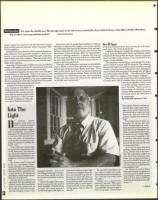
Dr. Harvey Brown:
Had a near-death experience in 1985.
Into The
10
LL,
58
r. Harvey Brown
dropped dead back in
1985. It really changed
how he looks at things.
A successful podiatric surgeon
and an amateur racquetball
champion, Dr. Brown says that
in the mid-1980s he was "win-
ning the game of capitalism,
working hard and playing hard."
Today he speaks in a wholly dif-
ferent voice.
"I can right now almost hear
the heartbeat of everyone in the
world. Everyone!" says the doc-
tor, who lives in Baltimore's and
attends Baltimore Hebrew Con-
gregation with his wife Kath
leen.
Dr. Brown, now 57, has read
books on near-death experi-
ences. He's been to conferences,
and given interviews just like
this one. Still it is hard for him
to talk about it He stammers
and takes a while to get started.
But then it comes out.
He was about to operate on
a patient's foot, the patient was
already under the anesthetic,
when the heart attack hit. As
the medical staff wheeled him
into the emergency room, "I dis-
PHOTO BY JANE HWANG
D ETR OI T J E W IS H N EW S
Light
,
engaged my body. I was up on
the ceiling looking down on my-
self, and I saw myself, and I saw
the nurses and doctors working
on me.
"Just to the right of Ale was a
black tunnel and at the end of it
was a tiny light. I started to float
through the tunnel and as I
moved through it, the light be-
came more brilliant, a light with
emotion to it, brighter than the
sun, and I wanted to go into it."
He went in, head first, then up
to his chest, and he felt "the most
loving feeling that I ever could
have thought to have experi-
enced in my life. It was a loving,
caring space, with no fear, no
anxiety."
He wanted to stay there, but
the doctors pulled him pack.
Only three minutes had passed,
"but I felt like I had been there
for years."
"Today, it's a bittersweet
memory," he says. "The sweet
part is that I feel certain there
is an afterlife. I became a part of
that loving light. I had always
been afraid of death, because my
parents died when I was a teen-
ager, and I couldn't believe that
God could be so mean as to do
that to me. But now I feel 100
percent certain that there is a
God."
Throughout his Jewish up-
bringing, Dr. Brown felt that
adults treated death as "some-
thing to shield children from, be-
cause life was so important." Yet
when actually faced with death,
he found it to be "totally differ-
ent from what I expected. I felt
a oneness with every person,
every animal, with leaves. I felt
that all this life was my life, that
we were attached."
In a way, he says, this does
perhaps reflect what he knows
of the Jewish view of the after-
life. "My upbringing taught me
that there was a heaven, that
there was no hell, and that it
was very peaceful," he says, and
what he found in that dark tun-
nel was in fact "an afterlife that
is accepting of all."
Dr. Brown is retired these
days, and he says he spends his
time "trying to do deeds of ran-
dom kindness. I feel my purpose
here now is to help everything,
including the temple that's with-
in me."
❑
— A.K.S.