

/-
matter, and all these things have come to-
gether to bring about a new interest in
this topic."
In his essay on "The Fate of the Soul,"
which appears in Rabbi Riemer's book,
the very founder of the Jewish renewal
movement, Zalman Schacter-Shalomi,
confirms his own commitment to a Jew-
ish belief in the hereafter.
"Classical Jewish belief is very clear,"
he writes. "There is this world, Olam
HaZeh, and there is the world-to-come,
Olam. HaBah. At birth the soul enters the
body, and at death it leaves it and con-
tinues to survive," a belief known as
hash'arat ha-nefesh, the survival of the
soul.
He continues in a more modern vein,
though, explaining that "tehiyyat ha-
metirn, the resurrection of the dead, can
There is a
world-to-crone,
the rabbis tell us ...
and we will he
judged.
... mean the coming to total awareness
of the planet as a living organism with
which we are connected. As beings in con-
nection with the holographic planet mind,
we will be augmented in consciousness
and enriched by all other conscious be-
ings."
This interesting linkage — drawing the
idea of an afterlife back down to earth, ty-
ing it to this world, this life — is perhaps
a unique gift of Jewish thinking. Brad
Hirschfield, an Orthodox rabbi and di-
rector of professional education at the Na-
tional Jewish Center for Learning and
Leadership, explains the connection in
perhaps more human terms. The resur-
rection of the dead teaches us to respect
the divinity within our bodies, he says,
which in turn can teach us to live a more
sacred life in this world. "Good sex, good
doctoring, those are all sacred things, once
you believe the body is sacred," he says.
Rabbi Hirschfield, argues that belief in
an afterlife should serve primarily to re-
mind us of the sanctity of this life. "It's a
way of saying, 'I am not going to settle for
life with its deficiencies'; it's a refusal to
accept the inconsistency, the imperfection
and pain of the world."
And just as the notion of personal res-
urrection should teach us to love this life
more dearly, he says, the dream of a Mes-
sianic time, when all the dead return to
earth, should prompt us to live a more sa-
cred life in the here-and-now. "If you can
tell me what your three Messianic expec-
tations are, I can tell you what you ought
to be doing with your life. If you think bod-
ies are going to walk around, heal bodies.
If you think the hungry will eat, feed the
hungry. If you think war will end, pursue
peace," he says.
For years, he says, the afterlife was like
the ugly cousin or the rude in-law in Jew-
ish life: they're kind of always at the table
at family celebrations, but you don't want
to pay attention to them.
"But today we live in a wonderful age,
where people want to be more spiritually
attuned and sensitized. They are moving
toward a rejection of the sexual revolu-
tion's purely hedonistic use of the body,
and looking for traditions which can be
resources, which can lead them to living
a more meaningful life," he says. "Now
people see their lives as spiritual journeys,
and are open to a range of spiritual ideas
about this life — and the next."
Rabbi Hirschfield first became con-
cerned with such ultimate questions as a
young boy. "The first time that I experi-
enced death in any meaningful way, I was
10 years old, and a woman who had tak-
en care of the children in our family from
before I was born died in our house. We
were going out, and my grandmother told
me to go upstairs and wake her, and when
I tried, she didn't wake up."
She was a black woman from Missis-
sippi, and the funeral was held in a black
church.
"I was stunned. There was a band play-
ing, people were clapping, dancing and
singing. It was the first funeral I ever went
to, but somehow I knew a Jewish funeral
would not be like this," he says. "I under-
stood that a part of the celebration was
the sense that she had gone to a better
place, and that was strange to me. I be-
lieved that we were already in the bet-
ter place, that this was the place to be."
Looking at that funeral today, he says,
he does not wholly agree with the mourn-
ers' apparent eagerness to shuffle off this
mortal coil; but he finds something of val-
ue in their style of mourning. Jews, he says,
are "terrible at comforting" — but it is only
because of how dearly we value life. It
would be nice, he says, if Jews could learn
to comfort more, without surrendering our
traditional zeal for this world. ❑
A Holy Spark
t age 44, David Mivasair has be-
gun to believe in eternity. The
Reconstructionist rabbi of Van-
couver's Or Shalom synagogue
explains that, like many American
Jews, he was raised with a "very ratio-
nal approach to life." Today, he and oth-
ers are "starting to feel the limitations
of an approach to religious life which re-
lies solely on the intellect and what can
be proven. We have to look beyond that
band on the spectrum for meaning."
What changed his view?
"Being a father, having a child, see-
ing a neshamah (a soul) come into the
world. There was no child, and then
there was -- like yesh min ayin, the cre-
ation of something from nothing. My
11
wife and I were just vessels for this cre-
ation. I don't think biology can explain
it all," says Rabbi Mivasair, a native of
Baltimore.
"And on the other end, it's the same
thing. It's very hard for me to believe
that when our physical lives are over,
that's just the end. I find it improbable
and very unsatisfying to think that
when the body dies, that's it. But that's
the easy part to say. What comes after,
that's more difficult."
Perhaps, he says, "we are like spray
coming out of the ocean. A drop exists
for a while, individual, but then it falls
back into the ocean. Each individual life
is the embodiment of a holy spark, a
spark of God energy. When something
happens to the body, I imagine that
spark, that neshamah, goes back into a
great pool of God energy, of life poten-
tial. I think perhaps an individual sinks
back into the neshamah-sphere."
Rabbi Mivasair was touched by death
at age 21, while in Israel during the Yom
Kippur War. That encounter changed
his feelings about death — and about
life.
"I had a girlfriend, and her previous
boyfriend was killed within an hour of
the cease-fire on the Golan," he recalls.
"That one death got to me more than
any other, even though I never met the
guy. She had hardly talked about him,
until after he died. Yet in a way
I felt very close. We both loved
the same woman, were about
the same age. It made me real-
ly, really aware of how fragile
life is, how illusory our sense of
security. And it made me want
to live life to the fullest."
Rabbi Mivasair did not find
solace for that death in tradi-
tional thinking. He did not see
a greater purpose in God's plan,
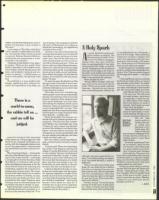
did not take
Rabbi David much comfort in
Mivasair of
thinking the oth-
Or Shalom in
er young man
Vancouver.
had gone on to a
better place. But
today, he says, he
sees among his colleagues in the
Jewish renewal movement a
marked return to just these
kinds of ideas.
He was- at a gathering of rab-
bis, he explains, when one who
was known to all of them both
as a great teacher and a facili-
tator of Jewish-Arab dialogue
died suddenly. That same day
Israel had accidentally killed several
hundred people in a Lebanese refugee
camp, and one of the rabbis remarked,
"liaShem must have known that those
people needed him with them."
"At first my secular Reform upbring-
ing said 'No! God didn't kill Myron just
for that,' Rabbi Mivasair recalls. "But
then I thought: What a beautiful thing
to say. At this time in my life, I want to
trust in more than my brain. Whether
I believe it or not, I don't know. But it's
beautiful, isn't it?"
— A.K.S.
❑