
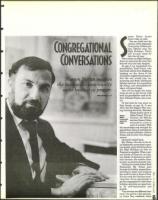

asson Natan knows
about wake up calls.
You see, that's how the
chazzan of the Sephardic
Community of Metropol-
itan Detroit sees the
High Holidays. That's
how he gets ready for
this time of year.
When there are High Holidays,
there are memories for some that
the rest of us can only imagine.
At age 5, he remembers his
grandfather, Yosef Natan, who
had made aliyah from Baghdad,
banging on the doors of his
Jerusalem neighborhood long be-
fore the sun would rise, an-
nouncing pre-Rosh Hashanah
Selichot services. It is something
Mr. Natan, now a Southfield res-
ident, will never forget.
Nor will he forget the many
times he sat on the bimah with
both his grandfather and his fa-
ther, Yehezkel Natan, also a can-
tor.
Or the time he was alone on
that bimah, at age 14. It was
1973, the Yom Kippur War. Dur-
ing morning services, Yehezkel
Natan had to leave to
defend Israel. That af-
Sasson
Natan:
ternoon, for Mincha
Learning the
services, Sasson Natan
prayers as
returned to a shul in
songs.
need of a leader. With
the knowledge and strength he
gained from years of watching his
father and grandfather, Sasson
Natan led his first Yom Kippur
service.
He hasn't looked back.
Mr. Natan, who also is the lo-
cal Sephardic community's spiri-
tual leader, starts thinking about
the High Holidays as soon as
Passover is complete. When a per-
son thinks of Passover, he says,
one thinks of cleaning out spiri-
tual chometz. Six months later,
he says, we rename chometz: sins.
During the month before Rosh
Hashanah, Mr. Natan goes
through the holiday preparations,
listening to tapes and studying
the work he has in front of him.
It's the work for God that moti-
vates him. It's an opportunity to
get his congregation to take these
holidays seriously, an opportuni-
ty for self-examination and
growth.
"Our services are different than
most," he said on a hot and sun-
ny Labor Day weekend, when
65