

most of his neighbors were more
concerned about charcoal for their
grills than they were for any up-
coming holidays. "What I want is
a conversation between the chaz-
zan and the congregation."
That's exactly what happens.
Mr. Natan has taught his con-
gregation how to pray through
the High Holiday services. There
are many gorgeous parts of the
service where Mr. Natan gives
way to various congregants who
carry the melody of the prayer.
The melodies Mr. Sasson sings
are very Eastern, very ethnic.
They are the sounds that Jews
from countries such as Spain,
Greece, France and Iraq grew up
with. There also is an Arabic fla-
vor to the melodies, according to
Mr. Natan. It is the result of years
and circumstances where Jewish
life thrived in Arab countries.
There is, said Mr. Natan, a
slightly different scale used by
Sephardic cantors. It is called the
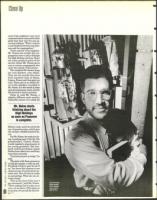
Mr. Natan starts
thinking about the
High Holidays
as soon as Passover
is complete.
Makam scale, and it involves the
use of quarter notes, which give
the melody a Middle Eastern fla-
vor.
For Mr. Natan, the scale is a liv-
ing, breathing part of his life. His
grandmother, Chatun Natan,
would regularly sing prayers to
her young grandson. Her hus-
band would have Sasson repeat
Psalms hour after hour until they
were done correctly.
"I learned prayers as songs," he
said.
"My goals with these prayers is
• to help give people a wake-up call.
The Book of Life is open for all of
= us. You have this chance to see
• where you are. It can't just be 'an-
, other year.' Now it's time to make
- an accounting. What are you ac-
c)
• tually doing?
1—
,
"This is the time of the year I
• get emotional," said Mr. Natan.
= "We're asking God to take us as
sons, not as slaves. If He takes us
on as sons, we can ask for his mer-
BO
Cantor Howard
Glantz looked
into a skylight
and found his
path for life.