

WHAT IF?
"The difference between Peres and Netanyahu is
very clear," insists Tsali Reshef, a Peace Now founder
and first-time Labor Knesset candidate. "It may be the
difference between the historic reconciliation between
Israel and the Palestinians on the one hand and a con-
tinuation of the confrontation, with all that involves.
"Netanyahu will do his best not to send the army
into the Arab towns," she says. "But once he resorts
to power policies, he may find himself doing it.... If
Bibi is elected, we'll be back in the not-so-good old
days."
And the settlers? "What we'd like," says Yechiel Leit-
er, a spokesman for the Yesha (Judea, Samaria and
Gaza) Council, "is a full-scale renewal of Mr. Sharon's
1990-92 strategy under the last Likud government.
The master plan then was to put 1 million Jews in
Judea and Samaria in as short a time as possible, say
four or five years.
"What we think Bibi will end up doing is something
less than that," he says. "That's where our traditional
role will come in. The same way Meretz sits on the left
shoulder of a Labor government and
pulls it in the direction of its radical
policies, it's our job to pull a Likud
government toward the right." ❑
No More Mistakes
A close Netanyahu adviser promises a world of differences
in a Likud government
I
f Binyamin Netanyahu forms
the next Israeli government, the
Middle East peace process will
take a radically different path.
That emerged from a wide-rang-
ing interview conducted by Eric Sil-
ver with Zalman Shoval, a former
Israeli ambassador to the United
States and now senior policy advis-
er to the Likud leader. The follow-
ing are excerpts from that talk.
Eric Silver:
What does Mr. Ne-
—
tanyahu mean when he says he accepts
A floating
Key
The 20 percent who are
up in the air about whom
to vote for will decide
the election.
LARRY DERFNER ISRAEL CORRESPONDENT
S
58
agreements. Both contain a clause
which says that in permanent-sta-
tus negotiations neither side will
necessarily be committed by any-
thing which has been agreed to be-
fore. Both sides could come to the
table and say some things are dif-
ferent. Everything is negotiable.
But we do not intend to turn back
the clock to where we were before
September 1993. We are not, for in-
stance, going to go back on the agree-
ment to redeploy Israeli troops from
the towns already evacuated. We are
not going to reoccupy Gaza. We are
definitely going to go ahead with
transferring civilian authority to the
Palestinians.
But we're not going to discuss any-
thing in the political domain in
Jerusalem. What we will be pre-
pared to talk about is the religious
authority and administration in the
holy places. We'll talk about cultur-
al affairs.
We're going to say the whole ques-
tion of refugees will have to be dealt
with in multilateral talks. It's not
going to be negotiated face-to-face
with the Palestinians alone. We op-
pose the creation of a Palestinian
state.
So what do you see as the final status
for the Palestinians?
Yavne
ince the bus bombings
in Jerusalem and Tel
Aviv evened the race be-
tween Shimon Peres
and Binyamin Ne-
tanyahu, it has been al-
most unanimously agreed that the
key to the May 29 election is the
"floating voter" — the one who could
go either way.
There are many demographic
"bloc votes" in Israel — the Ortho-
dox (Mr. Netanyahu), the Israeli
Arabs (Mr. Peres), the poor and poor-
ly educated (Mr. Netanyahu), the
well-to-do and well-educated (Mr.
Peres). Beyond them, many other Is-
raelis are ideologically committed to
the right or the left. These voters al-
ready have made up their minds;
Messrs. Peres' and Netanyahu's
campaigns can do little to change
them.
Oslo I and Oslo II?
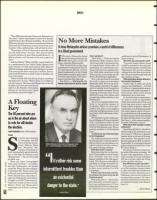
Zalman Shoval: — Those are interim
Zalman Shoval, former Israeli ambassador to the
U.S., is now Netanyahu's senior policy adviser.
Far-reaching autonomy in which
the Palestinians would run all their
affairs without our interference, ex-
cept for external security and cer-
tain parts of foreign relations.
What about Israel's security?
id rather risk some
intermittent troubles than
an existential
danger to the state."
— Zalman Shoval
Experience has shown that look-
ing to Yassir Arafat to protect Israel
from terrorism was one of the
biggest mistakes of the Oslo agree-
ments. We will preserve the right in
case there is a danger of terrorist at-
tack, or if a terrorist attack has tak-
en place, to act ourselves if we find
it necessary.
Wouldn't that risk armed confronta-
tion between the Israeli army and the
Palestinian police?
What is the choice — that Israelis
get continually murdered and no-
body does anything about it? [Late
Prime Minister Yitzhak] Rabin and
Mr. [Shimon] Peres believed they
could leave it to the Palestinians. It
hasn't worked.
And if this new policy doesn't work?
To protect Israeli citizens, Israel
would be prepared to face any ene-
my threatening them, certainly the
Palestinians who are not a serious
military force. But this is not our de-
sire. We do not want to get back into
the cauldron of Gaza.
What about future borders between Is-
rael and the Palestinians?
Under Oslo II, there are three
zones on the West Bank — A, B and
C. In Zone C, administration and se-
curity are still under complete Is-
raeli control. Most of the Jewish
settlements are in this zone.
In the final-status negotiations,
we want to reach an agreement
which leaves that area de facto, and
in the long term de jure, under full
Israeli control. In Zone B, where ad-
ministration is in Palestinian hands
but Israel retains control of securi-
ty, we shall have to look at each case
in detail and see which place should
be dealt with like Zone C and which
like Zone A, which comes complete-
ly under Palestinian control.
What about Likud's pledge to expand
settlements?
Out of the 120,000 to 150,000 Is-
raelis living in the territories, most
are in Zone C. Whatever is going to
happen there is not part of the long-
term problem. The question of set-
tlement expansion will be an entirely
Israeli affair Is a Likud government
going to expand settlements in Zone
B? I don't think so.
The future of Israelis living in ar-
eas under Palestinian autonomy will
be part of the negotiations. The so-
lution could be that each individual
will have all the rights as if they
lived in another territory.
How different are Labor and Likud?
If the policies of the left prevail,
we will be creating a situation where
in a few years from now Israel's very
existence could be threatened by a
Palestinian state on the outskirts of
our population centers. I'd rather
risk some intermittent troubles than
an existential danger to the State of
Israel. Ci
—Eric Silver
=/\